
Test your muscle power at home after 40: three leg power tests you can score, and why power fades before strength

Jeffrey Sun, ACE-CPT
September 21, 2026 · 19 min read
ACE-certified personal trainer specializing in functional movement, mobility, and strength training for busy professionals in San Jose and the Bay Area.
Book a free consultation →
A software architect in his early fifties came in last winter after a near miss on the stairs at work. He'd caught a toe on the top step, pitched forward, and grabbed the rail just in time. He deadlifts more than most men his age. His squat is clean. Nothing about his gym numbers said he was at risk.
So I had him do something simpler. Stand up from a chair five times, as fast as he could. It took him 13.4 seconds. For a man of his size, that works out to about 2.9 watts per kilogram of body weight, which puts him in the bottom quarter of men twenty years older than him.
His strength was fine. His power was not. Those are different things, and the gap between them is exactly what a trip on the stairs exposes.
This post gives you three power tests you can do at home, each with a number to score against, a decomposition of what a low score is actually telling you, and a way to train it that doesn't involve box jumps. Nothing here needs more than a chair, a staircase, a wall, and a phone stopwatch.
This isn't medical advice. If you've had a fall in the last year, a joint replacement, or anything that makes fast movement scary, do the first test only and take the result to a clinician before the other two.
Why power goes before strength
Strength is how much force you can make. Power is how fast you can make it. A slow, grinding deadlift is strength. Catching yourself after a stumble is power. In physics terms, power is force times velocity, and the velocity half is the part that ages first.
The research on this is older than most people realize. In 1994, Skelton, Greig, Davies, and Young published a study in Age and Ageing that measured 50 men and 50 women spread evenly across the ages of 65 to 89. They tested isometric strength, leg extensor power, chair rise time, and how high a step each person could get onto unaided. Strength fell by roughly 1 to 2 percent per year across the age range. Power fell by roughly 3.5 percent per year. And it was power per kilogram of body weight, not strength, that predicted both chair-rise time and step height.
Ten years later, Runge and colleagues in Clinical Physiology and Functional Imaging measured jumping power in 169 women and 89 men aged 18 to 88, all of them physically active and free of anything affecting the musculoskeletal system. Peak jumping power per kilogram fell by more than half between 20 and 80. The striking part was what didn't change: calf muscle cross-section, measured by CT, showed no meaningful correlation with age in the men at all. Muscle was still there. It had lost its speed.
The most recent and largest picture comes from Alcazar and colleagues in the Journal of Cachexia, Sarcopenia and Muscle in 2021. Across 9,320 older adults and 586 younger ones from four European countries, relative sit-to-stand power drifted down slowly between 30 and 50, then dropped at 0.10 to 0.13 watts per kilogram every year from 50 to 80. In percentage terms, that's under one percent a year through your forties and two to four and a half percent a year after fifty.
For a desk worker who lifts, this is the catch. Conventional strength training, done at a controlled tempo, preserves the force half of power well. It does much less for the velocity half unless you deliberately move fast. Which means you can be getting stronger on paper while getting slower where it counts, and no lift in your logbook will show it.
Test 1: the sit-to-stand power test
This is the same five-rep chair stand the sarcopenia self-test uses, but it asks a different question. That post times it against a 15-second line and calls it a strength screen. This one runs the seconds through a power equation, which is a more sensitive measure and the one with the most research behind it.
The equation comes from Alcazar and colleagues' 2018 validation study in Experimental Gerontology. They compared chair-stand power calculated from body mass, height, chair height, and time against power measured directly on a leg press with a linear position transducer in 40 adults aged 70 to 87, then applied it to 1,804 participants in the Toledo Study for Healthy Aging. The estimated and measured values differed by an average of 6.9 watts, and the correlation with maximal leg-press power was 0.72. Not perfect, but very good for a test that needs a chair and a stopwatch.
Setup. A firm chair with no arms, seat height around 45 cm (about 18 inches, a standard dining chair). Arms crossed over your chest. Feet flat, roughly shoulder width.
The test. On "go," stand fully upright and sit back down five times as fast as you can. Touch the seat each time, don't slam into it, and stand all the way up each rep. Time from "go" to the fifth time your backside lands. Do one practice run at moderate speed, rest a minute, then time the real one.
The math. Your relative power in watts per kilogram is:
88 × (half your height in metres − chair height in metres) ÷ seconds for five reps
The 88 folds together gravity, the assumption that your legs (about 10 percent of body mass) don't rise, and the assumption that the standing half of each rep is where the work happens. Height and chair height are both in metres.
Worked example: a 1.78 m man on a 0.45 m chair. Half his height is 0.89, minus 0.45 is 0.44. Multiply by 88 and you get 38.7. Five reps in 13.4 seconds gives 38.7 ÷ 13.4, or 2.9 W/kg. Five reps in 8 seconds gives 4.8 W/kg. If you want absolute watts, multiply by your body mass in kilograms.
Scoring. The 2021 study's cutoffs for "low relative power," the level below which the odds of a mobility limitation jumped 10-fold in women and 14-fold in men, were 2.1 W/kg for women and 2.6 W/kg for men. The median older adult in the same cohort sat at 2.85 W/kg (women) and 3.55 W/kg (men). Those numbers were built in people over 60, so clearing them at 48 is not a pass. Extrapolating the study's own decline rates back to the forties and fifties, my training lines are:
- Pass: 4.5 W/kg or above for men, 3.8 or above for women
- Borderline: 3.0 to 4.5 for men, 2.5 to 3.8 for women
- Fail: under 3.0 for men, under 2.5 for women
If you're under 60 and land below the clinical cutoffs of 2.6 and 2.1, that's a fail with an asterisk. Worth a conversation with a doctor alongside any training change.
One useful check: the 15-second line the sarcopenia post uses lands almost exactly on these clinical cutoffs for a person of average height. That isn't a coincidence. The two tests are looking at the same movement through different lenses, and they agree at the bottom. Where they disagree is the middle, where a 10-second chair stand passes the strength screen and still scores borderline for power.
Test 2: the stair-climb power test
The cardio fitness test on this site times a four-flight climb and reads it as aerobic capacity. This test is one flight, as fast as is safe, and reads as leg power. Same staircase, different measurement, and the two numbers can diverge in either direction.
Bean and colleagues validated the stair-climb power test in Archives of Physical Medicine and Rehabilitation in 2007 in 138 community-dwelling adults with a mean age of 75, all of them already showing mobility limitations on the Short Physical Performance Battery. Stair-climb power per kilogram correlated moderately (r = 0.47 to 0.52) with leg-press power measured at 40 and 70 percent of one-rep max, explained about as much of the variance in mobility performance as the leg press did, and was the only power measure that predicted standing balance. It was also, and this is the part the authors cared about, something you can do without a machine.
Setup. A flight of ten steps with a handrail. Count the steps and measure one riser (the vertical height of a single step, typically 15 to 19 cm). Total rise is the riser times the step count.
The test. Start one step back from the bottom. On "go," climb as fast as you safely can. Hand near the rail, not on it, unless you need it. Stop the clock when both feet are on the top landing. One at a time or two at a time is your choice, but be consistent when you retest.
The math. Relative power in W/kg is 9.81 × total rise in metres ÷ seconds. A ten-step flight with 17 cm risers is 1.7 m of rise. Climbing it in 2.5 seconds is 6.7 W/kg. In 3.5 seconds, 4.8 W/kg. In 5 seconds, 3.3 W/kg.
Scoring. There are no published norms for this test in 40 to 60 year olds, and I'm not going to pretend there are. Bean's cohort were mobility-limited seventy-somethings, so their numbers set a floor, not a target. Based on what I see in clients who move well versus clients who don't, on a standard 1.7 m flight:
- Pass: under 3 seconds (roughly 5.5 W/kg and up)
- Borderline: 3 to 4.5 seconds (3.7 to 5.5 W/kg)
- Fail: over 4.5 seconds, or any need to pull on the rail
I've had clients pass the chair stand comfortably and then take five seconds on a flight of stairs. Usually the second step gives it away, because that's the one where you have to push off a leg that's already bent, and there's no momentum from the trunk to help.
The most useful thing about this test is doing it again. Even without norms, a time that drops from 4.1 to 3.2 seconds over eight weeks is telling you something no gym lift can.
Test 3: the vertical jump, only if you passed the first two
A jump is the purest home measure of leg power, which is exactly why I put it last. Landing from a jump loads the knee and Achilles more sharply than anything else in this post. If you scored a fail on either of the first two tests, skip this one until you've retested and passed. Same if you have diagnosed knee osteoarthritis, an Achilles that complains, or any recent lower-body injury.
Setup. A wall you can mark, and chalk or a bit of tape on your fingertips. Stand side-on to the wall, feet flat, and reach as high as you can with the near arm. Mark that. That's your standing reach.
The test. From standing, dip quickly into a quarter squat, swing your arms, and jump as high as you can, touching the wall at the top. Land softly, knees bent, on both feet. Three attempts with a full minute between them. Your jump height is the highest mark minus your standing reach.
The math, if you want it. Sayers and colleagues in Medicine and Science in Sports and Exercise in 1999 derived an equation from 108 college-age adults on a force plate: peak power in watts = 60.7 × jump height in cm + 45.3 × body mass in kg − 2055. It was built in young people and underestimates the countermovement version by under 3 percent, so treat the watts as a tracking number, not a diagnosis. Jump height alone is enough to score.
Scoring. For adults between 40 and 60, in my practice:
- Pass: 40 cm or above for men, 30 cm or above for women
- Borderline: 28 to 40 cm for men, 20 to 30 cm for women
- Fail: under 28 cm for men, under 20 cm for women, or a landing you couldn't control
Runge's data puts a physically active 50-year-old somewhere around 65 to 75 percent of their peak jumping power at 25. If you were a 55 cm jumper in college, 40 now is roughly on schedule. If you were a 55 cm jumper and you're at 25 now, something beyond age has happened, and the next section is about finding out what.
What a low score is actually telling you
Three tests, each measuring the same quality slightly differently, produce a pattern. Reading the pattern is the whole point. Four things drive a low power score, and they need different fixes.
Strength ran out first. If all three tests are low and you also struggle with the basics, meaning ten bodyweight squats to a chair feel like work or the five sit-to-stands take over 15 seconds, the constraint is force, not speed. You can't express power you don't have the strength to produce. Start with the beginner's guide to strength training for longevity and revisit the power tests in twelve weeks. Trying to train speed on top of no strength is how people get hurt.
Strength is fine but the rate is slow. This is the software architect. He could deadlift twice his body weight and still needed 13 seconds to stand up five times. When lifting numbers are solid and power scores are low, the missing piece is rate of force development: the nervous system's ability to recruit fast fibers quickly. This responds well and fast to intent, and it's what the training section below is built for.
Range or stiffness is capping the movement. A jump that's low while the chair stand is fine often traces to the ankle. If the shin can't travel forward over the foot, you can't load the calf and quad into a countermovement, and you get a stiff, short jump regardless of how strong you are. The knee-to-wall test in the ankle mobility post will confirm or rule this out in two minutes. Tight hips produce the same signature on the chair stand: a slow first rep because the trunk has to lean a long way forward before the legs can take over.
Confidence, not muscle. Some people hesitate at the top of the countermovement, land wide and stiff, or grab the stair rail before they need it. That's a balance and fear problem wearing a power problem's clothes. The single-leg balance checks are where to start, because power training on top of poor balance just teaches the nervous system to brace instead of move.
There's a fifth pattern that's rarer but worth naming: a big left-right difference. If one leg lands first, one side of the chair stand shifts, or a single-leg hop on one side is clearly shorter, the problem is an old injury the body has been routing around. That's an old-injury problem, not a power problem, and it needs its own plan before any of the training below.
Power training after 40 without box jumps
The research on training power in older adults is more encouraging than the research on losing it. Tschopp, Sattelmayer, and Hilfiker's 2011 meta-analysis in Age and Ageing pooled eleven randomized trials, 377 adults over 60, comparing power training (the same exercises, done fast) against conventional slow resistance training. Power training came out ahead on functional outcomes, with a pooled effect size of 0.32. That's a small advantage, the confidence interval on the change scores was wide, and the authors said plainly that no firm conclusion could be drawn on safety. What it does establish is that the intent to move fast is trainable at any age, and that it transfers to things like chair rises and stair climbs better than slow lifting alone.
What separates this from what you're probably already doing is intent. Power training isn't a different set of exercises. It's the same hinge, squat, and step patterns done with the goal of moving the load as fast as possible, at a weight light enough that "as fast as possible" is actually fast.
Explosive chair stands. Same chair as the test. Sit, pause for a full second so you can't bounce, then stand as fast as you can. Five sets of three, two or three times a week, full recovery between sets. It's the most direct fix for a low Test 1 score I know of, and it costs nothing.
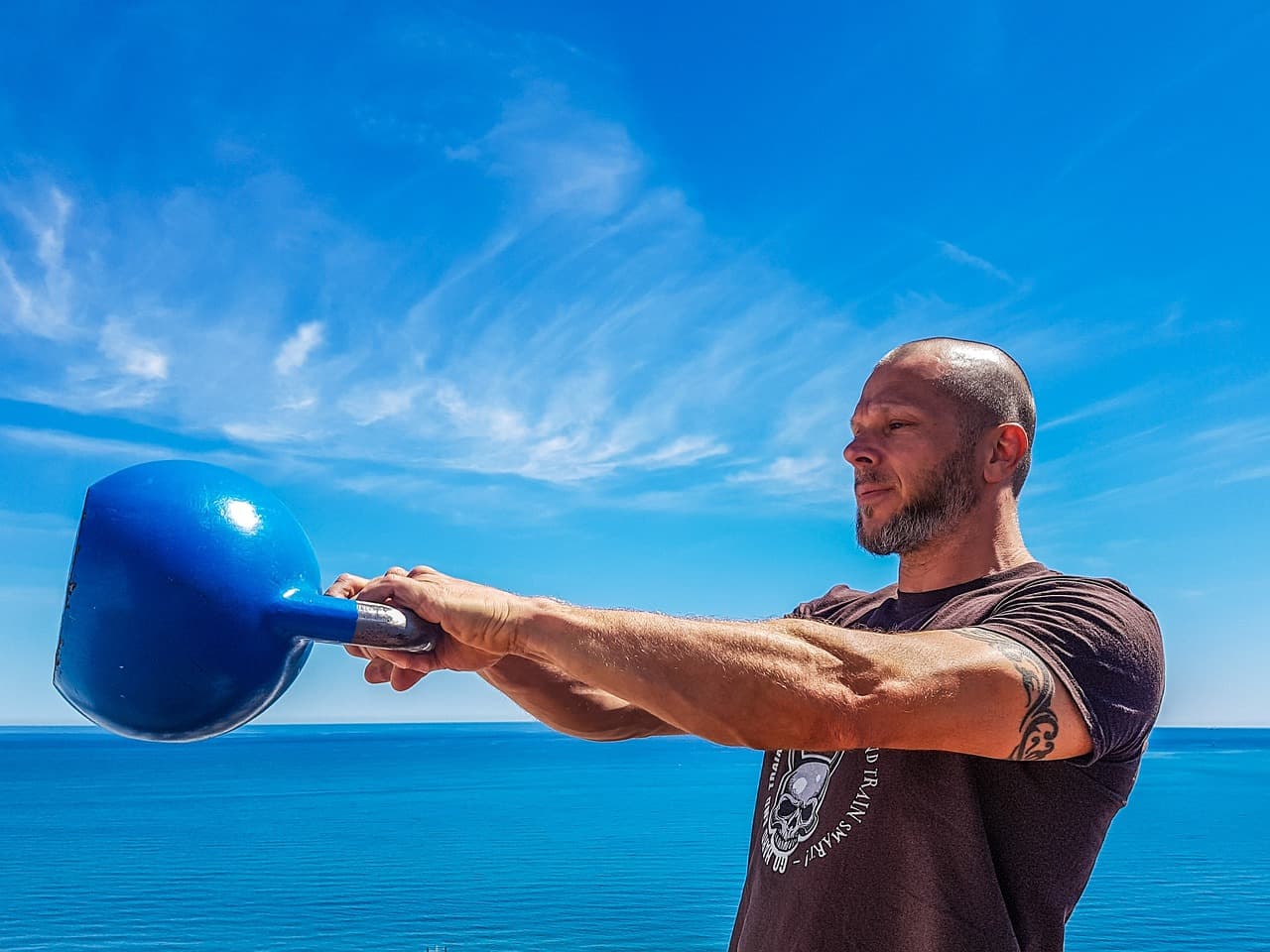
Kettlebell swings. The same hinge pattern as a deadlift, done as a snap instead of a grind. Start with a weight you can swing crisply to chest height for ten reps without your lower back joining in. Five sets of eight to ten. If you've never swung a bell, the demonstration below is worth ten minutes before the first set.
Medicine ball throws. A four to six kilogram ball, thrown hard against a wall or into the ground. Chest passes, overhead slams, and rotational throws all train the fast recruitment the tests are measuring, with no landing involved. Three sets of five per throw, thrown as if you're trying to break the ball.
Fast squats at light loads. Goblet or barbell squats at 30 to 50 percent of what you'd use for a hard set of five, moved as fast as you can control on the way up. Three to five sets of three to five reps. The bar speed is the target, not the fatigue. If you're slowing down, the set is over.
Stair bounds, later. Once the chair stand and stair tests have moved into the pass band, two-at-a-time stair climbs done for speed are a good bridge to jumping. Three to five flights, full walk-down recovery.
Where this fits in a week: it goes first, after the warm-up and before the heavy work, while you're fresh. Fifteen minutes is plenty. People who train twice a week can put five minutes of it at the start of both sessions. People who train four times can give it its own short day. The thing that doesn't work is tacking it on at the end of a hard session, when the nervous system is too tired to be fast and the only thing you'll train is sloppiness.
One more thing, since it comes up. Some people read this and want to keep their program exactly as it is, heavy and slow, and that's a defensible choice if what you care about most is strength and bone. Heavy lifting isn't wrong. It's just not the same stimulus, and if the tests above came back borderline, it's worth knowing that adding five fast minutes will move them in a way that adding another slow set won't.
When the tests point somewhere other than training
A few results mean the next step is a clinician, not a program.
Pain during the tests. Not effort, actual pain: a knee that catches on the stair climb, an Achilles that lights up on the jump landing, a hip that clicks and then aches on the chair stand. Sharp pain during a fast movement is not something to train through. For knees specifically, lifting with knee osteoarthritis covers what does and doesn't need to change, and the loading principles there apply to power work too.
A fall or a near-fall in the last twelve months, alongside a fail on Test 1. Power under the clinical cutoffs plus a recent fall is the combination the geriatrics literature was built around, and it deserves a proper assessment.
A number that dropped fast. If you jumped 45 cm last year and 30 this year with no injury and no change in training, that's not aging. Something else is going on, and it's worth finding out what.
Dizziness or unsteadiness that's out of proportion to the effort. Fast sit-to-stand can drop blood pressure briefly in some people, and that's a conversation for a doctor, not a trainer.
What to do with your numbers
If you passed all three, you're in good shape, and the useful thing is to write the numbers down. Retest twice a year. Power is the fitness quality that slips quietly, and a logbook is the only way to catch it early.
If you landed borderline on one or two, the decomposition section above tells you which of the four causes to work on, and the training section gives you six to eight weeks of material. Retest at the end of it. Most people who add intent to their existing program see the chair-stand number move by the second retest, which in the 2021 cohort's terms is roughly the 0.33 to 0.42 W/kg the authors defined as a minimal clinically important difference.
If you failed, or if the results were confusing, the next step is to find out what's underneath. The movement screen is the assessment I run with every new client. It takes five minutes, doesn't ask for an email, and looks at the hip, ankle, and trunk patterns that decide whether a power problem is a strength problem, a range problem, or a confidence problem. The right fix depends on which one it is.
And if you'd rather have someone watch you do the tests and tell you what they see, that's what the first session is for. I've run more than 12,000 sessions in San Jose and the South Bay, and a lot of them started with a number like yours. Book a consultation and bring your numbers.
Ready to train smarter?
Get a personalized program built around your goals, your body, and your schedule.
Book Your Free ConsultationRelated Articles
Am I losing muscle? A four-part sarcopenia self-test you can score at home
Sarcopenia has clinical cutoffs you can test with a chair, a tape measure, and a hallway. A San Jose trainer walks through the four screens, what a low score actually means after 50, and what to do about each cause.
Balance Test at Home: 3 Single-Leg Checks for Adults Over 40
Standing on one leg for 10 seconds is tied to how long you'll live. Three at-home balance tests, real age-decade benchmarks, and the drills that fix what's actually failing. A San Jose trainer's guide.
Do your glutes actually fire? A three-part dead butt syndrome test you can score at home
Dead butt syndrome has a real mechanism and a real test. A San Jose trainer walks through three glute activation checks with pass, borderline, and fail lines, what each result means for your back and knees, and a four-week plan to wake the muscles back up.