
Cardio Fitness Test at Home: 3 Checks for Desk Workers Over 40

Jeffrey Sun, ACE-CPT
August 7, 2026 · 14 min read
ACE-certified personal trainer specializing in functional movement, mobility, and strength training for busy professionals in San Jose and the Bay Area.
Book a free consultation →
The elevator in a client's Santa Clara office went out for most of a week last spring. He's forty-four, pulls more off the floor than anyone else in that time slot, and by Thursday he was texting me about the four flights up to his desk. His legs were fine. He was stopping on the third landing to let his breathing settle before he walked into a meeting.
That gap catches people off guard. You can build a genuinely strong body and leave your conditioning completely untouched, and nothing in a normal gym week will tell you. The barbell doesn't ask.
Strength reports on itself. The number either goes up or it doesn't. Mobility gets your attention too, usually by starting to ache around 2 PM. Conditioning is the one with no alarm attached, so it just erodes, and then some ordinary Thursday asks for it and you find out where you actually are.
This isn't medical advice, and these tests raise your heart rate on purpose. If you have known heart disease, chest pain or pressure with exertion, uncontrolled blood pressure, or you've been sedentary for several years, talk to your doctor before running any of them.
What you're actually measuring
Three different things, and they decline independently of each other.
Capacity is your ceiling. How much work your heart, lungs, and legs can produce together before you have to back off. VO2 max is an attempt to put a number on it.
Recovery is how fast you shut it back down once the work stops. Mostly that's your parasympathetic nervous system taking the controls back, and it's a better read on how your body is doing overall than you'd expect from something this easy to measure.
Pacing is whether your sense of easy and hard still matches reality. Lose that calibration, which most people do after a decade away, and you end up with walks too gentle to change anything and runs too hard to repeat twice in a week.
A single score can't separate those. That's the flaw in most of what you find when you search for this: you get a VO2 max estimate, a number between 30 and 45, and no idea which of the three is actually your problem. It's the same trap as the sitting-rising test, which bundles four qualities into one score and then leaves you guessing which one cost you the points. Splitting the measurement is where the useful information lives.
The three tests below take about twenty minutes. Two of them come off the same effort.
Test 1: four flights of stairs, timed
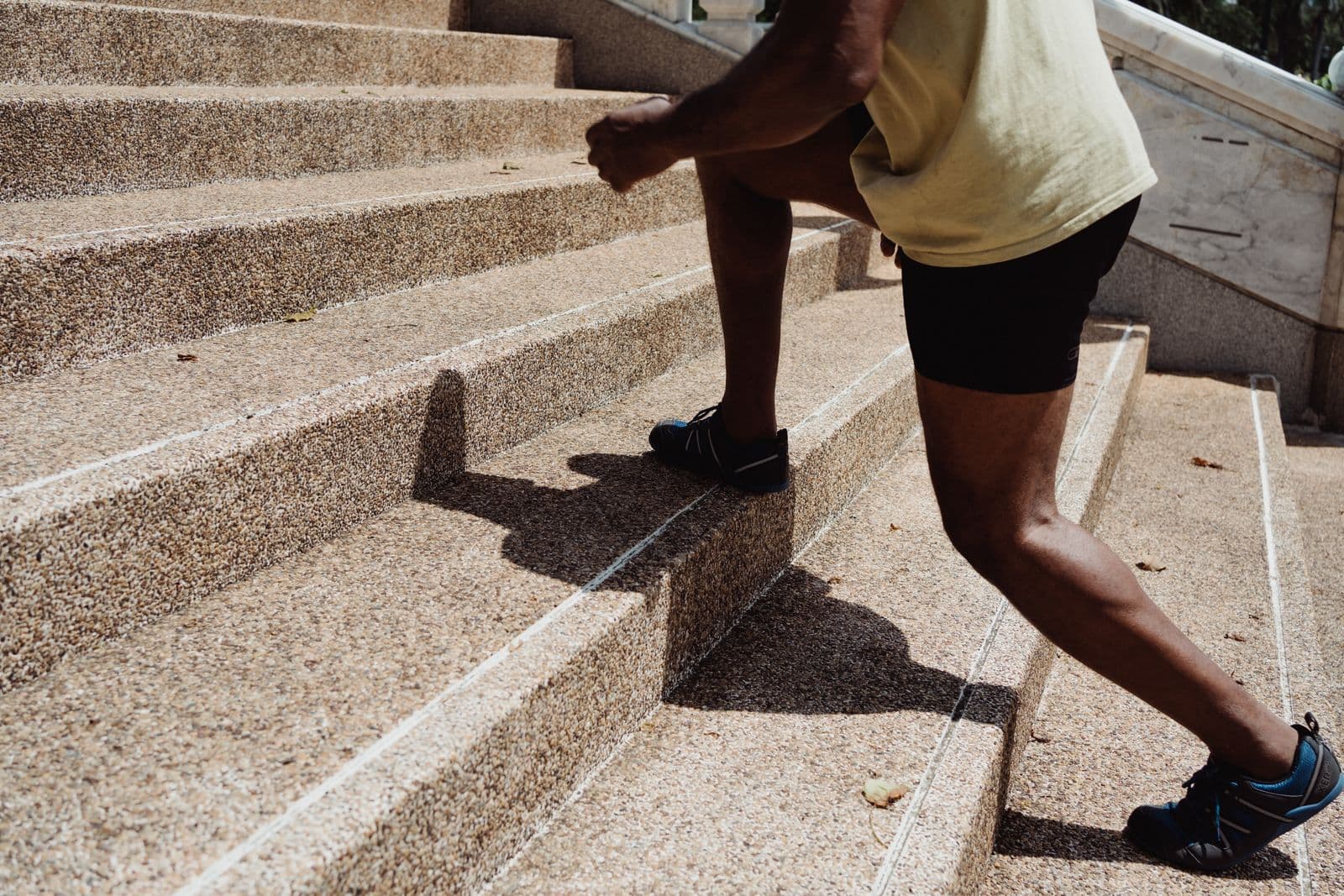
Find a staircase with four flights, somewhere around 60 steps. An office stairwell or a parking garage does the job. Climb at a fast pace without stopping. Don't run, and don't pull on the handrail. Time yourself from the first step to the last.
The reference point comes from Dr. Jesús Peteiro, a cardiologist at University Hospital A Coruña in Spain, who presented this at the European Society of Cardiology's EACVI congress in 2020. His group put 165 patients through a treadmill test to exhaustion, rested them fifteen or twenty minutes, then sent them up 60 stairs at a fast pace. Under 40 to 45 seconds corresponded to more than 9 or 10 METs on the treadmill. More than a minute and a half corresponded to under 8.
Worth knowing what that study actually was, since most of the coverage skipped it. Those 165 people had been referred for exercise testing in the first place because of chest pain or breathlessness on exertion. They were cardiology patients, not healthy adults off the street. The relationship between stair time and treadmill performance is real and the thresholds are a reasonable calibration, but 47 seconds is not a clean bill of health, and nobody has shown these numbers behave the same way in a population without symptoms.
Under 45 seconds: your exercise capacity is in good shape.
45 to 90 seconds: the middle band, where most desk workers I test land the first time.
Over 90 seconds: worth a conversation with a doctor before it's worth a training plan.
Two practical notes. Stair heights vary enough between buildings that comparing your time at the office to your time at the parking garage tells you nothing, so pick one staircase and keep using it. And go up only. Coming down fast is how people get hurt on this, and it isn't part of the measurement.
Test 2: your one-minute heart rate recovery
Don't walk it off at the top. Sit down where you are, because the next sixty seconds are the second test.
Take your pulse in the first fifteen seconds, count for a full fifteen, and multiply by four. Keep sitting. At the sixty-second mark, count for fifteen seconds again and multiply by four. The difference between those two numbers is your heart rate recovery. A watch or a chest strap makes this much easier, and if you have one, use it.
The research here is a 1999 paper in the New England Journal of Medicine from Cole and colleagues at the Cleveland Clinic. They followed 2,468 adults after treadmill testing and found that a one-minute recovery of 12 beats or fewer predicted death over the following six years, with an adjusted relative risk of 2.0 once they controlled for age, sex, medications, and cardiac risk factors. Twenty-six percent of the group fell into that category.
There's a detail that trips people up. The 12-beat threshold comes from protocols where the person keeps walking during the cool-down. If you stop and sit, your heart rate falls faster on its own, and the cutoff people use for that is 18. Sitting is easier to standardize at home, so sit.
Now the honest part. That research came off maximal treadmill tests, and four flights of stairs is nowhere near maximal for most people. Your number will not map cleanly onto those clinical thresholds, and anyone telling you it does is overselling. What it's genuinely good for is your own baseline, tracked over months, off the same staircase.
More than 25 beats: recovering well.
15 to 25 beats: typical.
Under 12 beats: worth attention, especially if it holds across several attempts.
This is also the number most sensitive to things that have nothing to do with your conditioning. A short night, two drinks the night before, a brutal stretch at work, the tail end of a cold. All of it shows up here. Sleep in particular moves this number around more than people expect. Run it three times over two weeks before you believe any of it.
Test 3: the three-minute step test
Do this one on a different day, or at least twenty minutes after the stairs.
You need a 12-inch step, a metronome, and a timer. Set the metronome to 96 beats per minute, which gives you four clicks per cycle: up, up, down, down. That's 24 complete step-ups per minute. Go for three minutes, then sit down immediately and count your pulse for a full sixty seconds. That total is your score.
The 12-inch height is the fussy part. A standard home stair riser is around 7 inches, so one is too low and two are too high. An aerobic step platform with risers gets you there, and so does a sturdy plyo box or a solid bench. Measure it once rather than eyeballing it, because the height changes the workload more than the cadence does.
The scoring below is condensed from the YMCA norms, which are grouped by age and sex. Find your row.
Men, 36 to 45: strong at 94 or below, middle from 95 to 112, room to work at 113 and up.
Men, 46 to 55: strong at 91 or below, middle from 92 to 117, room to work at 118 and up.
Men, 56 to 65: strong at 97 or below, middle from 98 to 117, room to work at 118 and up.
Women, 36 to 45: strong at 101 or below, middle from 102 to 121, room to work at 122 and up.
Women, 46 to 55: strong at 102 or below, middle from 103 to 124, room to work at 125 and up.
Women, 56 to 65: strong at 107 or below, middle from 108 to 122, room to work at 123 and up.
Hold the cadence. Almost everyone who gets a suspiciously good score on this drifted slow somewhere in the third minute, and almost everyone who gets a bad one was rushing the first thirty seconds and paid for it later. The metronome is the test.
A note on watches, since someone always asks. If yours reports a VO2 max, it's estimating from your heart rate and your pace on outdoor runs, and it's reasonable for watching your own trend over months. It isn't measuring anything. I've had two clients compare theirs after the same hike and come away eight points apart. Treat it like a bathroom scale that reads four pounds heavy: the direction it moves is real, the number on it isn't.
What the three results tell you together
Four patterns cover most of what I see.
All three in the good bands. Your conditioning is fine and it isn't the thing holding you back. Keep enough easy aerobic work in the week to hold it and spend your attention somewhere else.
Stairs slow, step test fine. This is legs, not lungs. Climbing stairs fast is closer to a strength expression than most people realize, and if your quads give out before your breathing does, more treadmill time won't move it much. Step-ups and loaded carries will.
Stairs and step test fine, recovery flat. Capacity is there, the downshift isn't. This is the pattern I see most in people with demanding jobs, and it usually tracks with sleep and stress load more than with training. Before you add sessions, look at what's happening the other twenty-three hours.
All three in the bottom band. A genuine aerobic base deficit, which is the most common result among desk workers who haven't done anything cardiovascular in years. It's also the one that responds fastest, which is the good news buried in it.
The client with the broken elevator was the second pattern, for what it's worth. He climbed his four flights in 71 seconds, which is middle of the road, and his step test came back in the strong band for his age. His lungs were never the problem. He'd spent three years training everything slow and heavy and had simply never asked his legs to move quickly against gravity.
Six weeks to move the numbers
Three sessions a week. Two easy, one hard.
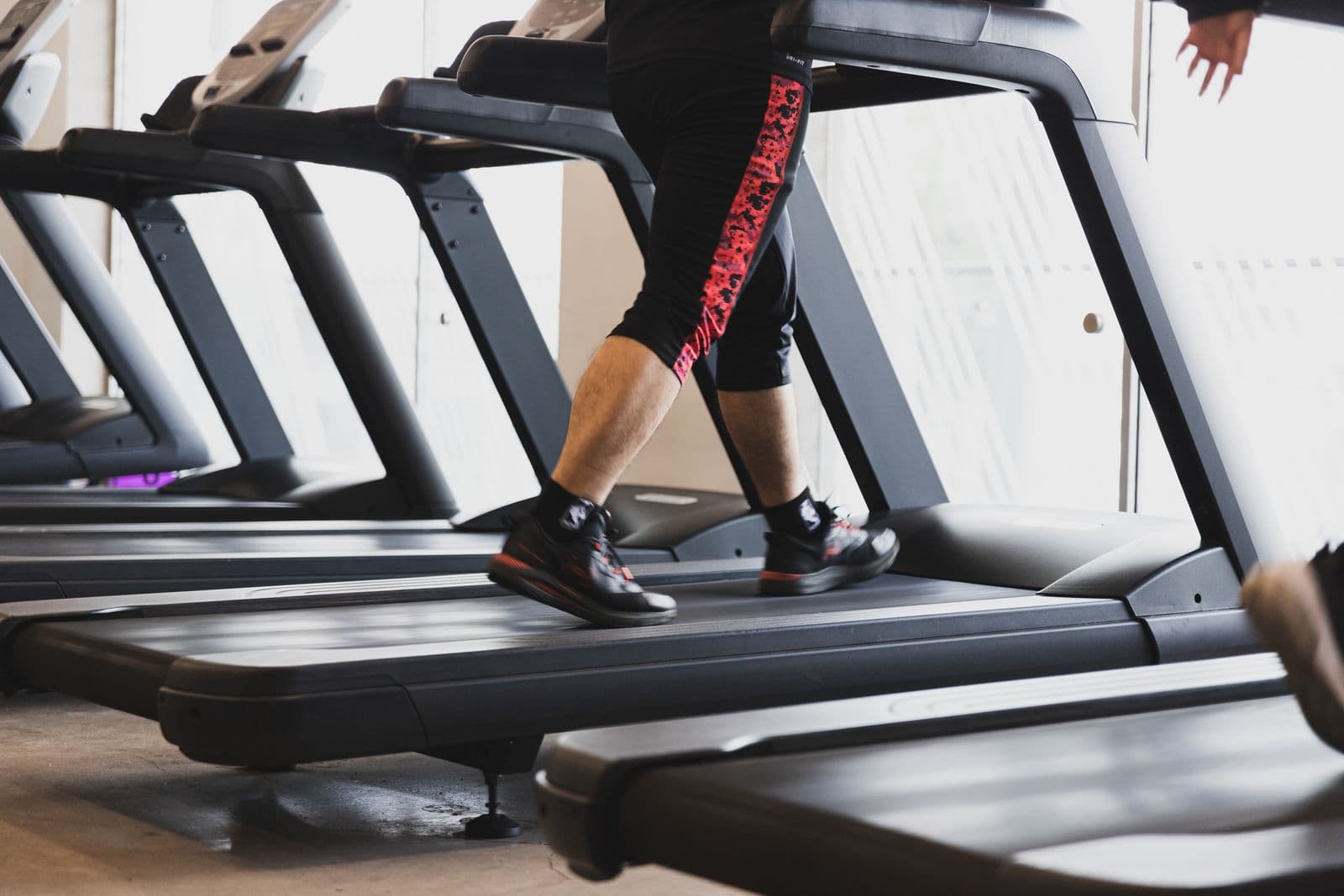
The two easy sessions run 30 to 40 minutes each. Brisk walking on a hill, an incline treadmill, an easy bike, whatever you'll actually do twice a week. Pace them by talking rather than by heart rate.
Running is the one option here I'd gate rather than just recommend. It's the highest-impact choice on that list, and if you haven't run in years your aerobic system will be ready for it well before your calves and Achilles are. There are three tests worth passing before your first run if that's the direction you're leaning.
The talk test is better than it sounds. It's been validated against ventilatory threshold in lab work out of the University of Wisconsin, La Crosse, and the finding is straightforward: the intensity where comfortable speech starts to break down sits almost exactly at the physiological threshold. So recite something out loud every few minutes. If you can get through a full sentence without gasping, you're where you want to be. If you're chopping sentences to breathe, you've gone past it.
Most people I put on this discover their easy sessions were too hard. They were spending thirty minutes in a middle zone that's uncomfortable enough to feel like work and not stimulating enough to drive much adaptation. Slowing down feels like cheating for about two weeks, then the numbers start moving.
The hard session is a 4x4. Four minutes near the top of what you can hold, three minutes easy, repeated four times. It's the protocol that came out of the Norwegian University of Science and Technology, and it's the most reliable way I know to raise a ceiling.
Build it like this. Weeks one and two, skip the hard session entirely and just get the two easy ones in. Week three, add the hard session but do two intervals instead of four. Weeks four through six, run the full four. Retest at the end of week six.
About what to expect: previously sedentary adults over 40 tend to improve VO2 max by 15 to 20 percent across 8 to 12 weeks of structured work. Six weeks gets you part of that. Recovery usually moves first, sometimes inside two or three weeks, because it's a nervous system adaptation rather than new capacity. The stair time comes next. The step test score is typically the last to budge, which discourages people right around week four if nobody warned them.
Fitting this around lifting without wrecking either
If you lift three days a week and add three conditioning sessions, that's six training days, and for someone with a job and kids that's often not real. So the arrangement matters more than the ideal.
Stacking an easy conditioning session onto a lifting day and keeping the hard interval session on its own day is what I use most with busy clients. It costs you one extra day on the calendar instead of three. If you'd rather keep them fully separate, that's cleaner for recovery, and it works well for people whose weeks are predictable enough to protect six slots. Neither is the correct answer. They're answers to different constraints, and how many days you can genuinely hold down is the input that decides it.
When both land on the same day, put the priority first. Lifting first if you're chasing strength, conditioning first if you're chasing the numbers in this post. A few hours between them beats back-to-back if your day allows it.
The interference worry gets more airtime than it deserves. Easy aerobic work and heavy lifting coexist fine for most people at these volumes. The friction is specific and predictable: a hard interval session sitting right next to a heavy squat or deadlift day. Keep those two apart and most of the problem disappears.
When a low score is a doctor conversation, not a training problem
Some results aren't a programming question.
Chest pressure, tightness, or pain with exertion. Breathlessness clearly out of proportion to the effort. Dizziness or lightheadedness during or right after. A heart rate that stays high well past the first minute. Any of these are worth a doctor's appointment before your next workout, not after six weeks of intervals.
A stair time over ninety seconds belongs in that category too, particularly in someone who doesn't otherwise look deconditioned. Peteiro's own comment when the stair research was presented was that taking more than a minute and a half is a good reason to go see someone. That's still the right read.
And getting cleared is worth something on its own. It's easier to push when you know what you're working with.
Where to go from here
Run the stair climb and the recovery count this week. It takes four minutes, and between them you'll know whether your problem is the ceiling or the downshift, which is more than most people ever find out.
If your conditioning came back in the middle band but something else feels like the real limiter, the free movement screen scores six areas including your hips, ankles, and core in about five minutes. No email required. It's the same assessment I run with new clients, and it builds a one-week program around whatever came back weakest.
And if the numbers came back low across the board, or you've tried to build conditioning back three times and stalled every time around week three, that's what one-on-one training is for. I've logged more than 12,000 sessions with adults around San Jose and the Bay Area, and a fair number of them started with someone realizing that the stairs had gotten harder without them noticing.
Ready to train smarter?
Get a personalized program built around your goals, your body, and your schedule.
Book Your Free ConsultationRelated Articles
Morning heel pain? At-home tests for plantar fasciitis, and why the first step after sitting hurts most
Heel pain in the morning that eases as you walk is the classic plantar fasciitis pattern. Three at-home self-tests to confirm it, a way to find what's driving yours, and the strength program the trials support, from a San Jose trainer.
Lumbar Spine Mobility Test at Home: 3 Checks for Desk Workers
Three at-home tests for lumbar spine mobility and control, with pass/fail ranges and five drills to fix a low back that's stiff, unstable, or both. A San Jose trainer's guide.

Balance Test at Home: 3 Single-Leg Checks for Adults Over 40
Standing on one leg for 10 seconds is tied to how long you'll live. Three at-home balance tests, real age-decade benchmarks, and the drills that fix what's actually failing. A San Jose trainer's guide.