
Balance Test at Home: 3 Single-Leg Checks for Adults Over 40

Jeffrey Sun, ACE-CPT
July 14, 2026 · 13 min read
ACE-certified personal trainer specializing in functional movement, mobility, and strength training for busy professionals in San Jose and the Bay Area.
Book a free consultation →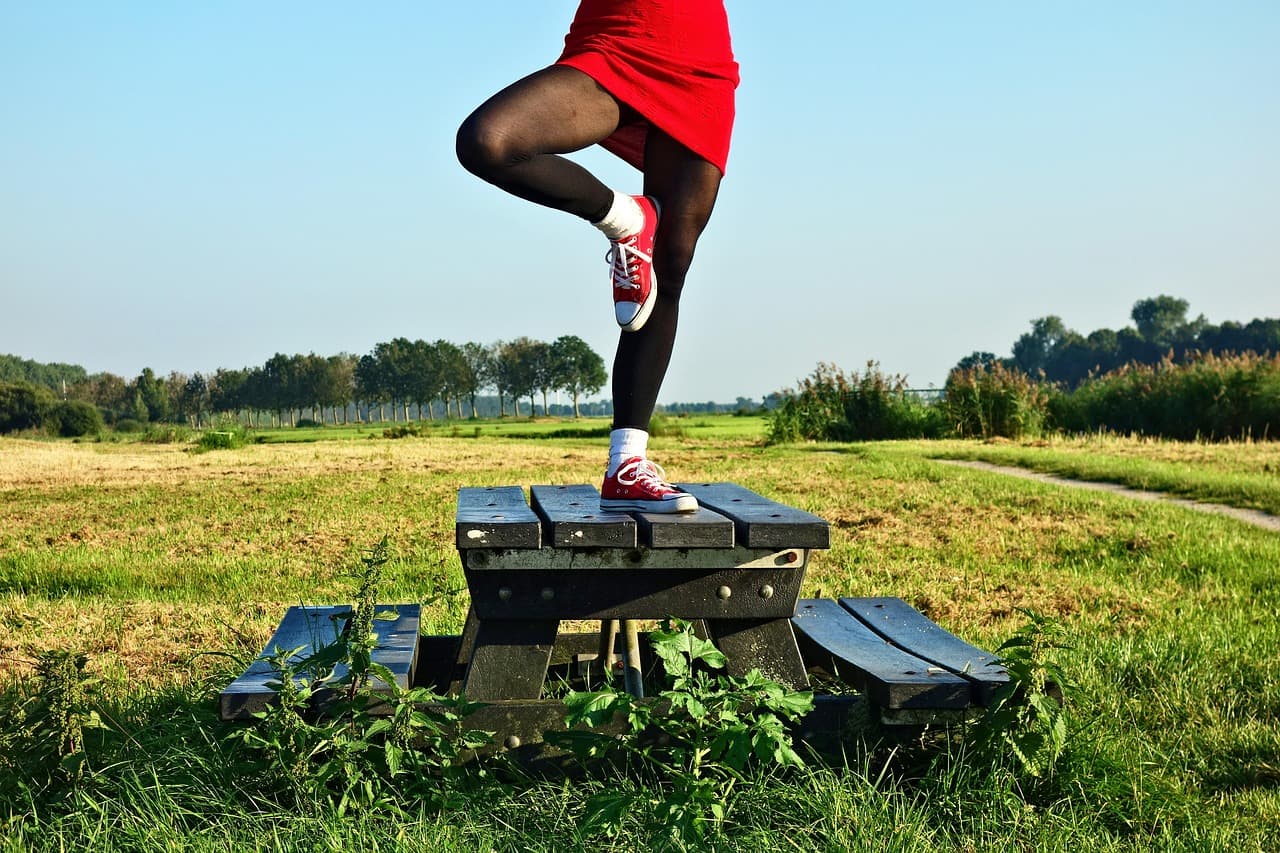
A client of mine, mid-fifties, breezed through his squat and deadlift numbers every week without complaint. Then I asked him to stand on one leg, arms crossed, eyes open, and time himself. He lasted four seconds before he had to put his foot down. He was stronger than most men half his age and couldn't stand on one leg long enough to tie a shoe without holding onto something.
That gap surprises people. Building strength and building balance aren't the same project, and one doesn't guarantee the other. Balance quietly erodes for years before it shows up anywhere you'd notice it, until a curb catches you wrong or a patch of ice does what it wouldn't have done at thirty.
This isn't medical advice, and if you have a diagnosed inner ear condition, neuropathy, or a history of falls, talk to a doctor before testing this on your own. For everyone else, here's how to check where you actually stand, in under two minutes.
Why your balance predicts more than your gym numbers do
Standing on one leg looks like a party trick. It isn't. A 2022 study in the British Journal of Sports Medicine followed 1,702 adults between 51 and 75 for a median of seven years. The people who couldn't hold a single-leg stance for 10 seconds had an 84 percent higher risk of dying from any cause during that follow-up period than the people who could. Death rate in the group that failed the test: 17.5 percent. Death rate in the group that passed: 4.6 percent.
I want to be precise about what that means, because it gets oversimplified constantly online. Standing on one leg doesn't cause you to live longer. It's a five-second window into how well your hips, ankles, and core are coordinating under a real demand, and that coordination happens to track closely with the kind of physical resilience that predicts a lot of other things: fall risk, recovery capacity, how your body handles an unexpected stumble instead of turning it into a fracture. The test is a messenger, not a cause. But it's a genuinely useful messenger, and it takes less time to run than it took you to read this paragraph.
Desk work makes this worse in a specific way. Sitting all day turns off the glutes that control your hip during single-leg loading, keeps your ankles in a narrow range they never have to stabilize through, and never asks your deep core to brace while your limbs do something independent. Balance requires all three working together, and desk work degrades all three at once over years without you noticing. That's why so many strong, otherwise fit professionals fail this test the first time they try it.
Test 1: Eyes-open single-leg stance
This is the standard version, the one with real published research behind it, and the one to start with.
Stand near a wall or sturdy chair for safety, but don't hold on unless you need to. Cross your arms over your chest. Lift one foot a few inches off the floor, without letting it touch your standing leg. Start a timer the moment your foot leaves the ground. Stop the timer the moment you uncross your arms, touch your raised foot down, hop, or noticeably shift your standing foot to catch yourself.
Do both sides. Most people have a real difference between their left and right, and the weaker side is the one worth paying attention to.
What you're measuring: how many seconds you can hold a stable single-leg position with your eyes open.
Pass: Close to the published average for your decade. Roughly 40 to 45 seconds in your 20s through 50s, around 30 seconds in your 60s, around 20 seconds in your 70s. No hopping, no arm movement, no touching down. Borderline: Noticeably under your decade's average but still well clear of 10 seconds. A real gap worth training, not an emergency. Fail: Under 10 seconds on either side, or a large gap between your left and right sides (more than 5 to 10 seconds apart).
Those benchmarks come from a normative study of 549 healthy adults published in the Journal of Geriatric Physical Therapy, which found no meaningful difference between men and women, only age. The 10-second threshold is the one tied to the mortality data above, so it's the number that matters most if you only remember one.
Test 2: Eyes-closed single-leg stance
Same position, harder condition. Closing your eyes removes the visual input your brain normally leans on to make balance easy. That shifts the load onto your ankle proprioception, your ankle's own sense of where it is in space without looking at it.
Set up the same way, near something sturdy to catch yourself. Lift one foot, cross your arms, then close your eyes. Start the timer the instant your eyes close. Stop it the same way as before: touching down, hopping, uncrossing your arms, or opening your eyes.
What you're measuring: how much your balance depends on vision to hold together.
Pass: 10 seconds or more with your eyes closed. There's a steep dropoff between the eyes-open and eyes-closed versions for everyone, so don't expect anywhere near your Test 1 number. Borderline: 5 to 10 seconds. Fail: Under 5 seconds, or such a dramatic collapse from your eyes-open number that vision is clearly doing almost all the work.
A big eyes-open-to-eyes-closed drop specifically points at weak ankle proprioception rather than a hip or strength problem, since your eyes were compensating for exactly that.
Test 3: Single-leg reach test
This one tests something the first two don't: whether your hip can control your pelvis while you actively move, not just while you're frozen in place.
Stand on one leg. Keeping your standing knee soft, not locked, reach your other foot forward along the floor as far as you can while staying balanced, then tap it down lightly and return to the starting position without putting weight on it. Do this to the front, then to the side, then behind you, all on the same standing leg.
What you're measuring: whether your hip and pelvis stay level and controlled through the reach, or whether your hip drops, your trunk leans hard to one side, or you have to catch yourself.
Pass: You can reach a meaningful distance in all three directions with your pelvis staying level and your standing knee tracking straight over your foot. Borderline: You can do it, but your hip visibly drops or your trunk leans to compensate, especially on the side or back reach. Fail: Your standing hip collapses inward or drops noticeably the moment you shift weight into the reach, or you can't complete a reach in any direction without stepping down to catch yourself.
A fail here, especially if Test 1 and 2 were fine, points at a hip control problem specifically. Your balance holds up fine standing still, but falls apart the moment something asks your hip to stabilize through movement. That's a lot closer to what happens on a curb, a hiking trail, or getting out of a low chair than standing frozen in one spot ever is.
What your three results mean together
No single test tells the whole story, but the pattern across all three does.
If you failed the eyes-closed test but passed the other two, the issue is mostly ankle proprioception. Your ankles aren't giving your brain good information about where they are without visual backup.
If you failed the reach test but passed the first two, the issue is hip control under movement, not static balance. Your glute medius, the muscle that keeps your pelvis level when you're on one leg, isn't doing its job when you actually need it.
If you failed all three, or failed Test 1 outright, the pattern is broader. Something in the chain of core bracing, hip control, and ankle stability has been offline for a while, and desk work is the most common reason why.
If you passed all three cleanly, you're in good shape here. That doesn't mean you're off the hook for the rest of what a body needs, but this particular system is working.
Five drills to fix what's failing
Five drills, matched to the causes above. Ten minutes a day is enough. Run this for four to six weeks, then retest all three checks.
1. Single-leg stance progression, 3 sets of 30 seconds each side
Targets: rebuilding the baseline (all three systems)
Start exactly like Test 1, but treat it as training instead of testing. Once eyes-open feels solid for 30 seconds, close your eyes. Once that feels solid, try standing on a folded towel or pillow to add an unstable surface. Progress in that order, not all at once.
This is the drill that directly rebuilds whatever Test 1 and 2 caught. Don't skip past the basic version just because it feels easy in the first week. The gains happen with repetition, not difficulty.
2. Single-leg Romanian deadlift, 2 sets of 8 each side
Targets: hip control under movement (Test 3)
Stand on one leg, soft knee. Hinge at the hip, letting your free leg extend straight back behind you as a counterbalance, lowering your torso toward parallel with the floor. Keep your hips square to the ground the whole way down, not rotating open. Squeeze your standing glute to come back up.
Start with just your bodyweight. This is the single best drill for the exact failure pattern in Test 3, since it forces your hip to control your pelvis through a real range of motion instead of standing frozen.
3. Standing hip hike, 2 sets of 12 each side
Targets: glute medius, lateral pelvic control
Stand on a low step with one foot, letting the other foot hang off the edge. Without bending either knee, let the hanging hip drop below level, then hike it back up above level by pulling your ribs toward that hip. Small range, controlled tempo.
This isolates the exact muscle that fails in Test 3 without the added coordination demand of the single-leg RDL, which makes it a good starting point if the RDL feels like too much at first.
4. Single-leg calf raise, 2 sets of 12 each side
Targets: ankle strength and proprioception (Test 2)
Stand on one foot near a wall for light support. Rise onto the ball of your foot as high as you can, pause for a second at the top, then lower under control until your heel is just short of the floor. Keep the standing leg straight throughout.
Loading the ankle through a full range while it's also doing balance work trains the same proprioceptive system that Test 2 is checking, not just calf strength.
5. Pallof press, 2 sets of 10 each side
Targets: core bracing under load
Anchor a resistance band at chest height to your side. Hold both hands at your sternum, step away until there's tension, then press the band straight out in front of you and back, resisting the pull that wants to rotate your trunk toward the anchor.
This is the drill for a broad, all-three-tests-failed pattern. Your core's job during balance work is to keep your trunk quiet while your hips and legs do the moving, and this trains exactly that without any leg involvement to hide behind.
How to retest and track progress over six weeks
Retest all three checks every two weeks, same time of day, same setup. Balance improves faster than most people expect once you're actually training it on purpose, since a big part of the early gain is neurological, your brain getting better at coordinating a skill it hasn't practiced in years, not new muscle.
Most people see a real jump in their eyes-closed number within the first two weeks. The reach test tends to move slower, closer to four to six weeks, since it depends on actual strength gains in the hip, not just improved coordination.
If nothing has moved by week six despite consistent daily work, that's the signal to get an actual assessment rather than keep training blind. Something structural, not just deconditioned, may be involved.
When wobbly balance is a bigger red flag than deconditioning
A few patterns mean this is a conversation with a doctor, not a home program.
Sudden new balance problems that showed up over days or weeks, rather than a slow decline over years, deserve prompt attention. So does balance loss paired with dizziness, spinning sensations, double vision, slurred speech, or numbness anywhere. Those point toward an inner ear or neurological issue, not a deconditioned hip.
A recent fall, or a near-fall that genuinely scared you, is worth mentioning to a doctor even if the balance tests above come back fine. And if you have diagnosed peripheral neuropathy, a history of stroke, or you're on medications that list dizziness as a side effect, work with a physical therapist on this rather than a blog post.
For everyone else, a slow decline that's been building for years and shows up as a low but stable number on these tests, the drills above are a legitimate first step.
Next step: the full movement screen
The three tests above look at one system. If you want the complete picture, hips, thoracic spine, hamstrings, ankles, core, and shoulders included, I built a free movement screen that scores all six areas in about five minutes. No email required. It runs the same assessment I use with new clients and generates a downloadable 1-week program built around whatever scored lowest.
Balance touches three of those six areas directly. If your reach test failed, the hip mobility test is worth running next, since a hip that can't move well usually can't stabilize well either, and the two problems tend to travel together.
Where to go from here
Run the three tests, figure out which cause is actually driving your number, and give the matching drill four to six weeks before you judge it. Most people notice the change less in the mirror and more in ordinary moments: stepping off a curb without a wobble, catching yourself less on stairs, standing to put on pants without touching a wall. If you're rebuilding balance specifically to get back on a pickleball or tennis court, here's the sport-specific version of this test along with the full return-to-play program.
If your numbers came back low across the board, or you want a program built around your specific pattern instead of a generic one, that's what one-on-one training is for. I've logged over 12,000 sessions with adults across San Jose and the Bay Area, and rebuilding a balance system that a decade of desk work left behind is one of the more satisfying things I get to help with. It's a fixable problem, and it tends to fix faster than people expect.
Ready to train smarter?
Get a personalized program built around your goals, your body, and your schedule.
Book Your Free ConsultationRelated Articles
Test your muscle power at home after 40: three leg power tests you can score, and why power fades before strength
Muscle power drops years before strength does, and no gym number catches it. A San Jose trainer walks through a sit-to-stand power test, a stair power test, and a vertical jump with pass, borderline, and fail lines, then sorts a low score into the four things that cause it.
Do your glutes actually fire? A three-part dead butt syndrome test you can score at home
Dead butt syndrome has a real mechanism and a real test. A San Jose trainer walks through three glute activation checks with pass, borderline, and fail lines, what each result means for your back and knees, and a four-week plan to wake the muscles back up.
Morning heel pain? At-home tests for plantar fasciitis, and why the first step after sitting hurts most
Heel pain in the morning that eases as you walk is the classic plantar fasciitis pattern. Three at-home self-tests to confirm it, a way to find what's driving yours, and the strength program the trials support, from a San Jose trainer.