
Resistance band routine for desk workers: no gym, no equipment, 15 minutes

Jeffrey Sun, ACE-CPT
July 2, 2026 · 9 min read
ACE-certified personal trainer specializing in functional movement, mobility, and strength training for busy professionals in San Jose and the Bay Area.
Book a free consultation →
A client of mine works out of a studio apartment in downtown San Jose. No floor space for a squat rack, no closet for dumbbells, and a lease that makes hanging anything from the ceiling a bad idea. For a year she told me she'd start training "once she had room for equipment." She never got the room. What she got instead was a single loop resistance band that fits in a desk drawer, and a 15-minute routine she actually does.
This is that routine. It's for the person who keeps waiting for the right setup before they start. You don't need one.
Why a $15 band beats a home gym you'll never build
Most people who tell me they need equipment before they can train are really telling me they're waiting for permission to start. A rack, a bench, a full set of dumbbells. It's a reasonable-sounding excuse, and it keeps people stuck for years.
A resistance band costs less than a lunch out. It rolls up to the size of a fist. It works in a hotel room, a cubicle with the door closed, a studio apartment, or a hallway. And for the specific problems a desk job creates, a band is often the better tool anyway. It provides resistance that increases as you stretch it, which trains the exact end-range strength that sitting all day erodes. A dumbbell gives you constant resistance through a range of motion. A band gives you more resistance right where your rounded, sitting-shaped body needs it most. This isn't just a convenience argument: a systematic review and meta-analysis of elastic versus conventional resistance training found no meaningful difference in strength gains between the two, across both upper and lower body.
This isn't a claim that bands are objectively superior to a full gym. Someone with a home gym and the time to use it will build strength faster with heavier compound lifts. But for someone with a desk job, no equipment, and 15 minutes between meetings, a band is not a compromise. It's often the right tool for the actual problem.
The three things a desk job breaks that a band can fix
Before the routine, it helps to know what you're actually working against. Three patterns show up in almost every desk worker I've trained.
Rounded shoulders and a locked-up upper back. Years of reaching forward for a keyboard shortens the chest and pulls the shoulder blades out of position. The muscles that should hold your shoulders back, mid-back, rear delts, rotator cuff, go quiet from disuse.
Sleepy glutes. Sitting on them for eight hours a day sends the signal that they're not needed. The hip flexors in front get tight and short to match. This combination is behind a lot of the low-back ache people feel by mid-afternoon.
A stiff thoracic spine. The middle of your back, which is supposed to rotate and extend, gets stuck in a hunched position. This limits shoulder mobility, drives neck tension, and is a big part of why reaching overhead starts to feel off by your late thirties.
A band routine that hits all three doesn't need to be complicated. It needs to be specific, and it needs to happen regularly.
The 15-minute routine (5 moves, no floor space required)
Five moves. About three minutes each including rest. All of them work in a space roughly the size of a yoga mat, and none require anything but the band.
Band pull-aparts, 3 sets of 15
Hold the band with both hands, arms straight out in front of you at chest height, palms down. Pull the band apart by squeezing your shoulder blades together, bringing your arms out to the sides. Return slowly. This is the single best move for reversing rounded shoulders. Do it standing at your desk between calls if you want to sneak in extra volume through the day.
Standing band row, 3 sets of 12
Anchor the band around something stable at waist height (a door handle, a heavy table leg) or step on it with one foot if you don't have an anchor point. Hold the other end and row your elbow back, squeezing your shoulder blade toward your spine at the top. This targets the same rounded-shoulder pattern as the pull-apart but loads it through a longer range, which builds more actual strength rather than just activation.
Banded glute bridge, 3 sets of 15
Lie on your back, knees bent, feet flat, with the band looped just above your knees. Drive through your heels and squeeze your glutes to lift your hips, pushing your knees out against the band the whole time. This wakes up the exact muscle that sitting puts to sleep, and the band adds a lateral resistance component that a bodyweight bridge doesn't have.
Banded external rotation, 2 sets of 15 each side
Anchor the band at elbow height. Stand sideways to the anchor, elbow bent to 90 degrees and tucked at your side. Rotate your forearm outward against the band's resistance, keeping the elbow pinned. This is a small-muscle move for the rotator cuff, which does a lot of the quiet work of keeping your shoulder stable and rarely gets trained directly.
Overhead lat stretch, 60 seconds each side
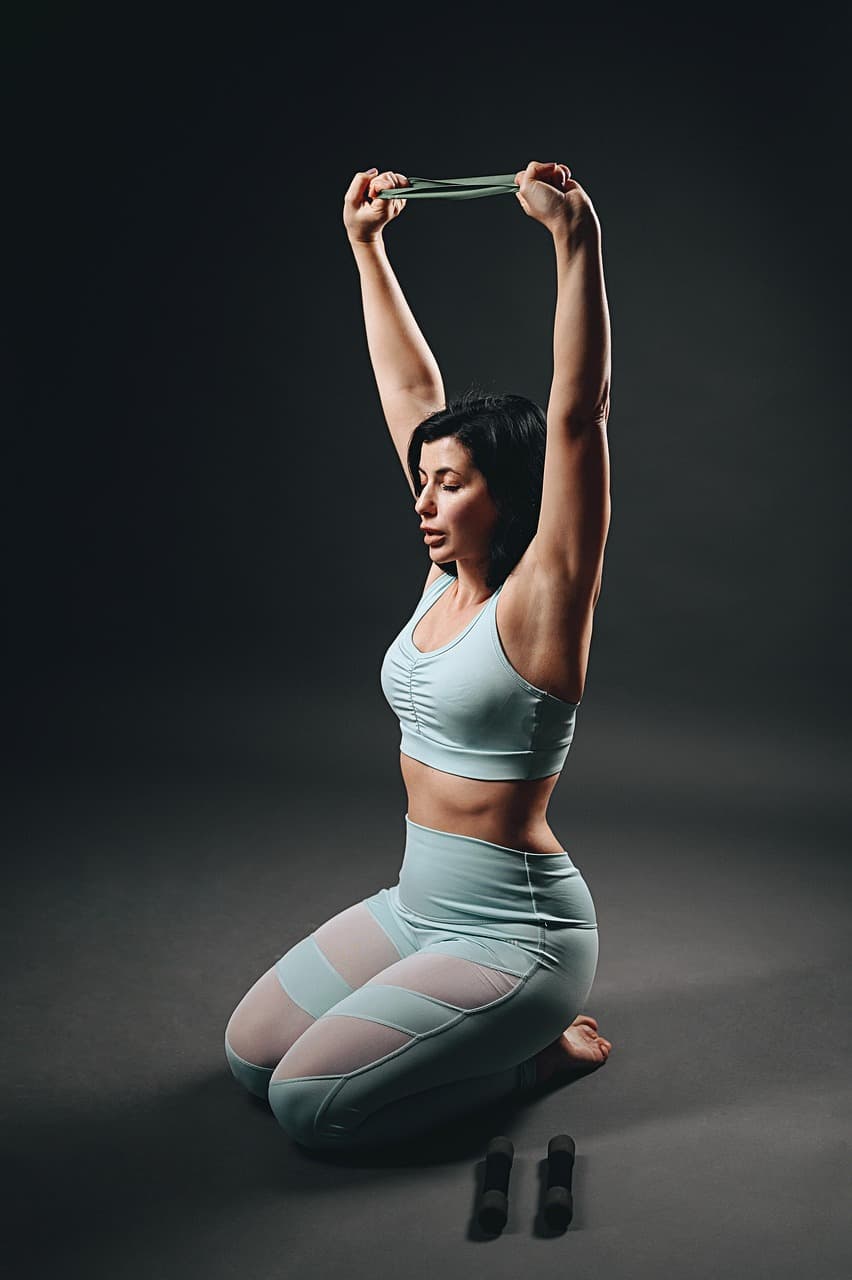
Loop the band around something above head height, or simply hold it overhead with both hands and lean your body weight back and to one side. This opens up the lats and the side body, which tend to get compressed from hours of sitting hunched forward. It's the one move in this routine that's a stretch rather than a strengthening exercise, and it's a good way to end the session.
How to make this harder as you get stronger
The routine above is a starting point, not a ceiling. Bands progress in three ways that don't require buying new equipment every few months.
Thicker bands. Most bands are sold by resistance level (light, medium, heavy, or numbered by pounds of tension). A $10 second band in a heavier resistance gives you a full progression without adding bulk to your desk drawer.
More stretch. Standing further from the anchor point, or starting the pull-apart with your arms wider, increases the tension at the same resistance level. This is the free progression that costs nothing.
Slower tempo. A three-second count on the way back from each rep turns a 15-rep set that felt easy into one that doesn't. Time under tension is a real training variable, and bands are particularly good for it because there's no risk of the weight dropping on you if your control breaks down.
Most of the desk workers I've coached through a band-only phase can run this progression for two to three months before they genuinely need more than a band and some patience.
When a band routine isn't enough (and what is)
A band routine is a real training stimulus, not a placeholder until you get to a gym. But it has a ceiling, and it's worth naming honestly.
Bands are limited for building maximal strength in big compound patterns like squats and deadlifts, because the resistance curve doesn't match how those lifts actually load your body. If your goal shifts from "undo what sitting did to me" to "build meaningfully more strength," you'll eventually want access to heavier, more linear resistance. A pair of adjustable dumbbells or a gym membership becomes worth it at that point, not before.
Bands are also not a substitute for a real assessment if you're dealing with pain rather than just stiffness. If your shoulder pinches specifically in the mid-range of overhead reach, that's a different problem than general tightness, and the shoulder impingement self-checks walk through how to tell the difference and what to do about it.
For the general case of "I sit all day and feel stiff and weak in predictable places," a consistent band routine is a legitimate long-term tool, not a stepping stone you need to outgrow quickly.
Building this into an actual workday habit
The routine only works if it happens. A few things that make the difference between people who stick with a band routine and people who buy one and never touch it again.
Keep the band somewhere you'll actually see it. A desk drawer works. A bag you carry to work does too. If it's in a closet at home, it doesn't exist.
Anchor it to something that already happens. Right before lunch. Right after your last meeting of the day. The specific time matters less than the fact that it's attached to an existing habit rather than floating free in your calendar, where it competes with everything else and usually loses.
Do it even when it's not the full 15 minutes. Three sets of pull-aparts during a phone call is better than skipping the day because you don't have a full block of time. The cumulative volume across a week matters more than any single session being complete.
If you want the fuller picture of what sitting does to the body and a longer routine to graduate into once equipment stops being the blocker, functional movement exercises for desk workers covers the 4-phase version with dumbbells and kettlebells. This band routine is the version for the weeks or months before that's realistic, or for the days when a full session isn't happening and something is still better than nothing.
Where to go from here
If you want to know which of the three patterns above (shoulders, glutes, or thoracic spine) is doing the most damage in your specific body, the movement screen is a free five-minute assessment that flags it. It's the same screen I use with new clients in San Jose, and it'll tell you which of these five moves deserves the most of your attention.
And if you've been doing a band routine on your own and want to know what the next step looks like, come work with me. I've coached more than 12,000 sessions, plenty of them with people who started exactly where this routine starts. The band isn't the ceiling. It's just not the barrier people think it is.
Ready to train smarter?
Get a personalized program built around your goals, your body, and your schedule.
Book Your Free ConsultationRelated Articles

How to Return to Strength Training After a Break (For Over 30)
A trainer's framework for coming back to the gym smart, not hot. Covers what changed during the break, how to pick a starting load, the 4-week re-entry ramp, and when an injury changes the rules.

How to Warm Up Before Lifting: A 10-Minute Routine for Over 30
A targeted warm-up that prepares the tissues, opens your limited ranges, and primes the lifts you're about to do. A San Jose trainer's guide for desk workers over 30.

Shoulder impingement for desk workers: 3 self-checks and what each one means
Shoulder pain in the 60-to-120 degree arc usually shows up at 35, not 25. A San Jose trainer's guide to the desk-worker shoulder pattern, three at-home tests, and the drills that actually move the needle.