
Core Stability Test at Home: 3 Checks for Desk Workers

Jeffrey Sun, ACE-CPT
April 30, 2026 · 15 min read
ACE-certified personal trainer specializing in functional movement, mobility, and strength training for busy professionals in San Jose and the Bay Area.
Book a free consultation →
Most desk workers I assess think they have a weak core. They picture six-pack abs that aren't there and assume that's the problem. The actual issue is something different. The deep core, the layer underneath the visible abs, has gone offline from years of slumping in a chair and trusting the spine to hold itself up. That's the layer that protects the low back. When it stops doing its job, the back takes the hit.
This is why so many of the tech professionals I train in San Jose come in with a chronic low-back ache and no obvious cause. They aren't deconditioned in any visible way. Some of them run, lift weights, and look fit. But ask them to brace and breathe through a heavy carry or a single-leg drill and the wheels come off. The deep core has stopped showing up to work. The parents among them tend to find this out the hard way, because lifting a toddler thirty times a day is a loaded carry whether or not anyone called it one.
Most of my desk-worker clients move from "core almost never fires" to "core fires reliably under load" in three to four weeks of focused work. But first, you need to know which piece is missing. Three tests, eight minutes, a clear floor. You can run them this morning.
Why "core stability" matters more than crunches
The word "core" gets misused constantly. Most fitness content treats it as a synonym for the rectus abdominis, the visible front-of-the-belly muscles that show up in mirror selfies. That's a small, surface part of the actual system.
The real core is a deeper, integrated package. The transverse abdominis wraps around your trunk like a corset. The multifidus runs along the spine, segment by segment. The pelvic floor closes off the bottom of the abdominal cavity. The diaphragm sits across the top. Together, these four create what physical therapists call intra-abdominal pressure, which is what actually stabilizes your spine when you bend, twist, lift, or breathe.
Sitting wrecks this system in two specific ways. First, the deep core stops being asked to brace. The chair holds your trunk for you, so the muscles that should be doing it slowly stop firing. Second, sitting compresses the diaphragm, so breathing turns shallow and chest-driven, which removes another lever the deep core normally uses to coordinate.
By the late thirties, most desk workers I assess have a deep core that fires late or not at all under load. The visible abs are usually fine. The plank hold can look strong on the clock. But the underneath layer, the part that actually prevents low-back injury, isn't online. That's what the three tests below are designed to expose.
A 2017 systematic review on core stability and low back pain found that targeted deep-core training outperforms general exercise for chronic low-back symptoms in desk-bound populations. That tracks with what I see in clients. Plank-hold endurance isn't what predicts low-back resilience. Deep-core coordination under limb load is.
Test 1: Dead bug coordination
The dead bug is the gold standard for testing whether your deep core can brace while your limbs move. It's not a strength test. It's a coordination test. The whole point is to keep the spine still while the arms and legs do work.
Lie flat on your back on the floor. Knees bent, feet flat. Press your lower back firmly into the floor by gently tucking your pelvis. Imagine flattening a balloon between your low back and the ground. Keep that contact the whole time.
Lift your arms straight up toward the ceiling, hands above your shoulders. Lift your knees over your hips so your shins are parallel to the floor. This is the start position.
Slowly lower one arm overhead and the opposite leg toward the floor at the same time. Don't touch the floor. Just go to the lowest point you can while keeping your low back pinned. Reverse and switch sides. That's one rep.
What you're measuring: how slowly and smoothly you can move opposite-side limbs without losing low-back contact with the floor.
Pass: Six controlled reps per side with the low back pinned the whole time. Limbs move slowly, breathing stays steady. Borderline: You can do four reps before the low back starts to lift. Or you complete six but you have to hold your breath to keep contact. Fail: The low back lifts off the floor on the first rep, OR you can't tell whether it's lifting because the deep core isn't sending a signal.
Most desk workers fail this the first time. The classic pattern is the low back arches up the moment a leg starts lowering, which means the deep core isn't taking over the bracing job that the chair has been doing all day. That's the gap to fix.
Test 2: Side plank hold
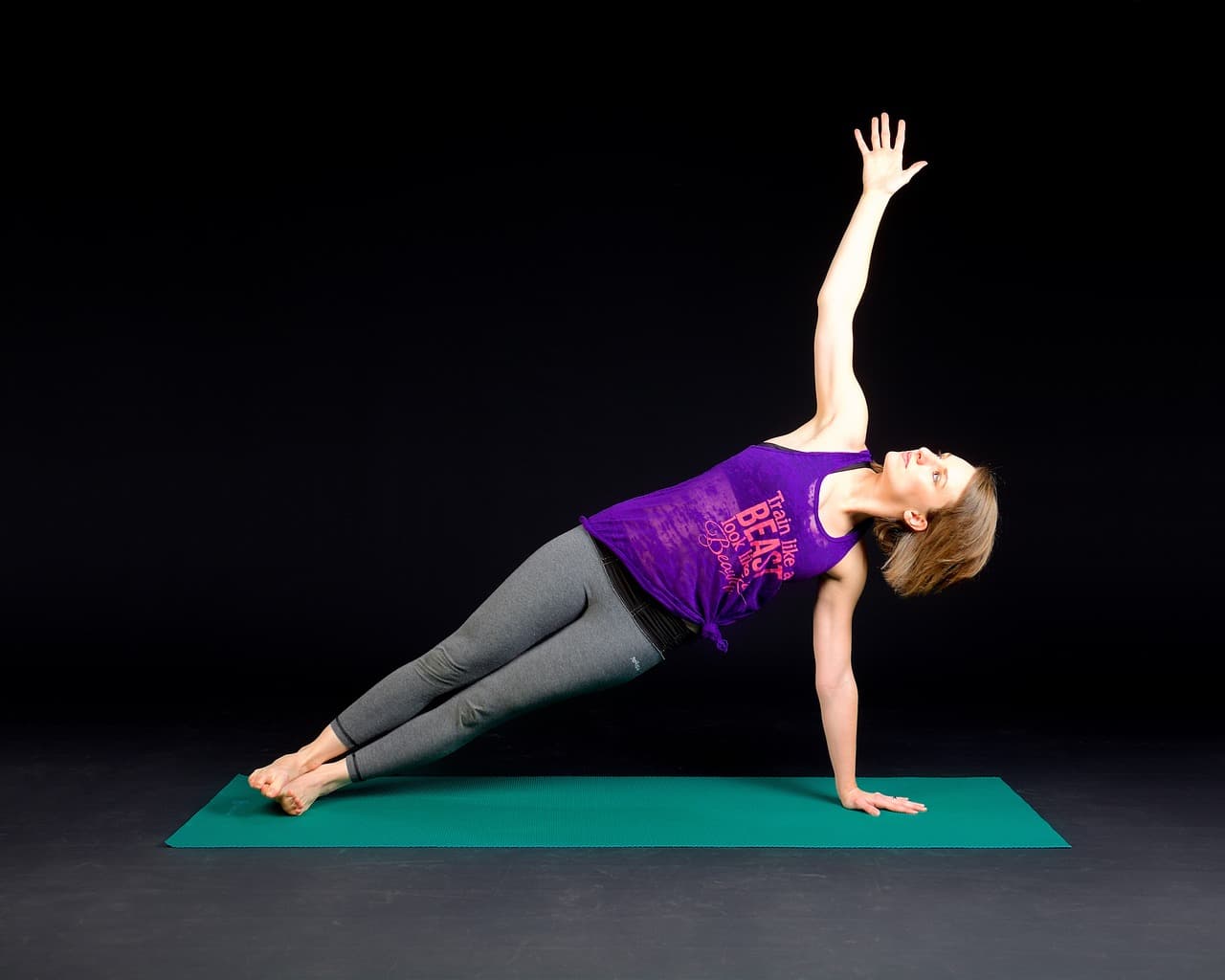
Side plank tests the lateral chain, including the obliques, glute medius, and the deep stabilizers running along the side of the spine. Asymmetry between sides matters more than the absolute time on either side.
Lie on your side with your forearm on the floor, elbow under your shoulder. Stack your feet, legs straight. Push your hip up so your body forms a straight line from ankle to shoulder. Hold.
Time how long you can hold a clean position. Stop when your hip starts dropping toward the floor, or when your form has clearly broken. Don't push through ugly reps. The number you write down is the time at which the line broke, not the time you collapsed.
Repeat on the other side. Note both numbers and the difference between them.
What you're measuring: time held in clean position on each side, and the asymmetry between sides.
Pass: Forty-five seconds or more on each side, with less than ten seconds difference between sides. Borderline: Twenty to forty-five seconds on each side, OR a difference between sides of ten to twenty seconds. Fail: Under twenty seconds on either side, OR a difference between sides greater than twenty seconds.
The asymmetry is what matters most. I've had clients hold a clean fifty seconds on the right and crumble at fifteen on the left. They never noticed because their daily life didn't ask them to hold a side plank. But that asymmetry shows up in the gym as a squat that tracks worse on one side, or a deadlift that locks out unevenly. It often shows up in life as a back that flares up in one specific direction.
Test 3: Bird dog hold
Bird dog tests anti-rotation control, which is the job the deep core does whenever you walk, run, or carry something on one side. It's also the test most people fail in a way they don't expect, because the body has clever cheats for hiding rotation.
Get on all fours. Hands under shoulders, knees under hips. Press your low back into a flat, neutral position. Imagine balancing a glass of water on your sacrum.
Slowly extend one arm forward and the opposite leg back, both in line with your trunk, both at horizontal height. Hold. Then return to start and switch sides.
What you're measuring: whether you can hold the extended position with a level pelvis and a still spine, and how long.
Pass: Hold ten seconds per side cleanly. The pelvis stays level, the spine stays neutral, the imaginary glass of water doesn't spill. Borderline: You can hold five to ten seconds, but your pelvis tilts to one side or your spine has to compensate to stabilize. Fail: You can't get the limbs up to horizontal without rotating, OR the pelvis dumps to one side as soon as you lift the leg.
The pelvis-tilt cheat is the one to watch for. If your pelvis is tilting away from the lifted-leg side, your deep core isn't controlling the rotation, and your QL and obliques are taking over the work in a way that loads the spine wrong.
If you have access to a mirror or a phone camera, video this test from above. Most people are surprised at how much rotation is actually happening that they couldn't feel.
Interpreting your results
One failed test doesn't tell you much. The pattern across the three is what matters.
If you failed the dead bug, your deep core can't coordinate with limb movement. This is the most common single finding in my desk-worker assessments. The fix is dead bug regressions plus dead bug volume, daily, until the pattern is automatic.
If you passed dead bug and failed side plank, the issue is lateral-chain endurance. Sitting all day deactivates the obliques because there's nothing pulling laterally on the trunk. You need direct side-plank work plus loaded carries.
If you failed bird dog with a clear pelvic tilt, you have an anti-rotation deficit. Anti-rotation work like the Pallof press becomes the priority. Without it, every step you take on a single leg loads your spine asymmetrically.
If you failed all three, that's what a decade of full-time sitting does, and it's reversible. The clients who score worst on day one are usually the ones who see the biggest changes by week four, because the deep core is responsive when you give it consistent, focused signals.
5 drills that actually work on a weak deep core
Five drills, each picked because it targets a different piece of the deep core puzzle. Start with the drill that matches your worst test, plus the dead bug, which is the foundation that everything else builds on.
1. Dead bug, 3 sets of 8 per side
Targets: anti-extension, deep core coordination
Lie on your back, knees over hips, arms straight up over shoulders. Press your low back flat into the floor. Slowly lower opposite arm and leg, keeping the low back pinned. Return and switch sides. Slow. Controlled. Breathing through your nose.
The most common mistake is going too fast. Speed is a way to mask the deep core not firing. Slow it down until you can feel the brace working. If your low back starts coming up at three reps, do three perfect reps and stop. Quality reps build the pattern. Junk reps reinforce the dysfunction.
This is the single highest-yield deep core drill I know. Three sets of eight per side, daily, will move the dead bug score on most people inside two weeks.
2. Side plank with knee bent, 30 seconds per side
Targets: lateral chain endurance, anti-lateral flexion
Lie on your side, forearm down, elbow under shoulder. Bend your bottom knee so the shin is on the floor and the bottom of your foot points behind you. Top leg stays straight. Push your hip up to form a straight line from your top knee to your top shoulder.
Thirty seconds per side. The knee-bent version cuts the lever arm in half, which makes it accessible if your full side plank scored under twenty seconds. Once you can hold thirty seconds per side cleanly, progress to a full side plank with both feet stacked.
The cue most people need: drive your bottom hip up, not your top hip down. The first one fires the obliques. The second one collapses into the floor.
3. Bird dog with pause, 8 reps per side
Targets: anti-rotation, spinal stability
All fours. Hands under shoulders, knees under hips, low back neutral. Slowly extend one arm forward and the opposite leg back. Pause for two seconds at the top with everything held still. Return slowly. Switch sides.
The pause is what makes this drill work. Without it, you can swing the limbs out and back fast enough that your deep core never has to do the anti-rotation job. With a two-second hold, the rotation control becomes the work.
If you're seeing pelvic tilt at the top, lower the leg height until the pelvis stays level. Range comes back as control improves. Eight clean reps per side beats fifteen messy ones.
4. Hollow body hold, 3 sets of 20 seconds
Targets: anti-extension, full-trunk bracing under load
Lie on your back. Press your low back flat into the floor. Lift your arms straight overhead, lift your legs straight out, and lift your shoulders and head an inch off the ground so your body forms a shallow C, with the low back pinned to the floor.
Hold for twenty seconds. Three rounds. The low back coming up off the floor is the universal signal to stop. If twenty seconds is too long, start with ten. The point is the brace, not the duration.
This is the most demanding drill in the list. It teaches the whole deep core to hold a brace while every limb is loaded against gravity. Once you can do three sets of twenty cleanly, that's a meaningful fitness baseline that maps to almost every loaded movement in life.
5. Pallof press, 3 sets of 10 per side
Targets: anti-rotation under external load
Anchor a resistance band at chest height. Stand sideways to the anchor, feet hip-width, both hands holding the band at your sternum. Step away from the anchor until the band has tension. Press the hands straight out in front of your chest until the arms are extended, then slowly bring them back to your sternum.
The band wants to rotate you toward the anchor. Your job is to not let it. Ten reps per side. Three sets. Slow controlled tempo.
The Pallof press is the loaded version of the bird dog test. It's where deep-core coordination becomes useful in real life, because almost every functional movement has an asymmetric load that the spine has to resist rotating around. A briefcase. A grocery bag. A child on one hip. A barbell racked on one shoulder. All anti-rotation challenges.
When it's not a deep core problem
A meaningful percentage of "weak core" presentations have a different root cause. Two patterns I see most often.
The first is breath-hold bracing. Some clients can pass the dead bug and bird dog, but only by holding their breath. That's not a functional brace, because real life requires you to breathe under load. If you notice you have to hold your breath to keep your low back pinned, the fix isn't more reps. It's deliberate diaphragmatic breathing practice paired with the same drills. Inhale into the belly through the nose, exhale through pursed lips, keep the brace steady through both phases.
The second is a tight set of hip flexors pulling the low back into anterior tilt all day. When the front of the pelvis is being yanked downward by a shortened psoas, the deep core has no reference position to brace against. The fix is to address the hips first. The hip mobility test takes another five minutes and shows whether anterior pelvic tilt is part of the picture. Most desk workers I assess have both issues at once.
Neither replaces the deep-core drills above, but if you've been doing them for three weeks and seen no test improvement, the answer is upstream.
The 10-minute daily routine
Here's the floor for anyone whose primary gap is deep-core function. Pick three drills, run them daily for two weeks, retest on day 14.
- Dead bug, 3 sets of 8 per side
- Bird dog with pause, 8 reps per side
- Side plank with knee bent, 30 seconds per side
Eight to ten minutes total. Do the dead bug first because the floor reference position primes the deep core for the next two drills.
Retest all three checks on day 14. Most desk workers see a measurable change in that window, even when day-one scores were brutal.
Next step: the full 12-question movement screen
If you want the complete picture across shoulders, thoracic spine, hips, hamstrings, ankles, and core in one sweep, I built a free movement screen that covers all of it. Twelve questions, five minutes, no email required. It runs the same assessment I do with new clients and generates a downloadable 1-week program built around whichever axes scored lowest.
Core stability is the sixth and final axis the Screen scores. If you've been running the test-at-home posts on hips, ankles, T-spine, hamstrings, and shoulders, this one closes the loop. The Screen pulls all six together and tells you which is the weak link in your specific chain.
Where to go from here
Pick the drill that matches your worst test and run it daily for two weeks. Retest. Most desk workers see real change in that window, and by week four it shows up where it counts. The 4 PM low-back ache starts letting up. Lifting a kid off the floor stops feeling sketchy. Heavy days at the gym stop ending with a back that doesn't trust you. If those heavy days include pulling from the floor, the deadlift setup guide walks through how a braced deep core changes the lift.
If you want eyes on your actual movement and a plan built around how your whole chain holds together under load, that's what one-on-one training is for. I've logged over 12,000 sessions, most with desk workers across San Jose and the Bay Area. A weak deep core is on the short list of what I work on the most. The fix is rarely more complicated than the test itself, but it has to be consistent.
Ready to train smarter?
Get a personalized program built around your goals, your body, and your schedule.
Book Your Free ConsultationRelated Articles
Lumbar Spine Mobility Test at Home: 3 Checks for Desk Workers
Three at-home tests for lumbar spine mobility and control, with pass/fail ranges and five drills to fix a low back that's stiff, unstable, or both. A San Jose trainer's guide.

Buttock pain when sitting? At-home tests to tell a hamstring tendon from a trapped nerve
Buttock pain when sitting usually comes from one of two places: the hamstring tendon at the sit bone, or the sciatic nerve deep in the buttock. Three at-home tests to tell them apart, and a plan for each, from a San Jose trainer.
Do your glutes actually fire? A three-part dead butt syndrome test you can score at home
Dead butt syndrome has a real mechanism and a real test. A San Jose trainer walks through three glute activation checks with pass, borderline, and fail lines, what each result means for your back and knees, and a four-week plan to wake the muscles back up.