
Lumbar Spine Mobility Test at Home: 3 Checks for Desk Workers

Jeffrey Sun, ACE-CPT
July 17, 2026 · 13 min read
ACE-certified personal trainer specializing in functional movement, mobility, and strength training for busy professionals in San Jose and the Bay Area.
Book a free consultation →
A client of mine, late forties, came in convinced his lower back was "just tight." He stretched it every morning, hamstrings and low back both, and it never seemed to help for more than an hour. When I had him hip-hinge to touch his shins, his spine started rounding before his hips moved an inch. His back wasn't tight. It was doing a job his hips had quietly stopped doing years ago, and no amount of stretching a joint that's already working too hard was ever going to fix that.
This mix-up is common. People feel a stiff, achy low back and assume the fix is more flexibility work on the low back itself. Sometimes that's right. Just as often, the lumbar spine is fine and the real problem is somewhere else in the chain, showing up at the low back because that's where the compensation lands.
This isn't medical advice, and if you have numbness or tingling down a leg, pain that's gotten steadily worse over weeks, or a history of spinal injury, see a doctor before running any of this. For the much larger group of people with a low back that just feels stiff, achy, or unreliable, here's how to sort out what's actually going on.
Why your lumbar spine needs control more than range
The lumbar spine is five vertebrae sitting between your ribcage and your pelvis, and its job description is narrower than most people think. It's built for some flexion, some extension, a little rotation, and a lot of stability. Compare that to the hips, which are built for a huge range of motion in almost every direction, and you can see the design intent. The hips are supposed to do most of the moving. The lumbar spine is supposed to hold steady while they do it.
Sitting flips that relationship. Hip flexors shorten from being held in flexion all day, and the glutes that should control hip extension go quiet from disuse. When you then ask your body to hinge forward, whether that's tying a shoe or picking something off the floor, the stiff, underpowered hips don't do their share, and the lumbar spine moves instead to make up the difference. Do that for a decade of desk work and the lumbar spine ends up doing a job it was never built to do as its main function, which is exactly the kind of overuse that produces the stiff, achy, unreliable feeling most people just call "a bad back."
The three tests below check three different things: how much extension range you actually have, whether your hips can do the hinging instead of your spine, and whether your lumbar spine can move on purpose when you ask it to, independent of your hips. Most people fail one or two, not all three, and the pattern tells you where to start.
Test 1: Prone press-up test
This one comes from the McKenzie method, a well-established approach to assessing and treating mechanical back pain, and it checks lumbar extension range along with how that range actually feels.
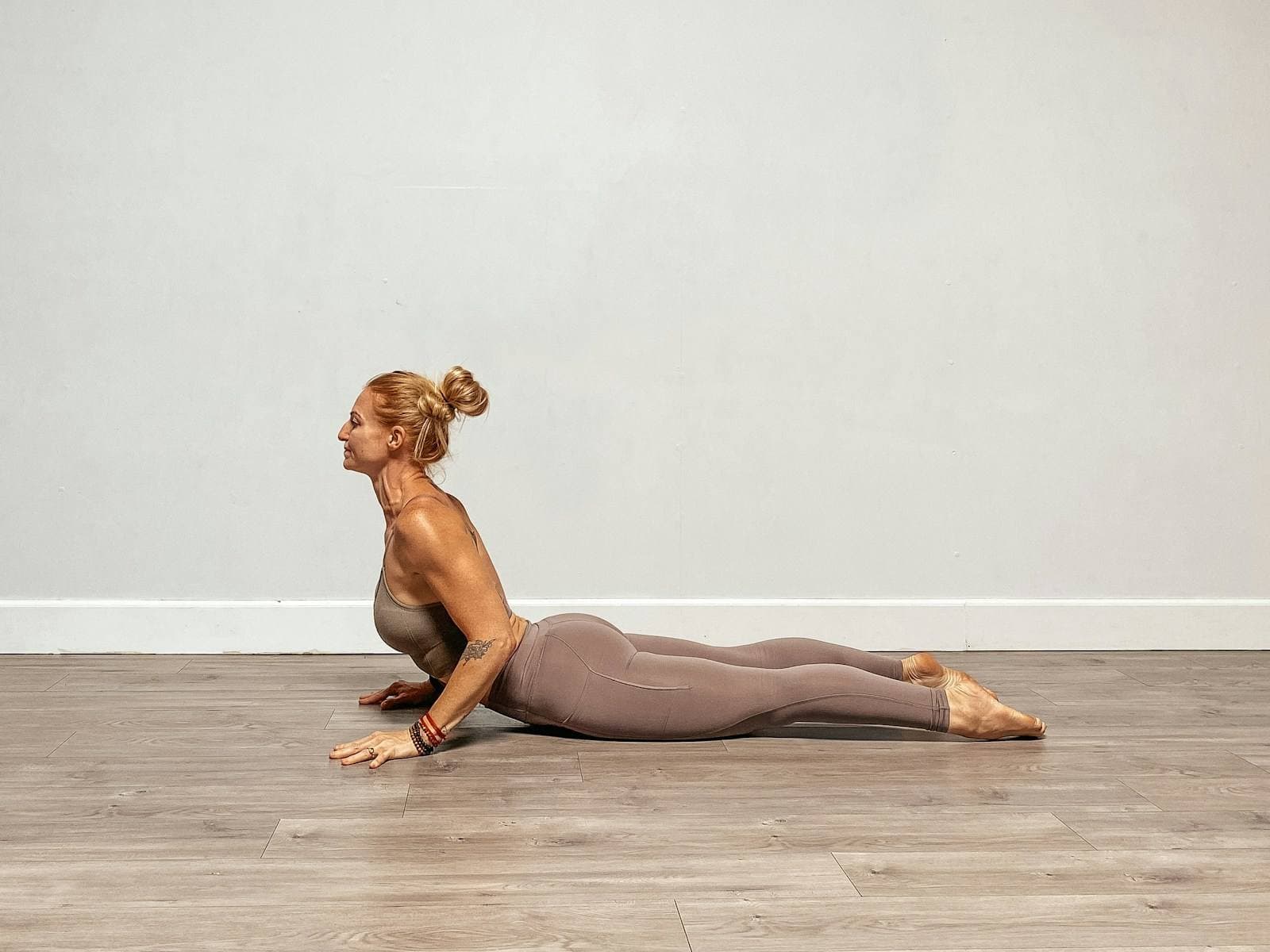
Lie face down on the floor. Place your hands under your shoulders like the start of a push-up. Keeping your hips and pelvis flat on the floor and your lower back muscles relaxed, press your upper body up using your arms only, not your back muscles. Go as high as feels reasonable, stop if anything sharp shows up, and lower back down.
What you're measuring: how far you can press up before your pelvis wants to lift off the floor, and whether the movement feels neutral, feels good, or provokes pain.
Pass: You can press up to a comfortable end range, arms nearly straight, pelvis staying on the floor, with the movement feeling neutral or actually relieving. Borderline: You can press up partway before your pelvis wants to lift, or the movement feels stiff and effortful without being painful. Fail: Your pelvis lifts off the floor almost immediately to compensate for lost range, or the press-up produces sharp pain or pain that travels down a leg.
That last pattern matters clinically. A 2005 review of McKenzie-based directional preference found extension was the preferred direction in a majority of mechanical low back pain cases, meaning it usually centralizes or eases the pain rather than worsening it. If extension makes things worse or sends pain further down your leg, that's a signal to get evaluated rather than push through it on your own.
Test 2: Standing hip-hinge test
This is the one that caught my client's real problem. It checks whether your hips can hinge while your lumbar spine holds its position. That's called hip-lumbar dissociation, and it's the pattern behind almost every "just picking something up" back tweak.
Stand with feet hip-width apart. Place one hand on your belly and one on your low back so you can feel what moves first, or better, record yourself from the side on your phone. Push your hips straight back like you're closing a door with your butt, letting your knees bend slightly, and reach your hands toward your shins or the floor. Watch or feel where the movement starts.
What you're measuring: whether your hips initiate the bend with your spine staying relatively still, or whether your lower back starts rounding early and does most of the work.
Pass: Your hips clearly push back first, your spine stays in a flat, neutral position through most of the movement, and you can reach at least to your shins without your back rounding. Borderline: You get a real hip hinge going, but your back starts rounding in the second half of the movement, usually once your hamstrings run out of length. Fail: Your lower back starts rounding almost immediately, before your hips have moved much at all, or you can't tell the difference between a hip hinge and just bending over.
A 2015 study validating a clinical test of thoracolumbar dissociation found that people with chronic low back pain reliably showed worse dissociation between their spine and hips during loaded movement than people without back pain. That's exactly the pattern this test is built to catch at home. If you failed this one, the hip mobility test is worth running next, since limited hip extension and internal rotation are two of the most common reasons the hips can't do their share of the hinge.
Test 3: Seated pelvic tilt test
This one is different from the first two. It's not testing range or a functional pattern, it's testing whether you have any voluntary control over your lumbar spine at all, independent of what your hips are doing.
Sit on the edge of a chair or a firm surface, feet flat on the floor. Rest your hands on your hip bones so you can feel them move. Without moving your shoulders, chest, or feet, try to tilt your pelvis forward, arching your lower back, then tilt it backward, rounding your lower back. Go back and forth slowly a few times.
What you're measuring: whether you can produce a clear, controlled arch and round using your pelvis and lower back alone, or whether the movement is vague, stuck, or borrowed from somewhere else.
Pass: You can clearly tilt the pelvis both directions, feel your lower back move with it, and control the speed of the movement in both directions. Borderline: You can move it, but the range feels small, uneven between directions, or you need a few tries to feel what's happening. Fail: You genuinely can't tell if anything is moving, or the only way you can produce the movement is by shifting your whole ribcage or holding your breath and straining.
A fail here is a motor control problem more than a flexibility problem. Your lumbar spine likely has the physical range to move, based on Test 1, but the connection between your brain and that specific movement has gone quiet from years of not using it on purpose.
Interpreting your three results together
If you passed extension and pelvic tilt but failed the hip hinge, your lumbar spine is fine. Your hips are the actual problem, and no amount of low back work fixes a hip that won't do its job. Start with hip mobility and hip hinge patterning specifically.
If you failed extension with real pain, especially pain that travels down a leg, that's worth a clinical evaluation before you self-treat with any of the drills below.
If you failed the pelvic tilt test but passed the other two, you have range and you have a decent hinge, but your lumbar spine has lost the specific skill of moving on command. This tends to show up as a back that feels vaguely unreliable even though nothing is technically wrong with it. Segmental control drills are the direct fix.
If you failed all three, the pattern is broad, and desk work is the most common reason for that. The good news is this responds well to consistent work. Most of the desk workers I've taken through this see a real change within three to four weeks.
5 drills to rebuild lumbar control and mobility
Five drills, matched to what the three tests catch. Ten minutes a day, run for three to four weeks, then retest.
1. McKenzie press-up, 2 sets of 10 reps
Targets: extension range (Test 1)
Same setup as Test 1. Press up to your comfortable end range, hold for a second, lower back down. Ten slow reps, twice through. If any rep produces pain that travels further down a leg than it did on the last rep, stop and get evaluated rather than pushing through it.
This is the same movement as the test itself, which is intentional. The McKenzie method uses repeated end-range movement as both the assessment and the exercise.
2. Dowel hip hinge, 2 sets of 10 reps
Targets: hip-lumbar dissociation (Test 2)
Hold a broomstick or dowel against your back with three points of contact: the back of your head, between your shoulder blades, and your tailbone. Keeping all three points touching, hinge back at the hips as far as you can while maintaining contact, then return to standing.
The dowel gives you instant feedback. The moment your lower back rounds to take over the movement, one of the three contact points comes off the stick, and you'll feel it immediately. This is the single best drill for retraining the pattern Test 2 catches.
3. Segmental cat-cow, 8 slow reps
Targets: voluntary lumbar control (Test 3)
Get on all fours, hands under shoulders, knees under hips. Instead of moving your whole spine as one block, start the movement at your tailbone and let it travel up one section at a time, tucking the pelvis first, then the low back, then the mid back. Reverse the same way, starting at the tailbone and arching section by section.
This is slower and harder to do well than a regular cat-cow. That's the point. You're teaching your lumbar spine to move independently again instead of as a single stiff unit.
4. Bird dog, 2 sets of 8 per side
Targets: control under limb movement (all three)
Start on all fours. Extend one arm straight forward and the opposite leg straight back at the same time, keeping your hips level and your lower back from arching or twisting. Hold for two seconds, return, switch sides.
This combines everything the first three drills teach separately. Your spine has to stay neutral while your limbs move independently, close to what real life actually demands of your lower back.
5. Glute bridge march, 2 sets of 10 per side
Targets: hip support for the hinge pattern
Lie on your back, knees bent, feet flat. Bridge your hips up and hold the position. Keeping your hips level, lift one knee toward your chest, lower it, then switch sides without letting your hips drop between reps.
Weak glutes are a big part of why the hips hand the hinge job to the lower back in the first place. This rebuilds the hip extension strength that takes the load off your spine during real hinge movements like picking things up off the floor.
When lumbar stiffness is actually a hip, SI joint, or thoracic problem
A stiff lower back is rarely an isolated lower back problem. The lumbar spine sits between two joints that are supposed to do most of the moving, the hips below and the thoracic spine above, and when either one goes quiet, the lumbar spine either tightens up to protect itself or gets recruited to cover the missing motion.
If your pain sits off to one side, right around the dimple above your glute, rather than centered on your spine, and gets worse with single-leg loading like stairs or getting out of a car, that's a different structure entirely. The SI joint self-tests walk through how to tell that apart from general lumbar stiffness.
If your upper back is the piece that's actually stuck, your lumbar spine often overextends to compensate for lost thoracic extension, which shows up as chronic lower back arching that no amount of core work seems to fix. The thoracic spine mobility test checks whether that's part of your pattern.
Next step: the full movement screen
The three tests above look at one region. If you want the complete picture, hips, thoracic spine, hamstrings, ankles, core, and shoulders included, I built a free movement screen that scores all six areas in about five minutes. No email required. It runs the same assessment I use with new clients and generates a downloadable 1-week program built around whatever scored lowest.
Lumbar spine problems almost always trace back to one of those other five areas. The Screen is built to catch that connection instead of treating the lower back as its own isolated issue.
Where to go from here
Run the three tests, figure out which pattern actually matches what you found, and give the matching drills three to four weeks before judging them. Most people notice the shift less as a single dramatic moment and more as a string of ordinary tasks that stop being events: bending to load the dishwasher, picking a bag up off the floor, getting out of a low chair without the small brace-and-wince.
If you want a program built around your specific chain instead of a generic one, or your results pointed at something you'd rather have a second set of eyes on, that's what one-on-one training is for. I've logged over 12,000 sessions with adults across San Jose and the Bay Area, and a lumbar spine that's been quietly overworking for a decade of desk sitting is one of the more common patterns I rebuild. It's a fixable problem, and it usually responds faster than people expect once the actual cause gets addressed instead of just the spot that hurts.
Ready to train smarter?
Get a personalized program built around your goals, your body, and your schedule.
Book Your Free ConsultationRelated Articles
Thoracic Spine Mobility Test at Home: 3 Checks for Desk Workers
Three at-home tests for thoracic spine mobility, with pass/fail ranges and five drills to loosen a stiff upper back from sitting. A San Jose trainer's guide.

Core Stability Test at Home: 3 Checks for Desk Workers
Three at-home core stability tests with pass/fail thresholds and five drills to build the deep core function that prevents low back pain. A San Jose trainer's guide.

Hip Mobility Test at Home: 5-Minute Self-Check
Four simple hip mobility tests you can do at home in five minutes, with pass/fail ranges in degrees. A San Jose trainer's guide for desk workers.