
Return to Running After 40: 3 Tests to Take Before Your First Run

Jeffrey Sun, ACE-CPT
August 28, 2026 · 11 min read
ACE-certified personal trainer specializing in functional movement, mobility, and strength training for busy professionals in San Jose and the Bay Area.
Book a free consultation →
A guy in his late forties told me last year that he'd started running again and it was going great. Three weeks in, four runs a week, breathing felt easy, pace was coming back faster than he expected.
Week five he had an Achilles that hurt every morning walking to the kitchen, and he didn't run again for four months.
Nothing about his plan was reckless. He'd built up gradually, taken rest days, bought decent shoes. He'd done what the articles say. The problem was that the thing he was monitoring, how hard the running felt, was not the thing that was failing.
Start slow answers a different question
Search for how to get back into running and the advice converges fast. Run-walk intervals. Two or three easy runs a week. The 10 percent rule for weekly mileage. Give yourself rest days.
That's reasonable advice and I'd give most of it myself. It's about how quickly to increase the dose.
But it assumes the starting dose is already safe for you, and for someone who spent the last twelve years in a chair, that assumption is doing a lot of unexamined work. Two people can follow the identical run-walk plan and one of them is building fitness while the other is accumulating damage, because they started with very different amounts of tissue capacity underneath.
The 10 percent rule can't tell you which one you are. Nothing about pacing the increase tells you whether the first step should happen at all.
Your engine comes back faster than your tissue does
Two systems are involved in running and they adapt on completely different schedules. That gap is what ends most comebacks.
Your cardiovascular system adapts quickly. Blood volume, stroke volume, and the mitochondrial machinery underneath all move within weeks. Three or four weeks in, running genuinely feels easier, and that feeling is real.
Tendon and bone work on a different clock. Tendon is poorly vascularized and remodels slowly, on a scale of months rather than weeks. Bone responds to the loading you covered with a lag measured the same way.
So week three or four is where people get caught. Your breathing says you can handle more. Your Achilles and shins are still weeks behind, and they don't get a vote. Almost everyone increases based on how they feel, and how you feel is a report from the fastest-adapting system you own.
Running is roughly two and a half to three times bodyweight through one leg, several thousand times per session. If your calves can't produce force repeatedly, something else absorbs that load, and it's usually the tendon or the bone directly underneath.
The three tests below check capacity, impact tolerance, and recovery. They take about fifteen minutes across two days, and none of them requires equipment.
Test 1: single-leg calf raise capacity
This is the one I'd run first if you only had time for one. The calf and Achilles complex is the primary shock absorber and push-off engine in running, and it's the tissue that most commonly gives out on returning runners.
How to do it. Barefoot, stand on one leg with your fingertips resting lightly on a wall or doorframe for balance only. Keep the standing knee straight. Rise as high as you can onto the ball of your foot, pushing through the big toe, then lower under control until your heel is just short of the floor. About one rep every two seconds.
Count until you can no longer reach your original height, your form breaks, or you have to lean on the wall to keep going. Stopping when the height drops is the part people skip, and it's what makes the number mean something.
What the numbers look like. Most return-to-run criteria use 20 to 25 controlled full-range reps per leg as a working floor. The largest normative dataset comes from Hébert-Losier and colleagues in 2017, who tested 566 adults aged 20 to 81 and reported medians of 24 for men and 21 for women, with older women outperforming older men past 60. Their version was done standing on a 10-degree incline, so the numbers aren't directly interchangeable with a flat-floor test, and I'd treat them as a rough map rather than a cutoff.
Reading your result. Under 15 on either leg, your calves aren't ready to be the shock absorber for a few thousand foot strikes yet. Between 15 and 20, you're close, and building for a few weeks before starting will cost you less time than an Achilles will. Above 20 on both legs with clean height throughout, this piece is not your limiter.
The asymmetry matters as much as the total. A gap of more than about 20 percent between legs means one side is doing extra work every stride, and that's the side that tends to break.
Test 2: single-leg hop tolerance
Capacity and impact tolerance are different qualities. A calf can grind out 25 slow reps and still not like being landed on, because a slow raise and a landing load the tendon in different ways.
How to do it. On a flat surface, stand on one leg and do 10 small continuous hops, staying on the ball of your foot, landing softly, with your knee tracking over your foot rather than falling inward. Then the other leg. You're not jumping for distance. You want a light, springy rhythm at about two hops a second.
Pass: 10 hops per side, no pain, landings stay quiet and controlled, and both sides feel roughly the same.
Borderline: you can do them but one side is noticeably heavier or noisier, or you feel a mild pull in the Achilles or shin that fades right after.
Stop: any sharp pain, or a specific point of tenderness that gets worse as you continue. That's information, not a failure, and it's the kind of thing worth having looked at before you add running on top of it.
The symmetry benchmark here is adapted from ACL return-to-sport testing, where clinicians look for less than a 10 percent side-to-side difference in hop performance. That research is about a different injury and a different population, so I use it as a rough sense of what a normal gap looks like rather than as a validated running standard.
Test 3: the walk-jog rehearsal and the 48-hour response
The first two tests measure your legs at rest. This one gives them an actual dose of running and watches what comes back.
How to do it. Go out and do six rounds of one minute easy jogging and two minutes walking. Eighteen minutes, conversational the whole way, on flat ground. It should feel almost insultingly easy. That's intentional.
Then do nothing for two days and pay attention.
What you're watching for. Ordinary training soreness is diffuse, shows up in the muscle belly, peaks within about 24 hours, and eases with gentle movement. That's adaptation, and it means the dose was about right.
The signal to respect is different: a specific tender spot rather than a general ache, stiffness in the Achilles or the bottom of the foot during your first steps in the morning, or anything that's worse on day two than it was on day one. Tendons and bone report late. That delayed pattern is the whole reason this test needs 48 hours instead of an afternoon.
If you're clean at 48 hours, you have real evidence that your starting dose is safe, which is more than a 10 percent rule can give you.
Reading the three results together
The tests answer different questions, so the combination tells you more than any single one.
If all three came back clean, start running. Your starting point is roughly the rehearsal dose, two or three times a week, and now the standard advice about gradual increases actually applies to you.
If your calf raise number was low but the hop and the rehearsal felt fine, you have a capacity problem rather than an irritation problem. Build calf capacity for four to six weeks while you keep doing the walk-jog rounds. Straight-knee and bent-knee calf raises, three sets to near failure, three times a week, adding load once bodyweight gets comfortable.
If the hop test hurt or the 48-hour response was sore in one specific place, hold off on running and address that first. Something is already irritated, and running is the least forgiving way to find out how irritated.
If your legs felt fine but your ankles wouldn't let you land softly, the limiter is upstream. Limited dorsiflexion changes how your foot meets the ground and pushes load into the knee and shin. That's a separate measurement, and I've written out the knee-to-wall test and the drills that move it, including what the numbers should look like.
And if the running itself felt harder than the tests predicted, the limiter may be aerobic rather than structural. The at-home cardio tests sort that out with a timed stair climb and a heart rate recovery count. Those two posts together cover the engine; this one covers the chassis.
What these tests can't tell you
I want to be straight about the limits, because the pages selling readiness tests generally aren't.
The calf raise test measures endurance of the calf complex under a specific slow protocol. The research is explicit that it does not directly measure maximum plantarflexion strength, Achilles tendon integrity, reactive strength, or injury risk. Passing it does not mean your Achilles is healthy. It means one useful proxy came back in a normal range.
None of these three have been validated as a screen that predicts running injuries in returning recreational runners over 40. They're borrowed from rehab settings where they're used alongside a clinician's hands and history, and I'm handing you the parts that translate to a living room floor.
What they genuinely give you is a baseline and a comparison. You'll know whether your two legs match, you'll know whether an actual running dose leaves a mark two days later, and you'll have numbers to retest against in a month. That's a much better starting position than a rule about percentages.
If something hurts consistently, none of this replaces getting it looked at.
Your first four weeks
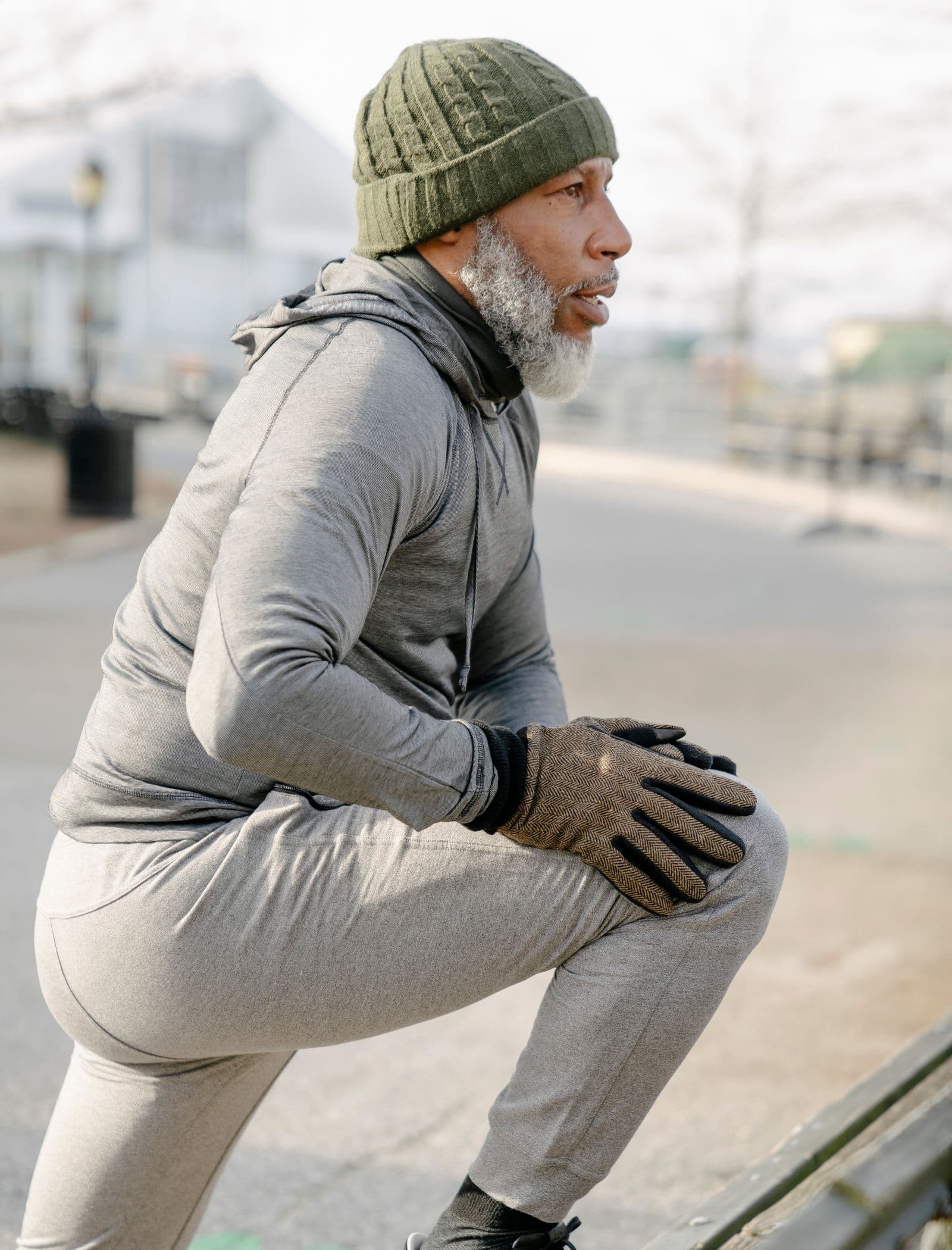
Assuming you cleared the three tests, here's the shape I use with clients coming back.
Weeks one and two are the rehearsal dose, three times a week. Six rounds of one minute jogging and two minutes walking. Resist adding to it even though you can, because the point of these two weeks is giving tendon and bone a consistent, unremarkable signal.
Weeks three and four, extend the jogging intervals rather than adding sessions. Two minutes jogging and two walking, then three and two. Same three days a week. Keep the 48-hour check running in the background the whole time.
Keep lifting through all of it. Calf raises twice a week, and something for the hips and glutes. Strength work is what raises the ceiling that running keeps bumping into, and dropping it when running starts is how people end up back where they were.
Then retest the calf raise at week four. If your number went up and your legs still match, keep going and start applying the gradual-increase advice, which by then is finally answering the right question for you.
If you want a fuller picture before you start, the free movement screen scores six areas including ankles, hips, and single-leg control in about five minutes, no email required. It's the same assessment I run with new clients, and for returning runners it usually finds the ankle or hip restriction that would have shown up at week five anyway.
And if you've tried to come back to running twice already and something has broken both times, that pattern is worth solving properly rather than attempting a third time with the same setup. That's what one-on-one training is for. I've logged more than 12,000 sessions with adults around San Jose and the South Bay. The guy with the Achilles runs three mornings a week now. He got there by spending six weeks not running, which he'll tell you was the least appealing and most useful advice he got.
Ready to train smarter?
Get a personalized program built around your goals, your body, and your schedule.
Book Your Free ConsultationRelated Articles

Getting Back Into Pickleball, Tennis, or Golf After 40? Test Your Body First
A San Jose trainer's self-test for pickleball, tennis, and golf injury prevention over 40, plus the 4-week return-to-sport bridge that gets weekend warriors playing without the setback.

Am I losing muscle? A four-part sarcopenia self-test you can score at home
Sarcopenia has clinical cutoffs you can test with a chair, a tape measure, and a hallway. A San Jose trainer walks through the four screens, what a low score actually means after 50, and what to do about each cause.
Morning heel pain? At-home tests for plantar fasciitis, and why the first step after sitting hurts most
Heel pain in the morning that eases as you walk is the classic plantar fasciitis pattern. Three at-home self-tests to confirm it, a way to find what's driving yours, and the strength program the trials support, from a San Jose trainer.