
Morning heel pain? At-home tests for plantar fasciitis, and why the first step after sitting hurts most

Jeffrey Sun, ACE-CPT
October 15, 2026 · 14 min read
ACE-certified personal trainer specializing in functional movement, mobility, and strength training for busy professionals in San Jose and the Bay Area.
Book a free consultation →
A product designer in Cupertino bought a standing desk and a walking pad in the same week in January. By March, getting out of bed felt like stepping on a thumbtack. The first ten steps to the bathroom were the worst of the day, then it faded, then it came back every time she stood up after a long meeting.
She'd read that it was plantar fasciitis and that she should roll a frozen water bottle under her foot. She did that for six weeks. It felt nice for about twenty minutes each time.
Sharp heel pain on the first steps that eases as you walk is about as recognizable as foot problems get. But "it's plantar fasciitis" only gives you a label. It doesn't tell you why your foot stopped tolerating its load, or how much you can safely ask of it now. The three tests below check the label and score how irritated your heel is. After that comes a look at what's driving it, and the program the trials support. None of it is a diagnosis, and the last section covers what should go to a doctor.
What's actually hurting
The plantar fascia is a thick band of connective tissue running from the bottom of your heel bone to the base of your toes. It holds up the arch, and every time you push off and your toes bend back, it tightens like a cable. Plantar fasciitis is irritation where it attaches to the heel, usually at the front inner edge of the heel pad.
The morning pain has a simple explanation. Overnight, and during a long stretch at your desk, your foot rests pointed slightly downward. The fascia and calf settle into a shortened position. Then you stand up and ask that irritated tissue to stretch suddenly under your full body weight. A few minutes of walking and it tolerates the load better, which is why the pain fades. Hours on your feet later in the day can bring it back as an ache.
That's also why desk workers get a double dose. You get the first-step pain in the morning and again every time you stand up after an hour of sitting.
It's also slower to clear than most people expect. In a Danish follow-up study by Hansen and colleagues in the Orthopaedic Journal of Sports Medicine in 2018, 174 patients diagnosed with ultrasound were tracked for up to 15 years. The risk of still having symptoms was 80 percent one year after onset, 50 percent at five years, and 44 percent at fifteen. Women and people with pain in both heels did worse. That's the strongest argument I know for doing something structured early rather than waiting it out.
Test 1: the big-toe lift (windlass test)
Because the fascia tightens when the big toe bends back, bending it back on purpose is a way to provoke it.
Stand barefoot next to a counter for balance. Slide a thick paperback or a tightly rolled towel, about two inches high, under just the big toe of the sore foot so the toe bends upward while the rest of the foot stays flat. Shift most of your weight onto that foot and hold for 30 seconds.
Positive: Your familiar pain shows up at the inner heel or along the arch.
Negative: Nothing at the heel, or only a stretch under the toe.
Read the result in one direction only. In a 2003 study in Foot & Ankle International, De Garceau and colleagues ran the standing version on 22 people with plantar fasciitis, 23 with other foot pain, and 30 with no foot pain. It was positive in only 7 of the 22 with plantar fasciitis, about a third. But it was positive in nobody else. So a positive result is a strong sign you're dealing with the fascia. A negative result tells you very little, and most people with plantar fasciitis will get one.
Test 2: the press map
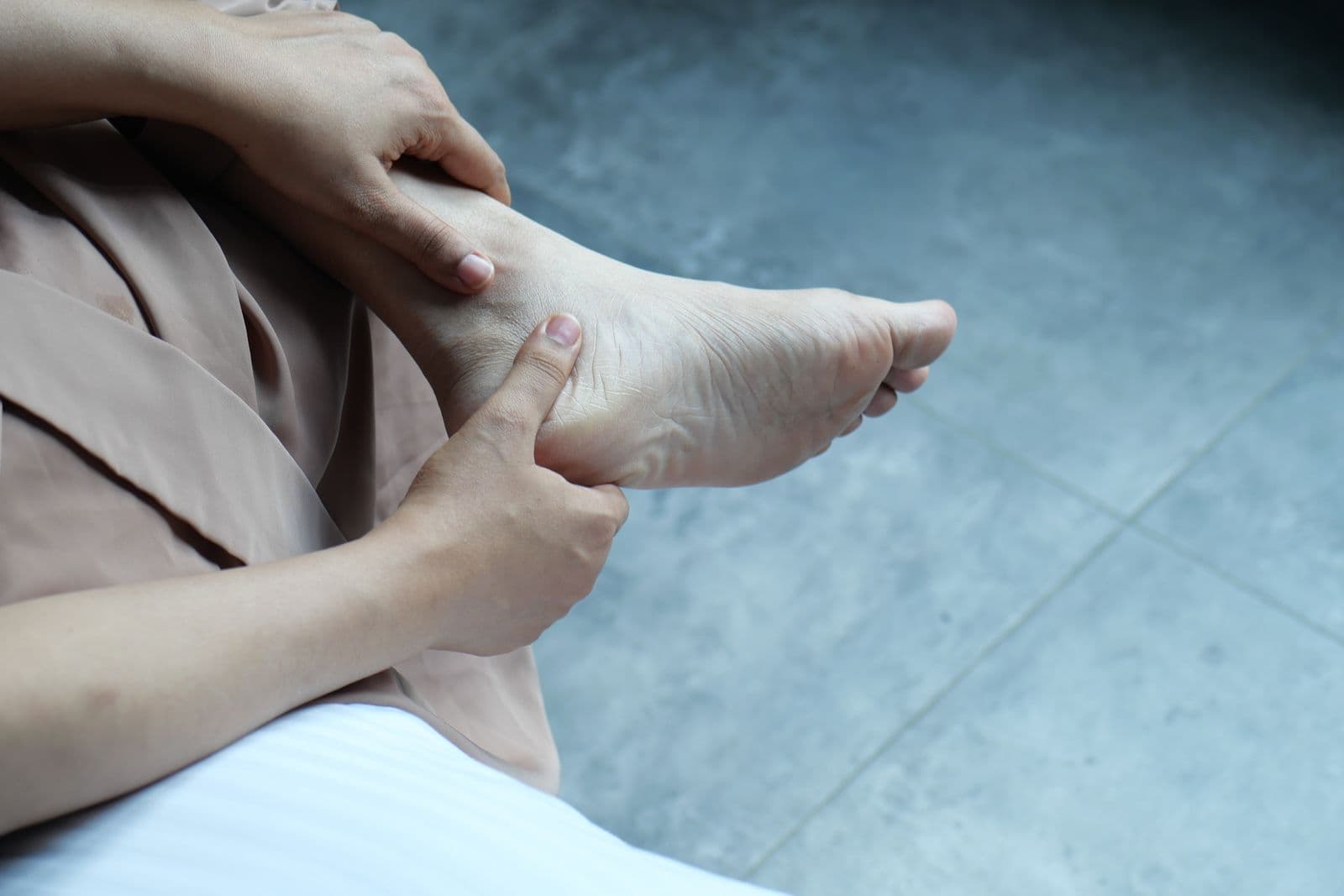
Several things hurt in the heel, and they live in slightly different places. This test is about where your pain is, because that's what separates the fascia from its neighbors.
Sit and cross the sore foot over your opposite knee. Pull the toes back with one hand so the fascia tightens, then press firmly with the other thumb at each of these spots, one at a time:
- The front inner edge of the heel pad, where the heel meets the arch. Tenderness here, sharpened by pulling the toes back, is the plantar fascia pattern.
- The middle of the heel pad. Diffuse, bruise-like tenderness here that doesn't change when you pull the toes back fits a fat pad problem more than the fascia.
- The back of the heel and the cord just above it. That's the Achilles tendon. If this is where it hurts, this post isn't about your heel.
- A squeeze from both sides. Cup the back of the heel and squeeze the sides together firmly. Pain here is a reason to see a doctor, since it can be a stress fracture of the heel bone.
- Just below the inner ankle bone. Tap there a few times. Burning, tingling, or electric pain into the arch points toward a nerve.
Plantar fascia pattern: Spot 1 is your sore spot, and the others are quiet.
Something else: Your worst spot is 2, 3, or 5.
Stop and get it checked: Spot 4 hurts.
Test 3: a two-day first-step log
This one scores how irritated your fascia is, which matters more than the label because it sets how hard the program starts. Over two ordinary workdays, write down:
- Morning first steps. Pain from 0 to 10 for your first ten steps out of bed, and how many minutes until it settles.
- After sitting. The same two numbers the first time you stand up after sitting for 45 minutes or more.
- End of day. Whether the heel aches by evening, and how much.
Take the worse of the two days.
Low irritability: First steps at 3 out of 10 or less, settling within five minutes, with little or no evening ache.
Moderate: First steps at 4 to 6, or taking 5 to 15 minutes to settle.
High: First steps at 7 or more, taking longer than 15 minutes to settle, or an ache that builds through the day and is worse by evening than it was at lunch.
Keep the log. You'll redo it at week six, and it's the most honest measure of whether anything is working.
What's driving yours
Plantar fasciitis is usually described as overuse, which is true but unhelpful. Overuse means the load on the fascia outran what the foot could handle, and there are a few different ways that happens. Most people have more than one.
The load jumped. This is the one I see most in desk workers, and it often comes from a change that was meant to be healthy. A new standing desk used for four hours on day one. A walking pad. A new job or a move that has you on your feet more. Working from home barefoot on hardwood or tile, where you used to wear shoes at the office. In a case-control study by Riddle and colleagues in the Journal of Bone & Joint Surgery in 2003, 50 people with plantar fasciitis were compared with 100 matched controls. Those who spent most of their workday on their feet had 3.6 times the odds.
The ankle is stiff. In the same Riddle study, ankle range was the biggest factor by far. People whose ankle couldn't bend upward past neutral had 23 times the odds of those with more than 10 degrees. But a similar study by Irving and colleagues in BMC Musculoskeletal Disorders in 2007, comparing 80 people with chronic heel pain against 80 matched controls, found the opposite: the heel pain group actually had more ankle range. Nobody has settled this. My read is that a genuinely stiff ankle is worth fixing whether or not it caused your heel pain, and a normal one isn't worth chasing. The knee-to-wall test tells you which you have in about two minutes.
The foot rolls in. Irving's study found people with a flatter, more pronated foot posture had 3.7 times the odds. A foot that collapses inward stretches the fascia further on every step. The foot arch tests show whether that's you, and the short-foot exercise in that post fits alongside the program below.
Body weight. Both studies found an association with a BMI of 30 or more, an odds ratio of 5.6 in Riddle and 2.9 in Irving. It's a load factor like the others: more weight per step means more load on the fascia per step. I mention it because it's in the research, not because the program below depends on it. The strength work helps the foot handle whatever load it's carrying.
The foot and calf can't take much load. This is the premise behind the strength program rather than a proven cause. Irving found no difference in calf endurance between the two groups. But the trial below suggests that building capacity is one of the faster ways out, whatever got you in.
The program: 12 weeks
The 2023 clinical practice guideline from the orthopedic section of the American Physical Therapy Association gives its strongest recommendations to plantar fascia and calf stretching, foot taping, and, for people who consistently have first-step pain, a night splint for one to three months. Strength training is recommended too, with a lower grade of evidence. Shoe inserts are recommended only alongside other treatment, not on their own. So the program combines them.
The pain rule throughout: up to 4 out of 10 during exercises is fine. The thing to watch is your first-step score the next morning. If it's up more than a point from your usual, back off a step.
Weeks 1 and 2: calm the first steps, adjust the load.
The stretch is for the first-step pain specifically. Before you get out of bed, and before you stand up after a long sit, cross the sore foot over the opposite knee, hold the base of the toes, and pull them back toward your shin until you feel a stretch along the arch. Hold 10 seconds, ten times.
That's the stretch from DiGiovanni and colleagues' 2003 trial in the Journal of Bone & Joint Surgery. They randomized 101 people with heel pain of at least ten months to it or to a standard calf stretch. After eight weeks the fascia-specific stretch did better on first-step morning pain, which was the item it was designed for. By the two-year follow-up, after everyone had been switched to the fascia stretch, the groups looked the same and most people reported being satisfied.
Then the load changes:
- Standing desk: go back to 30 to 45 minute standing blocks, alternated with sitting, and build up again over a few weeks. Pause the walking pad.
- At home: wear supportive shoes or slippers with some heel on hard floors for now, rather than going barefoot all day.
- Exercise: keep walking and cycling. Swap running, jumping, and long hikes for something easier on the feet for a couple of weeks if your log scored high.
- Taping and night splints are worth trying if your first-step score is moderate or high. A physical therapist can show you a taping method in five minutes.
Weeks 1 to 12: heavy, slow heel raises, every other day.
This is the strength protocol from Rathleff and colleagues' 2015 trial in the Scandinavian Journal of Medicine & Science in Sports. Stand on the sore foot on a step, with a rolled towel under your toes so they bend back at the top of each rep. The towel is the point: it turns on the windlass from Test 1, so the fascia is loaded on every rep. Rise up on one foot over three seconds, hold for two at the top, lower over three. Rest two minutes between sets.
- Weeks 1 and 2: 3 sets of 12, at a difficulty where 12 is about all you can do.
- Weeks 3 and 4: 4 sets of 10, adding a backpack with books in it to keep it hard.
- Week 5 onward: 5 sets of 8, adding weight to the backpack as it gets easier.
If your log scored high, or one leg is too painful to start, do the first two weeks on both feet and move to single-leg once your first-step score drops.
In the trial, 48 people with ultrasound-confirmed plantar fasciitis all got shoe inserts, then were split between this program and daily fascia stretching. At three months the strength group's foot function score was 29 points better. At six and twelve months, the two groups were the same.
So strength got people better sooner, and stretching caught up. If you have a few minutes every other day and a step, the heel raises probably shorten the bad stretch. If you'd rather do something quick every morning, the stretch gets you to the same place over a longer runway. Most of the people I work with do both, because the stretch helps the first steps and the heel raises build the capacity that keeps it from coming back.
How long it takes, and when to see a doctor
Expect your first-step score to start moving in two to four weeks if the load changes have taken. Strength gains show up over six to twelve weeks. If a heel spur showed up on an X-ray, that matters less than people think: in the Hansen study, having a heel spur at diagnosis made no difference to the long-term outcome.
Get it looked at if any of these apply:
- The heel hurts when you squeeze it from both sides, or the pain gets steadily worse with every step instead of easing, especially after a jump in walking or running. That's a stress fracture until proven otherwise.
- Numbness, burning, or tingling in the heel or arch.
- Visible swelling, redness, or warmth.
- Both heels hurt along with other joints, or you're stiff for more than half an hour every morning in places other than your feet. That pattern belongs with a rheumatologist.
- A sudden pop and sharp pain in the arch during a push-off or a jump.
- You have diabetes with reduced feeling in your feet.
- Six to eight weeks of consistent work with no change in your first-step log.
A podiatrist or sports physician can also talk you through injections and shockwave therapy, which sit outside a trainer's lane.
Retest at week six, and where to go from here
At six weeks, redo the first-step log over two days and compare. You're looking for a lower morning score, a shorter time to settle, and less evening ache. Redo the press map too. Tenderness at spot 1 often lags behind the first-step score, so don't be discouraged if pressing still hurts. Keep going to twelve weeks either way, since the heel raises are still getting heavier at that point.
The foot is the bottom of a chain, and whether the ankle bends, how the arch holds up, and how well the hips control each step all change how much the heel takes. If you want a broader read, the free movement screen checks six areas in about five minutes, ankle mobility included, and doesn't ask for an email. It's the same assessment I start new clients with.
If you'd like someone to build the heel raise progression into a full program and adjust it as your log changes, that's what one-on-one training is for. I've logged more than 12,000 sessions with adults around San Jose and the South Bay, and a standing desk shows up in the history of a surprising number of heel pain stories.
The Cupertino designer kept the standing desk. She dropped to 30-minute standing blocks, did the toe-pull stretch before her feet touched the floor, and did her heel raises on the bottom stair with her laptop bag on her back. Her first-step score went from a 7 to a 2 in about seven weeks. The walking pad came back in May, on a ramp-up schedule she complains about to this day.
Ready to train smarter?
Get a personalized program built around your goals, your body, and your schedule.
Book Your Free ConsultationRelated Articles

Cardio Fitness Test at Home: 3 Checks for Desk Workers Over 40
Three at-home tests that score your aerobic fitness without a lab: a timed stair climb, your one-minute heart rate recovery, and the three-minute step test. What each result means, and the six-week plan that moves them. A San Jose trainer's guide.

Return to Running After 40: 3 Tests to Take Before Your First Run
Your cardiovascular system comes back in weeks. Your tendons take months. Three at-home tests that tell you whether your legs can absorb running load yet, using the numbers physios actually use. A San Jose trainer's guide.

Buttock pain when sitting? At-home tests to tell a hamstring tendon from a trapped nerve
Buttock pain when sitting usually comes from one of two places: the hamstring tendon at the sit bone, or the sciatic nerve deep in the buttock. Three at-home tests to tell them apart, and a plan for each, from a San Jose trainer.