
Ankle Mobility Test at Home: Fix Tight Dorsiflexion in 10 Minutes

Jeffrey Sun, ACE-CPT
April 18, 2026 · 13 min read
ACE-certified personal trainer specializing in functional movement, mobility, and strength training for busy professionals in San Jose and the Bay Area.
Book a free consultation →
The ankle is the joint most people ignore until it starts causing them problems somewhere else. Knees that ache on the stairs. A squat that folds forward at the bottom. A calf that stays tight no matter how many times you stretch it. A knee-to-wall measurement under three inches is a reliable predictor of all three, and most desk workers I test in San Jose are sitting somewhere around two.
The fix isn't complicated. Five minutes of the right drills, done a few times a week, moves the number in a direction you can actually feel. But first you have to know what your starting point is, and that's a five-minute test you can run on your kitchen floor.
Why ankle mobility matters more than you think
Your ankles are the ground floor of the kinetic chain. Everything above them, knees, hips, lower back, has to compensate when the ankle runs out of range. Most of the time, that compensation is the actual injury.
The specific range that matters for most movement is called dorsiflexion. That's the motion of pulling your toes up toward your shin, or, more usefully, the motion of your shin bone traveling forward over your foot when your heel stays planted. You use it every time you squat, walk down stairs, land from a jump, or push off during a run.
When dorsiflexion is limited, the body finds workarounds. The knee caves inward. The heel lifts. The torso pitches forward. The low back arches to stay upright. None of those compensations are neutral. Each one adds wear to a different joint and usually shows up as pain weeks, months, or years later. The most common pattern I see is desk workers whose knees ache from long sitting sessions when the actual driver is a locked ankle two segments below.
Desk workers lose ankle mobility for a couple of reasons, and they stack. Sitting with the foot relaxed or plantarflexed lets the calf shorten over months of repetition. Heeled shoes, even a small everyday heel, quietly accept a shorter calf as the new normal. And most people never load the ankle in a way that challenges the end range, because the movements that do (deep squats, runner's lunges, uphill hiking) are the exact movements they avoid once they notice their ankles feel tight.
The good news is that dorsiflexion is one of the more trainable ranges in the body. I've had clients move their knee-to-wall score two full inches in six weeks of consistent work.
The knee-to-wall test: step-by-step
Of the dozen or so ankle mobility tests physical therapists use, the knee-to-wall is the one I keep coming back to. It's simple, it requires nothing, and the measurement you get correlates well with real-world squat depth, walking gait, and knee pain risk.
Here's the setup.
Find a blank stretch of wall and a clear floor. Take your shoes off. A tape measure helps but isn't required if you use a fixed reference like the line where a tile meets the next one.
Kneel in front of the wall, then stand up into a half-kneeling lunge so one foot is flat on the floor, toes pointing straight at the wall. Slide that front foot away from the wall, gradually, while trying to drive your knee forward to touch the wall directly in front of your toes. Your heel has to stay on the floor the entire time. The second your heel lifts, the rep doesn't count.
Find the farthest distance from the wall at which your knee can still touch while the heel stays down. Measure from your big toe to the wall.
Repeat on the other side. Take the best of two or three attempts per foot. Don't bounce. Don't force the knee past what it wants to do.
What you're measuring is how many inches of clearance you have between your toe and the wall when your knee touches. That number is your score.
Pass: 4 to 5 inches (roughly 10 to 13 cm) with the heel planted. This is the range most adults need to squat, run, and live without ankle compensation leaking up the chain. Borderline: 2.5 to 4 inches. Enough to survive most daily movement but you'll hit a ceiling in lifts and your knees are probably taking extra load. Fail: Under 2.5 inches, or the heel lifts before the knee gets close. This is where squat depth is usually limited, knee pain on stairs shows up, and the calves stay tight in a way that stretching hasn't been touching.
What your score actually means
One score on its own doesn't tell you much. The pattern across both ankles does.
If both ankles come in under 2.5 inches, you've got a bilateral mobility problem. It's almost always a long history of desk sitting plus heeled shoes plus calves that have never been loaded at end range. The fix is consistent daily work on both sides for four to six weeks before you'll see a meaningful shift.
If one ankle is noticeably better than the other, say 4.5 on one side and 2 on the other, that asymmetry is usually pointing to an old sprain. Even an ankle sprain from ten years ago that you thought healed often leaves lasting stiffness in the joint capsule. The knee on that side is picking up the slack, and that's where I start asking about knee pain history.
If the heel lifts before the knee gets within a few inches of the wall, your calves, especially the soleus, are the limiter. The soleus is the deeper calf muscle that does most of the work at the end range of dorsiflexion, and it's the one that responds best to knee-bent stretching, not the classic straight-leg calf stretch most people default to.
If the knee touches easily but something at the front of the ankle feels pinched, that's a joint-level restriction, often tied to old sprains. This one responds better to banded distraction work than to calf stretching.

Why your ankles got tight in the first place
Understanding the mechanism matters because it tells you what to fix.
Sitting shortens the calves. Your ankles spend most of the workday at roughly 90 degrees, with the calf unloaded and slightly shortened. Do that for eight hours a day for a decade and the tissue adapts. The muscle gets shorter at rest. The fascia gets stiffer.
Heeled shoes accelerate the same thing. Even the half-inch heel in a dress shoe keeps the calf in a shortened position all day. Over years, the calf treats that length as baseline and fights anything that asks it to lengthen past there.
Old ankle sprains stick around. A bad roll in high school sports can leave the joint capsule thickened and restricted in a direction you can't fix with stretching alone. This is the ankle that needs banded distraction or mobilization work.
Calf dominance during running or hiking is another one. Runners who spring off their calves rather than pushing through the hip tend to end up with strong, short calves and locked-down ankles. If you're a regular runner who fails this test, the calves need work but the hip drive might also need to be rebuilt.
The 10-minute fix: 5 drills that actually work
Do all five in order. The whole thing takes about ten minutes. Three times a week moves the number. Daily moves it faster.
1. Banded ankle distraction, 60 seconds per side
Loop a heavy resistance band around a pole or a low table leg at ankle height. Slip the band high around the front of your ankle, as far back as it will go toward the joint line. Step back until there's strong tension pulling your ankle forward.
Drop into a half-kneeling position with that leg forward, foot flat on the floor. Rock your knee forward over your toes, keeping the heel planted. The band is pulling your talus forward in the socket, opening up the front of the joint where it tends to jam.
For anyone with an old ankle sprain, this is the drill that does the most work. Joint-capsule restrictions don't respond well to stretching, but they do respond to a pull on the joint while you actively rock through dorsiflexion.
2. Knee-bent wall calf stretch (soleus), 45 seconds per side
Stand facing a wall. Put one foot about a foot away from the wall, the other foot back. Bend both knees. Press the front knee forward toward the wall while keeping the back foot flat on the floor.
The bent back knee is what makes this a soleus stretch rather than a gastrocnemius stretch. Most people do the straight-leg version and wonder why their calves never seem to change. The soleus is the deeper calf muscle that actually limits dorsiflexion at end range, and it only stretches under a bent knee.
You should feel the stretch deep in the calf, not behind the knee. If you feel it behind the knee, you've drifted back into the straight-leg version.
3. Weighted knee-to-wall, 10 reps per side
Set up like the original knee-to-wall test. Place a dumbbell, a weight plate, or a kettlebell on the front of your knee, pressing down gently. The weight bias loads the ankle into dorsiflexion slightly past what it would choose on its own.
Rock your knee forward to touch the wall, heel down, then slowly back. Ten slow reps. Keep the weight centered and the heel glued to the floor.
This is an end-range strengthening drill for the ankle. Passive stretching alone rarely moves the number past a certain point. Loading the joint at end range is what moves it.
4. Deep toe sit, 30 seconds
Kneel on the floor. Tuck your toes under so your heels are pointing up and the balls of your feet are on the ground. Slowly lower your butt toward your heels, letting your body weight stretch the bottom of your feet, arches, and plantar fascia.
This one bypasses the calf entirely and works on the foot. Most desk workers have tissue restrictions running through the sole of the foot that nobody thinks to address, and ignoring them leaves dorsiflexion stuck.
If this is brutal on day one, start with just 10 seconds and build. It gets easier fast.
5. Dynamic dorsiflexion march, 20 steps
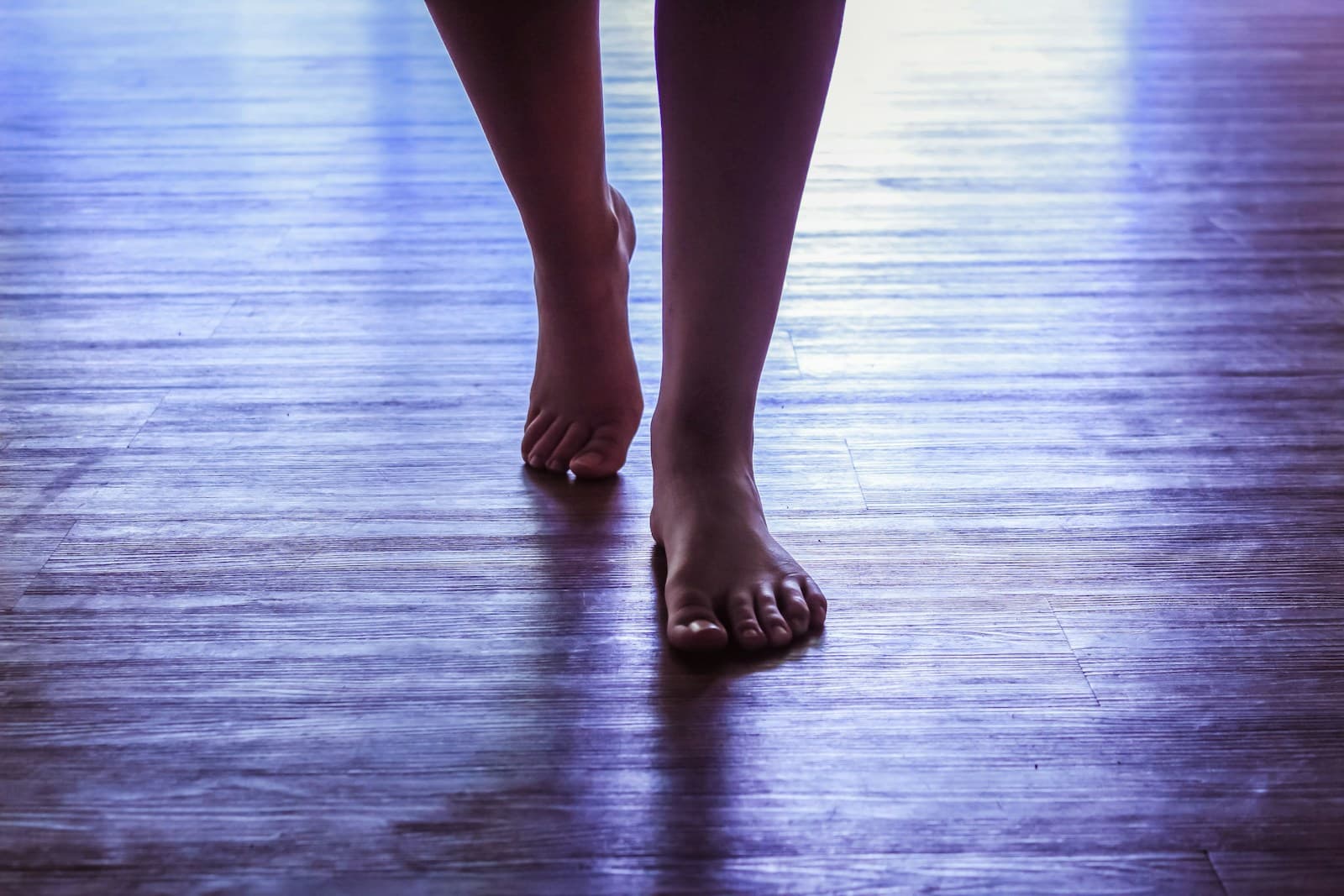
Walk across the room exaggerating the dorsiflexion with each step. As your lead leg swings forward, actively pull the toes up toward your shin as aggressively as you can. Land on the heel. Then roll through.
You're not trying to cover ground. You're rehearsing the muscle pattern on the top of the shin, the tibialis anterior, which is weak in almost every desk worker I test. A tight calf and a weak shin muscle are usually a package deal.
How often and how to re-test
Twice a day for ten minutes is overkill unless you're actively rehabbing from an injury. Three sessions a week is what I program for most clients. Stacking it onto an existing warm-up is easier than fitting a separate session, so I'd just tack it onto the front of whatever you already do.
Re-test every two weeks, same time of day, same foot order. Same conditions matter because ankle mobility varies a lot between first thing in the morning (stiffer) and after you've been up and moving for a few hours (looser). Use the knee-to-wall test with a tape measure, record the number, and track it over six to eight weeks.
Most people see a real shift by week two, a meaningful one by week four, and a number they're happy with by week eight. If you're still under two inches after four weeks of consistent work, that usually means either the old sprain is doing more than I can fix with drills, or your calves are much tighter than the protocol handles. That's when I'd want someone looking at the ankle in person.
When tight ankles point to a bigger problem
Ankle mobility rarely exists in a vacuum. If yours came back poor, there's a decent chance other links in the chain are also limited.
Tight calves and stuck ankles almost always travel with tight hip flexors and stiff thoracic spines in the people I train who sit for a living. The same years of sitting that shorten the calves shorten the hip flexors and lock up the mid-back. I've written about the hip mobility test and the thoracic spine mobility test if you want to run the paired assessments on the floor. Worth checking the joint one step further down the chain too: a collapsing or overly rigid arch changes how much work the ankle has to do on every step, and it's the one link most people never think to test.
If you want the more complete picture in one pass, I built a movement screen that covers the whole body. Twelve questions, five minutes, no email. It runs through the same assessment I do with new clients and flags which areas, ankles included, are most limiting your movement. You come out with a downloadable one-week program built around your lowest-scoring regions.
FAQ
How much ankle mobility is enough?
For general daily movement, 4 inches on the knee-to-wall is plenty. For deep squatting, Olympic lifts, and pain-free downhill walking, I'd want to see 5 or more. Past that is rarely necessary unless you're dancing or doing sport-specific work. If it's the downhill part you care about, range is only half of it, and the descent capacity tests cover the braking strength that has to work alongside it.
Can ankle mobility be restored after 40?
Yes, and I've watched it happen plenty of times. The mechanism doesn't change with age. Tissue length responds to consistent stretching and end-range loading at 60 the same way it does at 25. The main difference is that older ankles with sprain history need more banded distraction work, not less.
Should I train ankle mobility barefoot or in shoes?
Do the mobility work barefoot or in flat, zero-drop shoes. Normal running shoes and lifting shoes with a raised heel undercut the very adaptation you're trying to create. Barefoot lets the foot feel the ground and engage the small stabilizers that shoes replace.
Is cracking or popping during the drills bad?
Not on its own. The ankle joint is small and it's common for it to release gas bubbles during mobilization. If a specific drill produces sharp pain (not just stretch), stop that one.
Where to go from here
If you came back with a failing score and you've been blaming your knees or your squat form for a while, now you know. The ankle might be where the fix actually lives.
The drills above cover most of what I'd have you do in a session anyway. If you want someone watching how you actually move and building a plan around your whole chain, not just the ankle, that's what one-on-one training is for. I've logged over 12,000 sessions, most with desk workers around San Jose and the Bay Area trying to get their bodies back from years of sitting. Ankles are a recurring theme.
Ready to train smarter?
Get a personalized program built around your goals, your body, and your schedule.
Book Your Free ConsultationRelated Articles

Sitting-Rising Test at Home: Score Yourself, Then Fix Your Weak Link
The sitting-rising test scores how well you get down to the floor and back up without support. How to run it at home, what your score actually means, and the four-week plan that adds points. A San Jose trainer's guide.
Hamstring Flexibility Test at Home: Score Your Tight Hamstrings
Three at-home hamstring flexibility tests with pass/fail thresholds and five drills to loosen tight hamstrings from sitting. A San Jose trainer's guide for desk workers.
Foot Arch Test at Home: Flat Feet or High Arches in 3 Minutes
A 3-minute self-test for flat feet or high arches, with the knee, hip, and lower back connections most podiatry checklists skip. A San Jose trainer's guide.