
Deadlift Setup for Over 30 Lifters: A Trainer's Guide

Jeffrey Sun, ACE-CPT
May 24, 2026 · 13 min read
ACE-certified personal trainer specializing in functional movement, mobility, and strength training for busy professionals in San Jose and the Bay Area.
Book a free consultation →
A new client tried to deadlift in his first session last month and the bar got about three inches off the floor before his lower back rounded hard. He looked up at me afterwards and said, "I thought I knew how to deadlift." He'd done them in his twenties for a few years. The pattern still felt familiar. The weight wasn't even heavy. But something had clearly changed.
That's the most common version of the deadlift conversation I have with new clients in their thirties and forties. They learned the lift at some point, they remember the cues, the bar feels like an old friend, and then their body refuses to set up cleanly. The strength is usually fine. What changed is the mobility, the resting joint positions, and the connective tissue stiffness that came with a decade at a desk.
The deadlift is one of the most useful lifts in any strength program, and one of the most form-sensitive. A clean setup makes the rest of the lift feel almost easy. A bad setup makes the lift feel ugly even with light weight, and increases the cost of any small mistake during the pull. The post you're about to read covers the conventional barbell deadlift setup, the four variations that work for bodies the conventional version doesn't fit anymore, the mobility prerequisites that make any of them land cleanly, and the common setup mistakes that quietly cost progress.
Why the setup matters more than the lift itself
A deadlift is mostly decided before the bar moves. Get the setup right and the pull is straightforward. Get the setup wrong and you spend the entire lift trying to correct the angles, with the spine taking the cost.
Three reasons the setup matters this much. First, the joint positions you start in are roughly the joint positions you finish in. If your back rounds at the start, it stays rounded under load. If your knees cave inward in the setup, they cave under tension. The lift doesn't fix bad position; it amplifies whatever you started with. Second, leverage is locked in by the setup. The angle of your torso, the distance of the bar from your shins, where your hips sit relative to your knees, all determine how hard the lift actually is at a given weight. Third, your nervous system commits to the pattern in the bottom position. Bracing, breath, glute and lat tension all need to be set before the bar moves. Adjusting them mid-pull is much harder than just setting them right at the start.
That's why technique-focused programs spend so much time on setup specifically. Five years of pulling clean reps starts with the first inch.
The conventional barbell deadlift setup
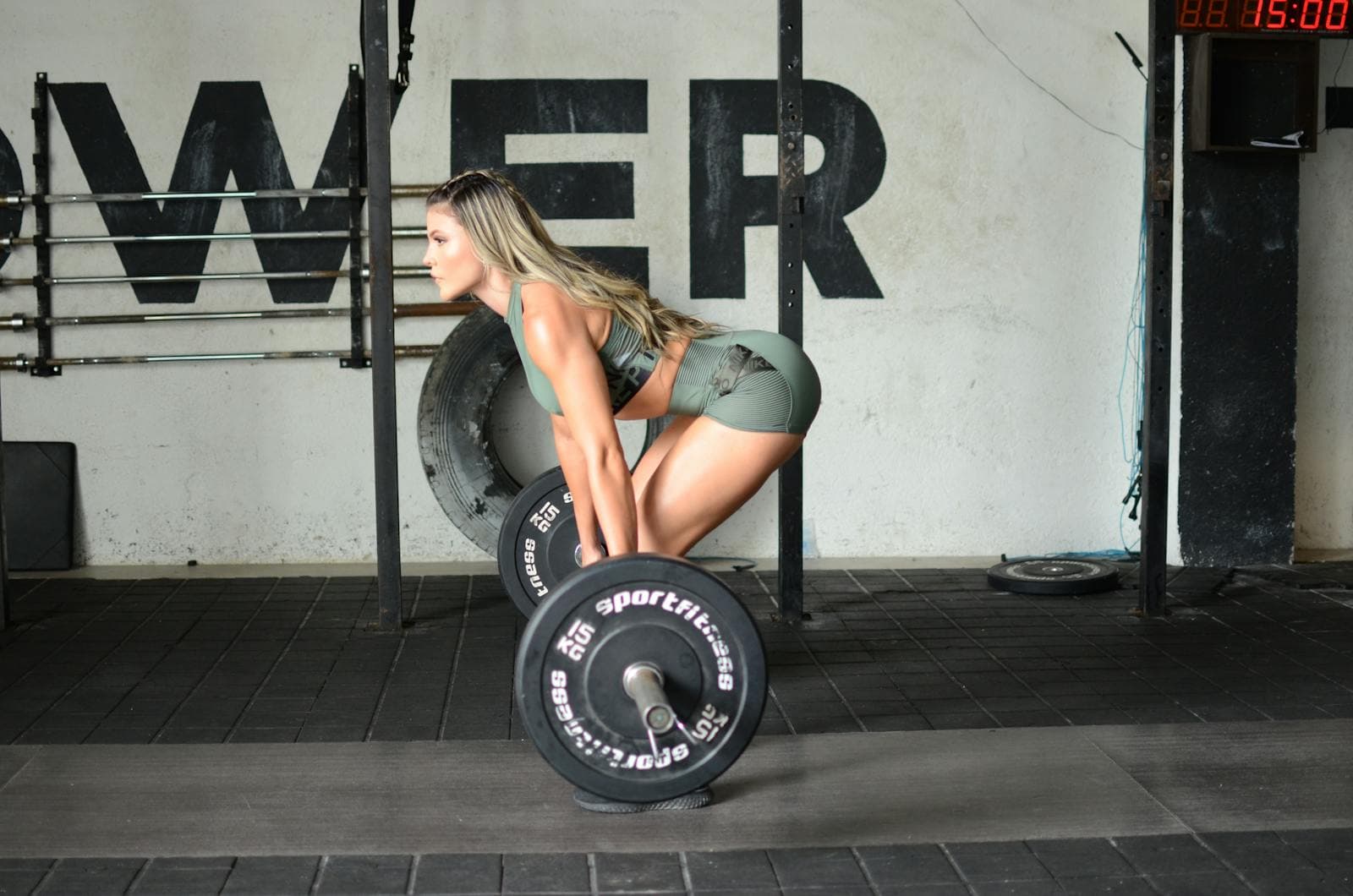
This is the version most lifters learn first, and the one that works for most people who can actually achieve the positions it requires. Here's the five-step sequence I teach.
Step 1: Bar position. Stand with the bar over the middle of your feet. The bar should be about an inch from your shins when you look down. Feet roughly hip-width apart, toes pointing forward or slightly out (about 5 to 10 degrees).
Step 2: Hip hinge to grip. Push your hips back as if reaching for a wall behind you. Keep your shins mostly vertical for now. Bend down to grab the bar with both hands just outside your knees. Use a double-overhand grip to start.
Step 3: Pull yourself down to the bar. This is the cue most people skip. With your hands on the bar, pull your chest up and toward the bar. The bar shouldn't move yet. Your hips drop slightly, your shoulders pull back over the bar, and you create tension throughout your back. Your shoulder blades should be roughly stacked over the bar.
Step 4: Brace and set the lats. Take a breath into your stomach (not your chest), brace your abs like you're about to be punched, and squeeze your armpits down toward your hips. This activates the lats and locks the bar against your body, which is the single most underrated technical cue in the lift. If the brace itself feels foreign or weak, that's usually a breathing pattern problem rather than a strength problem, and I wrote up how to breathe during heavy lifts as a separate piece for fixing it.
Step 5: Push the floor away. Drive your feet through the floor as if you're pushing the floor down rather than pulling the bar up. The bar tracks straight up along your body. Hips and shoulders rise together. Lock out by squeezing your glutes at the top, without leaning back.
That's the basic sequence. It works well for lifters who have decent hip mobility, hamstring length, and thoracic extension. For lifters who don't, one of the variations below usually fits better than forcing conventional.
When conventional doesn't fit (and what that looks like)
Most over-30 desk workers I assess can't conventionally deadlift cleanly on day one. The most common signs that the conventional version isn't working for your current body.
Your back rounds the moment you reach the bar. Hands haven't touched the bar yet and your spine is already in flexion. The cause is almost always hamstring length and hip flexion range — your body literally can't get you down to the bar with a neutral spine.
Your shins angle forward and your hips ride high. The bar is in front of your shins instead of touching them, and your hips are well above your knees. Looks more like a stiff-legged deadlift than a conventional pull. Same mobility cause as above, sometimes paired with quad stiffness keeping the knees from bending enough.
Your knees cave inward as you grip the bar. Hip mobility limits showing up at the knee. Could be tight adductors, weak glute medius, or both.
You can't keep the chest up without arching the lower back. Thoracic spine extension isn't sufficient to keep the torso position you need. The lower back compensates, which is a setup the spine doesn't love under load.
If two or more of those apply, conventional deadlift isn't the version that fits your body right now. That doesn't mean you can't deadlift. It means the right variation is something other than conventional.
Four variations that work for tighter bodies
Each variation solves a specific mobility constraint while still delivering the strength and longevity benefits of pulling something heavy from the floor. Pick the one that matches what your body is asking for.
Trap bar (hex bar) deadlift
The trap bar surrounds you instead of sitting in front of you. Hands are at your sides, not in front of your shins. The biomechanics shift toward a half-squat, half-deadlift hybrid that's more forgiving of limited hip mobility and tight hamstrings.
When this is the right call: tight hamstrings or hip flexion limits make conventional shins-vertical setup impossible. Or you're new to loaded hinging and want a forgiving entry point that still trains the pattern hard.
The setup is simpler. Step into the bar, feet roughly hip-width, hips back, grab the handles. The handles are usually about six inches off the floor, which acts like a built-in elevation. The pull is more knee-driven than conventional, which is exactly what most desk workers need.
Sumo deadlift
Wide stance, toes turned out 30 to 45 degrees, hands inside the knees rather than outside. The setup looks like a deep half-squat with the bar in front. Range of motion is shorter than conventional because the torso stays more upright.
When this is the right call: you have decent hip external rotation but limited hip flexion range. Or your spine doesn't tolerate the forward-leaned conventional torso angle but your knees and hips can open up wide.
The trade-off: sumo requires more hip mobility into external rotation specifically. If your hips can't open up wide, sumo creates its own problems. The 90/90 hip rotation test from the hip mobility post tells you whether your hips have the rotation range that sumo needs.
Elevated (block) pull
Start the bar two to four inches above the floor on blocks or stacked plates. Shortens the range of motion at the bottom, which is the part of the lift that demands the most hip and hamstring mobility.
When this is the right call: conventional setup is close but you can't quite get a clean position at the bottom. Or your shoulders sit too far in front of the bar at the bottom because hamstring length cuts your torso angle short.
This is the variation I use most often with new clients who want to work toward conventional but aren't there yet. As mobility improves, the elevation comes down by an inch or two over weeks until the bar is on the floor.
Romanian deadlift (RDL)
This one isn't a from-the-floor pull, it's a hinge pattern that builds the hamstring and glute strength conventional deadlift demands. Bar starts at hip level, you hinge down to roughly knee height keeping the bar against your legs the whole way, then drive the hips forward to return to standing.
When this is the right call: you can't get any from-the-floor variation to feel clean, and the priority is building the pattern and posterior chain strength before trying to pull from the floor. Two months of consistent RDL work usually creates enough hamstring and glute capacity that an elevated pull becomes accessible.
The hamstring flexibility test covers the underlying mobility piece in detail if hamstring length is the limiter. Treating the hamstring length first and then layering in RDL work is a faster path than fighting tight hamstrings with the deadlift directly.
The mobility prerequisites
Whichever variation fits you today, four mobility ranges quietly determine how the lift feels. Working on these alongside your deadlift training is what creates room for the harder variations later.
Hip flexion range. You need to be able to fold the femur up toward the torso while keeping the spine neutral. Most desk workers lose this fast. The hip flexion test from the hip mobility post is the cleanest baseline check.
Hamstring length. Tight hamstrings pull the pelvis under as you hinge, which forces the lower back to round to compensate. The active knee extension test from the hamstring flexibility post tells you exactly where you sit.
Thoracic spine extension. Holding chest up requires the upper back to extend. A stiff T-spine forces the lower back to overextend, or rounds the upper back into flexion. The wall angel test from the T-spine mobility post catches this.
Ankle dorsiflexion. Especially for conventional and trap bar variations. Locked ankles change shin angle, which changes everything above. The knee-to-wall test from the ankle mobility post is the quick check.
The free movement screen covers all four (plus shoulders and core) in five minutes. If you don't know which of the four is your bottleneck, the Screen is the cleanest way to find out.
Common setup mistakes and what they cost
Five mistakes I see constantly, and the cost of each.
Bar too far from the shins. The bar should be over the middle of your feet, about an inch from your shins at setup. Too far out and the lift becomes a stiff-legged variation regardless of intent, with the lower back taking more load than the legs.
Hips too high at the start. If your hips are above your knees in the setup, you're starting in a stiff-legged position. Drop the hips slightly, pull yourself down to the bar in step 3, and let the shoulders come over the bar.
No lat engagement. Most lifters set up everything but forget the lats. Without lat engagement, the bar drifts away from the body as it leaves the floor, which dramatically increases lower-back stress. Squeezing armpits toward hips before the pull is the cue.
Looking up. Some old-school cues say to keep the head up and eyes forward. That tends to push the lower back into extension and the cervical spine into a position it doesn't love under load. Neutral neck (eyes about 6 to 10 feet in front of you on the floor) is cleaner.
Lockout by leaning back. At the top of the lift, the cue is to squeeze the glutes and stand tall, not lean back. Leaning back hyperextends the lumbar spine and adds zero strength benefit.
How to know if your setup is good
Three self-checks worth running on the first set of every session.
The first inch test. The bar should leave the floor smoothly and travel straight up along your shins. If it swings forward away from your shins as it leaves the floor, your lats weren't engaged or your hips were too high. Reset and try again.
The shoulder check. At the lockout position, your shoulders should be over your hips, glutes squeezed, no lean. If you have to lean back to feel finished, you're hyperextending instead of completing the lift.
The spine reset. Between reps, the bar comes back to the floor, you re-brace, and you reset the lats before pulling again. Don't bounce reps. Each rep is a new setup. This habit alone protects the lower back across hundreds of training sessions.
Where to go from here
If your conventional deadlift doesn't feel right, the move isn't usually to push harder through it. The move is to figure out which mobility limit is the actual bottleneck and either work on it directly or pick a variation that respects it. Both work, and they're not in competition. Most lifters I train start with one variation as the main lift and another as an accessory for the first six months. From there, some transition to conventional as their mobility catches up; others stay on trap bar or sumo for years because that variation fits their body better. Neither path is the "right" one.
If you want to know which axis is most likely limiting your setup, the free movement screen scores the six joints that matter most for the deadlift. Twelve questions, five minutes, no email. It runs the same assessment I use with new clients before we put weight on the bar.
If you want to pair the technique work with the broader strength framework, the strength training for longevity post covers the five movement patterns the deadlift belongs to, and the warm-up post covers the pre-lift prep that specifically matters for hinge days.
If you want eyes on your actual setup and a program built around your specific limitations, that's what one-on-one training is for. I've logged over 12,000 sessions, most with desk workers, hobbyists, and retired clients in San Jose and the Bay Area. The deadlift is one of the lifts I spend the most time coaching with new clients, because clean setup pays off across every rep that follows it.
Ready to train smarter?
Get a personalized program built around your goals, your body, and your schedule.
Book Your Free ConsultationRelated Articles
What to Do on Rest Days: A Strength Trainer's Guide for Over 30
Rest days aren't off days. Here's what active recovery, light mobility, walking, and sleep actually do for your strength training, and how to decide which version of rest your week needs.

Sleep and muscle recovery for strength training after 30: a coach's playbook
Sleep matters more than your workout for over-30 lifters. A San Jose trainer's guide to how poor sleep wrecks recovery, when to change your training, and what actually fixes the pattern for busy professionals.

How to breathe during heavy lifts: a desk worker's guide to bracing
Bracing falls apart for most desk workers because they've been chest-breathing for years. A San Jose trainer's guide to diaphragmatic breathing, the Valsalva maneuver, and how to breathe under real load.