
Sitting-Rising Test at Home: Score Yourself, Then Fix Your Weak Link

Jeffrey Sun, ACE-CPT
August 4, 2026 · 13 min read
ACE-certified personal trainer specializing in functional movement, mobility, and strength training for busy professionals in San Jose and the Bay Area.
Book a free consultation →
Since that longevity study went around last summer, clients have been trying this on my gym floor without being asked. They read a headline, get curious, sit down, stand back up, and then look at me for a number.
The number is the easy part. What almost nobody walks away with is the second half of the information: which specific thing cost them the points, and whether it's fixable.
One guy, late forties, deadlifts more than anyone else in his time slot. He got down to the floor without a problem. Coming up he rolled onto a hip, planted a palm, pushed off his own knee, and made it to standing. That's a 7. Nothing in three years of his programming had ever asked him to do that, so the score wasn't surprising, but it did irritate him.
This isn't medical advice. If you've had a knee or hip replacement, or you have a history of falls, check with your doctor before trying this on a hard floor.
What the sitting-rising test actually measures
A Brazilian sports medicine physician named Claudio Gil Araújo built this test in the 1990s to capture the parts of fitness a treadmill can't see. Aerobic capacity gets measured constantly. Strength, flexibility, balance, and body composition mostly don't, at least not in a doctor's office in under a minute.
Getting to the floor and back up needs all four at once. You need enough ankle and hip range to fold into a low position. You need enough leg strength relative to your own bodyweight to push out of it. You need the balance to stay over your base while your center of mass moves through a big arc, and the coordination to sequence it.
The 2025 study, published in the European Journal of Preventive Cardiology, followed 4,282 adults aged 46 to 75 for a median of 12.3 years. Natural-cause mortality was 3.7 percent among people who scored a perfect 10. It was 42.1 percent among those who scored 4 or lower. The line where the curve starts bending is around 8.
I want to be careful about what that means, because most of the coverage flattened it. Sitting on the floor does not extend your life. What the test does is read four systems that tend to decline quietly and on the same timeline, and it's that decline the survival curves are following. The score reports on something. It doesn't cause it.
How to run the test at home and score it honestly
Find a clear patch of floor with nothing to hit on the way down. Bare feet or grippy socks, and something you can move in. Stand near a wall if you feel unsteady, but the wall is for emergencies, not for the test.
The instruction is deliberately loose: sit down on the floor, then stand back up, using as little support as you can manage. Don't rush it. Speed isn't scored.
You start with 10 points, five for sitting down and five for standing up, and you subtract from there.
Minus 1 point for each support you use, scored separately on the way down and the way up. A hand on the floor, a forearm, a knee, the side of your leg, or a hand braced on your own knee. Each one costs a full point, and using two hands on the floor costs two.
Minus 0.5 points for a visible loss of balance on either half. A wobble you have to catch, a hand that shoots out and hovers, a lurch sideways as you come up.
Record it on your phone. This is the part people skip, and it's the part that matters. Almost nobody scores their own wobble accurately in real time, and a lot of people don't notice they braced a hand on a knee until they watch it back. Prop the phone against a water bottle, get your whole body in frame from the side, and run it twice. Take the better of the two.
What your score means at 35 versus 55
The bands are straightforward.
10 means you got down and back up with nothing but your feet and your seat touching the floor, no wobble either direction.
8 to 9.5 means you used one support, or came through clean with a balance deduction. This is still on the good side of the research threshold.
5.5 to 7.5 means you're using a hand or a knee on both halves, which is where most desk workers I test land the first time.
5 or below means the transition has become genuinely hard and you're building the descent around whatever body part you can get under yourself.
Age changes how much weight to put on that number, and this is where the online coverage gets sloppy. The mortality data comes from adults between 46 and 75. Nobody has shown those survival curves apply to a 32-year-old, and it's a real stretch to assume they do.
At 35, a 6 isn't a health warning. It's a mobility report card, and it usually means your ankles and hips have gotten narrow from sitting rather than anything systemic. At 55, the same 6 is worth more of your attention, because that's inside the age range where the research actually lives and where the four systems it measures start declining on their own without training to hold them up.

Why desk workers lose points: the four usual culprits
After running this with a lot of Bay Area professionals, the deductions cluster into four causes. Most people have two of them.
Stiff ankles. To sit down through a controlled squat you need your knee to travel well past your toes, which takes real dorsiflexion. When the ankle runs out of range, your heels lift, your weight falls backward, and you put a hand down to catch yourself. That's a point, and it's the single most common one I see.
Limited hip range. The cross-legged landing needs external rotation and enough adductor length to let your knees drop toward the floor. When the hips don't rotate, you land heavy on one side, and the way back up starts from an awkward position instead of a stacked one.
Not enough leg strength through a deep range. Plenty of people who squat well in a gym are only strong down to parallel. The floor is a lot lower than parallel. Standing from a full cross-legged position is close to a one-legged effort at the hardest point, and a hand on the knee is what fills the gap.
A balance system that's out of practice. This is where the half-point deductions come from. Your center of mass travels a long way in this movement and your base changes shape three or four times along the route. If your ankles and hips haven't had to stabilize through anything unpredictable in a decade, the wobble shows up here first.
Find your weak link with three follow-up checks
Your total score tells you there's a problem. These three tell you where it is. Ten minutes, same floor.
Check 1: the deep squat hold. Feet about shoulder width, toes turned slightly out, squat down as far as you can and try to sit there for 30 seconds with your heels flat.
Pass: 30 seconds, heels down, no hands. Borderline: You get to the bottom but your heels lift, or you can only hold it for a few seconds. Fail: You can't get below parallel without falling backward.
A borderline or fail here points at ankles first. Confirm it with the knee-to-wall ankle mobility test, which isolates dorsiflexion cleanly instead of letting your hips hide the problem.
Check 2: the cross-legged floor sit. Sit cross-legged, hands off the floor, and try to sit tall for 60 seconds.
Pass: Knees settle at or below hip height, spine stays upright, no hands needed. Borderline: You can sit but your knees float high and your lower back rounds to compensate. Fail: You have to prop on your hands behind you, or your knees stay dramatically higher than your hips.
That's a hip rotation problem, not a flexibility-in-general problem. The 4-test hip mobility check will tell you which direction is actually restricted.
Check 3: the half-kneeling stand-up. From half kneeling, one knee down and one foot forward, stand up without using your hands. Both sides.
Pass: Clean on both sides, no push off the thigh. Borderline: You get up but you need a hand on your knee, or one side is clearly worse. Fail: You can't stand from half kneeling on either side without pushing off something.
This one is strength and single-leg control. If Checks 1 and 2 were fine and this is the one that fell apart, the problem isn't your range, it's what you can produce inside it. The single-leg balance checks will separate a strength issue from a stability issue.
A four-week plan to add points to your score
Five drills, matched to the four culprits plus the skill itself. Fifteen minutes, four days a week. Retest at the end of week four.
1. Banded ankle mobilization, 2 sets of 10 each side
Loop a band around your ankle just above the joint, anchored low and pulling backward. Step into a lunge and drive your knee forward over your toes, keeping your heel glued down. The band pulls the joint into a position it can't reach on its own.
This is the fastest-moving of the five. Ankles that have been stiff for years often give up noticeable range inside two weeks.
2. 90/90 hip switches, 8 each side
Sit with both knees bent at 90 degrees, one leg in front and one out to the side. Rotate through the middle to switch which leg is in front. Move slowly and keep your chest tall.
This trains both directions of hip rotation, which is what the cross-legged landing needs. It's also the drill I open the most sessions with.
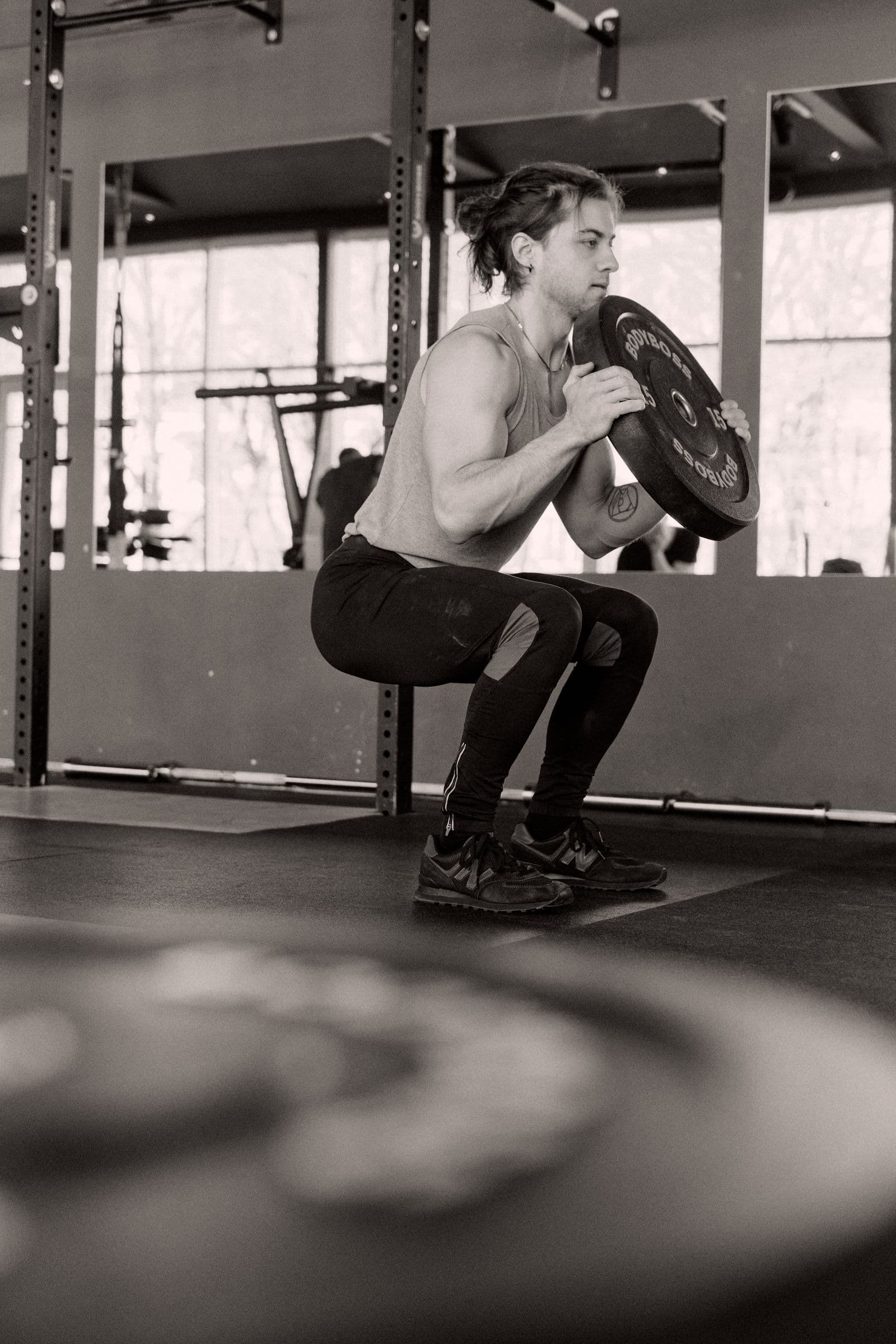
3. Prying goblet squat, 2 sets of 8
Hold a dumbbell or kettlebell at your chest and squat as deep as you can. At the bottom, use your elbows to gently press your knees out, and rock side to side for a few seconds before standing.
Holding the weight in front acts as a counterbalance, which lets most people reach a depth they can't hit with bodyweight alone. That's the point: you're teaching your body the bottom position under control.
4. Half-kneeling to standing, 2 sets of 6 each side
Start in half kneeling, back knee down, front foot flat. Drive through the front heel and stand without touching anything. Lower back down under control, which is the harder half.
This is the exact strength pattern the rising half of the test asks for. Start with your hands hovering if you need to, then cross them over your chest once it's reliable.
5. Cross-legged sit-to-stand practice, 5 slow reps
Practice the test itself, slowly, without scoring it. Sit down, pause, stand up. Use whatever support you need at first and try to need slightly less each week.
Skill is a real component here. Some of the points people gain in four weeks come from a body that got better at sequencing a movement it hadn't performed in twenty years, not from new strength.
What a low score does not mean
A 5 is not a diagnosis. I've seen people treat this test as a verdict, and it isn't built to carry that.
Structural things cap the score for reasons that have nothing to do with your fitness. A knee replacement often makes deep kneeling permanently uncomfortable. Hip replacements come with rotation limits that are surgical, not trainable. Arthritis, an old meniscus repair, a fused ankle, a recent pregnancy, all of these change the mechanics of getting to the floor without saying anything about your cardiovascular health or your strength.
If any of that describes you, the useful version of this test is your own score over time, not the published bands.
The other thing worth saying: floor sitting isn't a virtue. Some people spend a lot of time on the ground with kids or in a garden or on a jiu-jitsu mat, and this transition is a daily skill for them. Others go years without needing it, and their training reasonably prioritizes other things. The test is useful for a narrower reason than "everyone should sit on the floor." The four qualities it measures matter whether or not you ever use them in this particular way.
How often to retest, and what counts as real progress
Retest at four weeks, then every six to eight weeks after that. Same floor, same footwear, phone in the same spot. Testing more often than that mostly measures how you slept.
Half a point is a real change. People expect to jump from a 6 to a 9 and get discouraged when they go from a 6 to a 7, but that 7 usually means one specific support disappeared, which is exactly what you were training for.
Expect the deductions to fall in a rough order. Balance half-points tend to go first, often inside two or three weeks, since coordination responds fast. Hand supports on the way down go next, as ankle and hip range opens up. The hand on the knee coming up is usually last, because that one is waiting on actual leg strength through a deep range, and strength takes longer than range does.
If nothing has moved after eight weeks of consistent work, stop guessing and get assessed. A score that won't budge despite real effort usually means something structural is involved, and that's a conversation with a physical therapist rather than another four weeks of the same drills.
Where to go from here
Run the test, watch the video back, and find out which of the four culprits owns your deductions. That's the whole point of scoring it instead of just noticing that getting off the floor got harder.
If you want the full picture rather than one movement's worth, I built a free movement screen that scores six areas including your hips, ankles, and core in about five minutes. No email required. It's the same assessment I run with new clients, and it generates a one-week program built around whatever came back weakest, which is a reasonable place to start if the follow-up checks pointed in more than one direction.
And if your score came back low across the board, or you'd rather have someone watch you move than score yourself off a phone video, that's what one-on-one training is for. I've logged over 12,000 sessions with adults around San Jose and the Bay Area. Getting back a movement someone had quietly written off is one of the better parts of the job, and this particular one usually comes back faster than people expect.
Ready to train smarter?
Get a personalized program built around your goals, your body, and your schedule.
Book Your Free ConsultationRelated Articles

Score your joint hypermobility at home, then change how you lift
The Beighton score takes four minutes and nine points. If you come back hypermobile, the usual mobility advice is aimed at someone else's problem. A San Jose trainer on what the score changes about your training.
Ankle Mobility Test at Home: Fix Tight Dorsiflexion in 10 Minutes
A simple knee-to-wall test to check your ankle mobility at home, with pass/fail ranges and five drills to fix tight dorsiflexion. A San Jose trainer's guide.
Push-Up Test at Home: What Your Number Actually Means After 40
A push-up number is measuring three different things at once: pressing strength, trunk stability, and shoulder position. How to run the test honestly, score it by age and sex, and work out which of the three is costing you reps. A San Jose trainer's guide.