
Push-Up Test at Home: What Your Number Actually Means After 40

Jeffrey Sun, ACE-CPT
August 13, 2026 · 12 min read
ACE-certified personal trainer specializing in functional movement, mobility, and strength training for busy professionals in San Jose and the Bay Area.
Book a free consultation →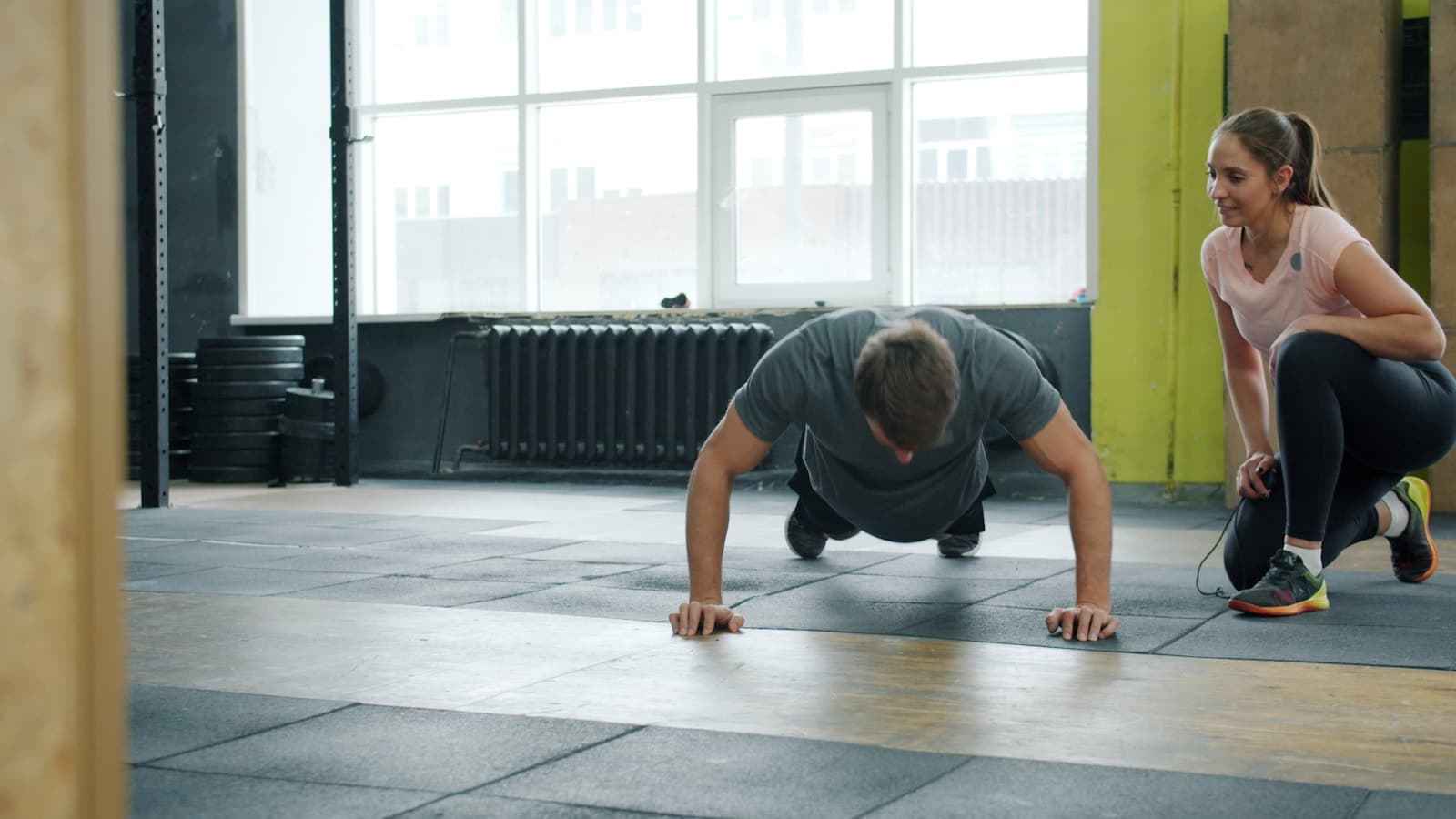
A client hit 205 on the bench press this spring, which was a number he'd been chasing since January. Two weeks later I asked him to show me ten push-ups. He got to six before his hips dropped and his lower back took over, and the last two were more of a worm than a push-up.
He was annoyed, and I understood why. He'd been pressing more than his bodyweight off a bench and couldn't do ten clean reps of the thing every gym teacher assigns to twelve-year-olds.
Nothing was wrong with him. The bench and the push-up ask for different things, and only one of them cares whether you can hold your own body in a straight line while you do it.
The number everyone quotes, and what it's actually measuring
Search for push-up standards and you'll get a rep-count chart. Do this many for your age, you're average. Do that many, you're excellent.
The charts are fine. What none of them mention is that the push-up is three separate abilities stacked into one movement, and a low number tells you nothing about which one ran out.
Pressing strength is the obvious one. Can your chest, shoulders, and triceps move roughly two thirds of your bodyweight through that range.
Trunk stability is the one that surprises people. A push-up is a moving plank. Your midsection has to resist your hips dropping toward the floor for every rep, and the moment it stops doing that, you're leaking force and the rep stops counting.
Shoulder position is the quiet one, and it's where a decade of desk work shows up. If your shoulders sit forward and your upper back is stiff, your elbows flare out to ninety degrees, the shoulder joint sits in a position it doesn't like, and you'll stop from discomfort well before you stop from fatigue.
My bench-press client had the first one in abundance. He was failing on the second.
How to run the test so the number means something
Clear a patch of floor. Hands about shoulder width, maybe a thumb's width wider. Body in one line from your head to your heels. Squeeze your glutes and brace like someone's about to poke you in the stomach.
Lower until your chest is a few inches off the floor, then press back up to straight arms. That's one. Do as many as you can with the same depth on every rep, and stop the count the moment your depth shortens or your hips break the line.
That last part is the whole test. Most self-reported push-up numbers are inflated because people count the reps where their range quietly halved and their hips started leading. If you're going to compare yourself against a chart, you have to earn the reps the way the chart assumes you did.
Film it from the side. Same as with any of these self-tests, you will not see your own hips drop, and the video is not kind but it is accurate.

Two other things. Don't test on a day you've already trained your chest or shoulders. And if you have current shoulder pain, particularly pain in the front of the joint when you lower, skip the max test entirely and read the shoulder section below instead.
What the firefighter study actually found
The reason this test gets written about at all is a 2019 paper in JAMA Network Open by Yang, Christophi, Farioli and colleagues. It followed 1,104 male career firefighters across ten Indiana fire departments, mean age 39.6, with baseline exams between 2000 and 2007 and follow-up through the end of 2010.
Push-ups were done to a metronome at 80 beats per minute. The researchers sorted everyone into five groups by rep count and tracked cardiovascular events over the following decade. Compared with the men who managed 10 or fewer, the men who did 41 or more had an incidence rate ratio of 0.04. That's the 96 percent figure you see in headlines. The 21 to 30 group came in at 0.16, and push-up capacity turned out to be more strongly associated with future cardiovascular risk than aerobic capacity estimated from a submaximal treadmill test.
That last detail is the genuinely surprising one, and it's why I take this test more seriously than I used to.
Now the parts the headlines leave out.
There were 37 cardiovascular events in the entire study, across 8,601 person-years. The whole result rests on those 37. The confidence interval on that 0.04 runs from 0.01 to 0.36, which is enormous, and it's what a very small number of events in a very fit group looks like.
The pattern also isn't clean. The 21 to 30 group did better than the 31 to 40 group. If push-ups protected your heart in a tidy dose-response way, that shouldn't happen. It's noise, and it's a reminder that the underlying signal is coarser than a five-band chart implies.
And the cohort was 1,104 men whose job requires them to be physically capable, with an average age under 40. The authors say it themselves in the paper: the results may not generalize to women, to older adults, or to people who aren't occupationally active. If you're a 54-year-old woman who sits at a desk, this study was not about you, and anyone converting your rep count into a heart-risk percentage is inventing something.
What I take from it is narrower and still useful. Upper-body strength endurance tracks with general physical resilience, it's measurable in your living room in two minutes, and most people have never checked.
Scoring your number
These are the standard full push-up norms used in fitness testing. I've collapsed the usual seven bands into three, because the distinctions between "above average" and "average" aren't worth the false precision.
Men in their 30s: strong at 34 or more, middle from 13 to 33, worth work at 12 or under.
Men in their 40s: strong at 28 or more, middle from 11 to 27, worth work at 10 or under.
Men in their 50s: strong at 25 or more, middle from 9 to 24, worth work at 8 or under.
Men 60 and up: strong at 24 or more, middle from 6 to 23, worth work at 5 or under.
Women in their 30s: strong at 21 or more, middle from 7 to 20, worth work at 6 or under.
Women in their 40s: strong at 15 or more, middle from 5 to 14, worth work at 4 or under.
Women in their 50s: strong at 13 or more, middle from 4 to 12, worth work at 3 or under.
Women 60 and up: strong at 10 or more, middle from 3 to 9, worth work at 2 or under.
If you're testing from your knees, use modified norms instead, which run higher across the board because the shorter lever cuts both the load and the demand on your trunk. Comparing a knee push-up count against full push-up bands will flatter you by roughly a full category, and there's no point in a test you've rigged.
While we're here, a small opinion. Most testing protocols still default women to knee push-ups, and I think that convention has outlived its usefulness. It made sense when it was written and it made a lot of women skip the full version entirely, on the assumption it wasn't for them. Plenty of the women I train do full push-ups. Some of them out-rep the men in the same time slot. If knee push-ups are where you are today, they're a completely reasonable place to test and train from. Just don't let a table from decades ago decide the ceiling for you.
These are also population norms from testing tables, not health thresholds. Landing in "middle" means you're near the middle of the people who happened to get measured. It isn't a diagnosis.
Three reasons the push-up fails
Watch the rep where it breaks down. The failure has a shape, and the shape tells you which of the three ran out.
Pressing strength. Your line stays straight, your elbows stay tucked, and you simply stop coming back up. You lower under control and then you're stuck at the bottom. This is the cleanest failure and the most direct to fix.
Trunk stability. Your hips sag toward the floor, or your lower back arches and your ribs flare. Sometimes the hips pike upward instead, which is the same problem solved in the opposite direction. Your arms had more in them. The middle gave out first, and every rep after that is being paid for by your lumbar spine.
Shoulder position. Your elbows drift out toward ninety degrees from your body, your shoulders creep up toward your ears, and you feel a pinch in the front of the shoulder as you descend. You stop because it's uncomfortable rather than because you're spent. This one is common in people who spend their days typing, and it's the one where pushing harder makes things worse rather than better.
Most people have one dominant cause and a bit of a second. Very few have all three.
Three checks to find which one is yours
Ten minutes, and you'll know where to put your effort.
Check 1: the incline push-up. Hands on a kitchen counter, body straight, same depth rules. Do as many as you can.
Pass: 15 or more clean reps at counter height. Borderline: 8 to 14. Fail: Under 8, or your line breaks here too.
Passing this while failing on the floor points squarely at pressing strength. You own the movement and you can't yet handle the load.
Check 2: the forearm plank. Elbows under shoulders, body in one line, hold it.
Pass: 45 to 60 seconds with your hips level and your ribs down. Borderline: 20 to 45 seconds, or you hold longer but your hips sink partway through. Fail: Under 20 seconds, or your lower back is doing the work immediately.
If this one falls apart, your push-up was never going to hold together, because it's the same demand with moving parts. The core stability test covers this in more depth if it's your weak link.

Check 3: the slow negative. From the top, take five full seconds to lower yourself. Watch the video.
Pass: Elbows stay at roughly 45 degrees from your body, shoulder blades stay flat against your ribcage, no pinching. Borderline: Elbows drift wide toward 90 degrees, or your shoulders shrug up as you descend. Fail: Sharp discomfort in the front of the shoulder, or your shoulder blades wing off your back.
Borderline or fail here is a shoulder problem, not a strength problem. The shoulder mobility test will tell you whether the restriction is in the joint or in the upper back feeding it.
A six-week plan for each cause
Three days a week, on whatever days you already train. Retest at six weeks.
If it's pressing strength
Incline push-ups, 4 sets of 8 to 12, lowering the incline every two weeks. Counter, then a bench, then a low step, then the floor.
The mechanism is boring and it works. Each drop in height adds a few percent of your bodyweight to the load, and you're progressing the resistance the same way you'd add plates to a bar.
Add slow negatives on the floor twice a week. Five reps, five seconds down each, reset to the top however you need to. You can control more weight lowering than lifting, and the descent builds the strength that eventually turns into the press.
If it's trunk stability
Dead bugs, 3 sets of 8 per side, with your lower back pressed flat the entire time.
This teaches your midsection to hold position while your limbs move, which is the exact skill a push-up is asking for and the exact skill sitting all day removes.
Then plank progressions. Build to a clean 60 seconds, then start adding movement: shoulder taps, then slow reaches. A 90-second plank with sloppy hips is worth less than 40 seconds of a genuinely flat one.
If it's shoulder position
Band pull-aparts, 3 sets of 15, before you do any pressing.
These wake up the upper back muscles that hold your shoulder blades where they belong. Desk work leaves them long and quiet, and pressing on top of that is what generates the pinch.
Pair them with thoracic extension work over a foam roller, and cue your elbows to stay at 45 degrees on every push-up rather than flaring. Narrowing the elbow angle alone resolves the discomfort for a lot of people, before any mobility work has time to matter.
Where to go from here
Test it, film it from the side, and pay more attention to the shape of the failure than to the number. The number tells you where you stand. The shape tells you what to do on Monday.
If more than one of the three checks came back borderline, the free movement screen scores six areas including your shoulders and core in about five minutes and builds a one-week program around whatever came back weakest. No email required. It's the same assessment I run with new clients.
And if you've been training consistently and your push-up number hasn't moved in a year, that's usually a programming problem rather than an effort problem, which is what one-on-one training is for. I've logged more than 12,000 sessions with adults around San Jose and the Bay Area. My bench-press client is at fourteen clean reps now, and the thing that changed wasn't his chest.
Ready to train smarter?
Get a personalized program built around your goals, your body, and your schedule.
Book Your Free ConsultationRelated Articles

Sitting-Rising Test at Home: Score Yourself, Then Fix Your Weak Link
The sitting-rising test scores how well you get down to the floor and back up without support. How to run it at home, what your score actually means, and the four-week plan that adds points. A San Jose trainer's guide.
Thoracic Spine Mobility Test at Home: 3 Checks for Desk Workers
Three at-home tests for thoracic spine mobility, with pass/fail ranges and five drills to loosen a stiff upper back from sitting. A San Jose trainer's guide.

Shoulder impingement for desk workers: 3 self-checks and what each one means
Shoulder pain in the 60-to-120 degree arc usually shows up at 35, not 25. A San Jose trainer's guide to the desk-worker shoulder pattern, three at-home tests, and the drills that actually move the needle.