
Score your joint hypermobility at home, then change how you lift

Jeffrey Sun, ACE-CPT
October 3, 2026 · 14 min read
ACE-certified personal trainer specializing in functional movement, mobility, and strength training for busy professionals in San Jose and the Bay Area.
Book a free consultation →
A software engineer in her thirties came to me two years ago with shoulders that kept aching and a low back that complained after long days. She'd been doing yoga twice a week for six years and could fold flat over her legs without warming up. By every measure in the room she was the most flexible person there.
She'd also been told, repeatedly, that she needed to stretch more.
I had her put her palms on the floor with straight knees, which she did easily. Then I asked her to hold a plank for 30 seconds without her lower back sagging, and she couldn't. Then I asked her to stand on one leg with the knee slightly bent rather than locked, and she had no idea what I was asking for, because she had never once stood on a soft knee in her life.
Her problem was never length. It was that she had more range than she could control, and she'd spent six years adding to the side of the equation that was already full.
This is the one test on this site where a high score is a finding rather than an achievement. Every other check I've published asks whether you have enough range. This one asks whether you have more than you can manage, which is a different question with a different answer.
Below is the Beighton score, two follow-up checks it doesn't cover, and what each result changes about how you train. This isn't medical advice, and the last section covers what belongs with a doctor instead.
Why extra range can work against you
Flexibility and stability are separate qualities. Having a lot of the first tells you nothing about the second, and the people who get caught out are usually the ones who assumed it did.
Think of a joint as having a range it can travel and a range it can control. For most desk workers those two numbers are close together, and both are small. Sitting shortens things, the controllable range shrinks along with the available one, and the job is to open up some room and then learn to own it.
Hypermobile people have the opposite shape. The available range is large, sometimes enormous, and the controlled range hasn't kept pace. The gap between the two is where things go wrong, because a joint will happily travel into territory the muscles around it have no practice stabilizing.
The injury evidence is real but narrower than people assume. Pacey and colleagues published a meta-analysis in the American Journal of Sports Medicine in 2010 pooling 18 studies on generalized joint hypermobility and lower-limb injury in sport. Hypermobile participants had significantly higher odds of knee injury in contact sports, with a combined odds ratio of 4.69. Two things to hold alongside that number. The confidence interval ran from 1.33 to 16.52, which is enormous and means the true effect could be modest or very large. And there was no increased risk at the ankle at all.
So the honest version is: hypermobility raises knee injury risk in contact sport, by an amount the research can't pin down well, and doesn't appear to raise ankle risk. That's a long way from "being flexible will hurt you." Nobody in that analysis was lifting weights.
The finding I think matters more for a desk worker who trains is about sensing rather than injury. Smith and colleagues ran a meta-analysis in Rheumatology International in 2013 on joint position sense in benign joint hypermobility syndrome. Across five studies and 254 people, those with hypermobility had significantly poorer lower-limb joint position sense and were slower to detect that a joint had started moving, both at p < 0.001. Upper limb results were murkier: finger position sense differed, shoulder position sense didn't reach significance.
Five studies and 254 people is a small evidence base and I'd hold the size of the effect loosely. But the direction fits what I see on the gym floor. The joint goes further and reports back less precisely about where it is, which is a bad combination under load.
Score your Beighton at home
The instrument comes from Beighton, Solomon and Soskolne's 1973 paper in the Annals of the Rheumatic Diseases, a survey of articular mobility in an African population. It has been the standard screen for joint laxity ever since, largely because it needs no equipment.
Five maneuvers, four of them scored on both sides, which is where nine points come from.
1 and 2. Little finger. With your forearm flat on a table, palm down, use your other hand to bend the little finger back toward the wrist. One point per hand if it passes 90 degrees from flat.
3 and 4. Thumb. Bend your wrist and use the other hand to draw the thumb down toward the forearm. One point per hand if the thumb touches the forearm.
5 and 6. Elbow. Straight arm out in front, palm up, and let it straighten as far as it goes. One point per arm if it travels more than 10 degrees past straight. Film from the side, because this is almost impossible to judge from inside your own body.
7 and 8. Knee. Stand side-on to a phone camera and let your knees settle back as far as they go. One point per leg if the knee passes 10 degrees beyond straight.
9. Forward bend. Feet together, knees locked straight, bend forward and put your palms flat on the floor. One point if both palms lie flat. Palms, not fingertips.
That last item overlaps the toe-touch in the hamstring flexibility tests, with the interpretation flipped. There, reaching the floor is a pass. Here, flat palms are a point on a laxity score. Same movement, opposite meaning. What a result is worth depends entirely on who's doing it.
On self-scoring. Juul-Kristensen and colleagues tested reproducibility in Rheumatology in 2007 and found good agreement between trained examiners, with a kappa of 0.74 for diagnosing generalized hypermobility across 40 patients. That's examiners who've been trained on the protocol, assessing someone else. You, at home, judging 10 degrees of elbow extension on your own arm, are working with more noise than that. Film everything, and treat a score sitting right on the line as uncertain rather than decided.
What your score means
The thresholds come from the 2017 international classification of the Ehlers-Danlos syndromes, which set them by age because joint range declines over time.
5 or more out of 9 for adults under 50. 4 or more for adults over 50. 6 or more for children before puberty.
That age banding matters for anyone reading this at 45 or 55. The same body that scored 6 at 25 might score 3 at 60 without anything having changed except collagen and years. If you're over 50 and score 4, you're over the line, and if you're 35 and score 4, you're not, and both of you might be carrying the same pattern.
Now the part that usually gets lost. Being over the line is a description of your joint range. It is not a diagnosis, it doesn't mean you have a syndrome, and on its own it doesn't mean anything is wrong with you. Plenty of people score 7 and go through life without a single joint complaint. What the score does is tell you which training problem you're more likely to have.
0 to 3. Generalised hypermobility isn't your situation. If something feels unstable, the cause is local rather than systemic, and the rest of this post isn't aimed at you.
4 to 5, depending on your age. Borderline, and borderline on a test this noisy means genuinely uncertain. Run the two checks below, because they tell you more about how you function than the score does.
6 or more. Clearly at the loose end of the range distribution. The training implications in this post apply to you directly, and the two checks below will tell you how much catching up the control side has to do.
Check 2: do you live in your end range?
The Beighton tells you what your joints can do. This tells you what they habitually do, which I find more useful.
Stand normally, the way you'd stand waiting for coffee, and have someone photograph you from the side. Or set a phone against a wall and use the timer.
Look at your knees. Hypermobile people very often rest with the knees pushed all the way back into hyperextension, because it's the position where the joint structures hold you up and the muscles get to switch off. It's efficient. It's also hours a day spent hanging off tissue rather than using muscle, and it's the single most common habit I end up changing.
The check. Stand on one leg with the knee held about 10 degrees short of lock, so the quad has to work. Hold it for 60 seconds. Switch.
Pass: 60 seconds a side, the knee stays soft, and you're not gripping with your toes.
Borderline: you can find the position but it drifts back toward lock as you fatigue, or one side is clearly worse.
Fail: you can't locate the position at all, or the knee snaps back to lock the moment you stop thinking about it.
A fail here isn't weakness exactly. It's that the position is unfamiliar, and unfamiliar positions feel like hard work regardless of how strong you are. The engineer I mentioned took about three weeks to stop finding it strange.
Check 3: can you find an angle without looking?
This one tests the thing the Smith meta-analysis measured, which is whether your knee knows where it is without your eyes helping.
Sit on a table or counter with your lower legs hanging free and a phone filming from the side. Straighten one knee to roughly halfway between hanging and fully straight. Hold it for five seconds and pay attention to how it feels. Let it drop back down. Close your eyes, wait ten seconds, and reproduce that same angle. Open your eyes and compare the two positions on the video.
Pass: the two angles look within about five degrees of each other across three attempts.
Borderline: five to ten degrees of error, or wildly inconsistent between attempts.
Fail: more than ten degrees out, or you genuinely can't tell whether you're close.
These bands are my training lines. Published joint position sense studies use equipment that measures to a fraction of a degree, and a phone on a counter doesn't. What the test does well is comparison: your left against your right, and your result now against the same test in eight weeks.
Reading the three together
Low Beighton, both checks pass. None of this is your limiting factor. Train normally.
High Beighton, both checks pass. You're loose and you control it, which is the position most hypermobile athletes who train sensibly end up in. Keep doing what you're doing and skip to the last section.
High Beighton, Check 2 fails. The most common result, and the most fixable. You have range and you rest at the end of it. The habit change does more than any exercise here.
High Beighton, Check 3 fails. A sensing problem rather than a strength problem. This is where balance and single-leg work earn their keep, because they force the joint to report its position continuously.
High Beighton, both checks fail. Start with Check 2. The end-range habit feeds the position sense problem, since a joint resting on its ligaments gets less useful feedback than one held by muscle.
How to train when you're at the loose end
Nothing here is exotic. It's ordinary strength training with four adjustments.
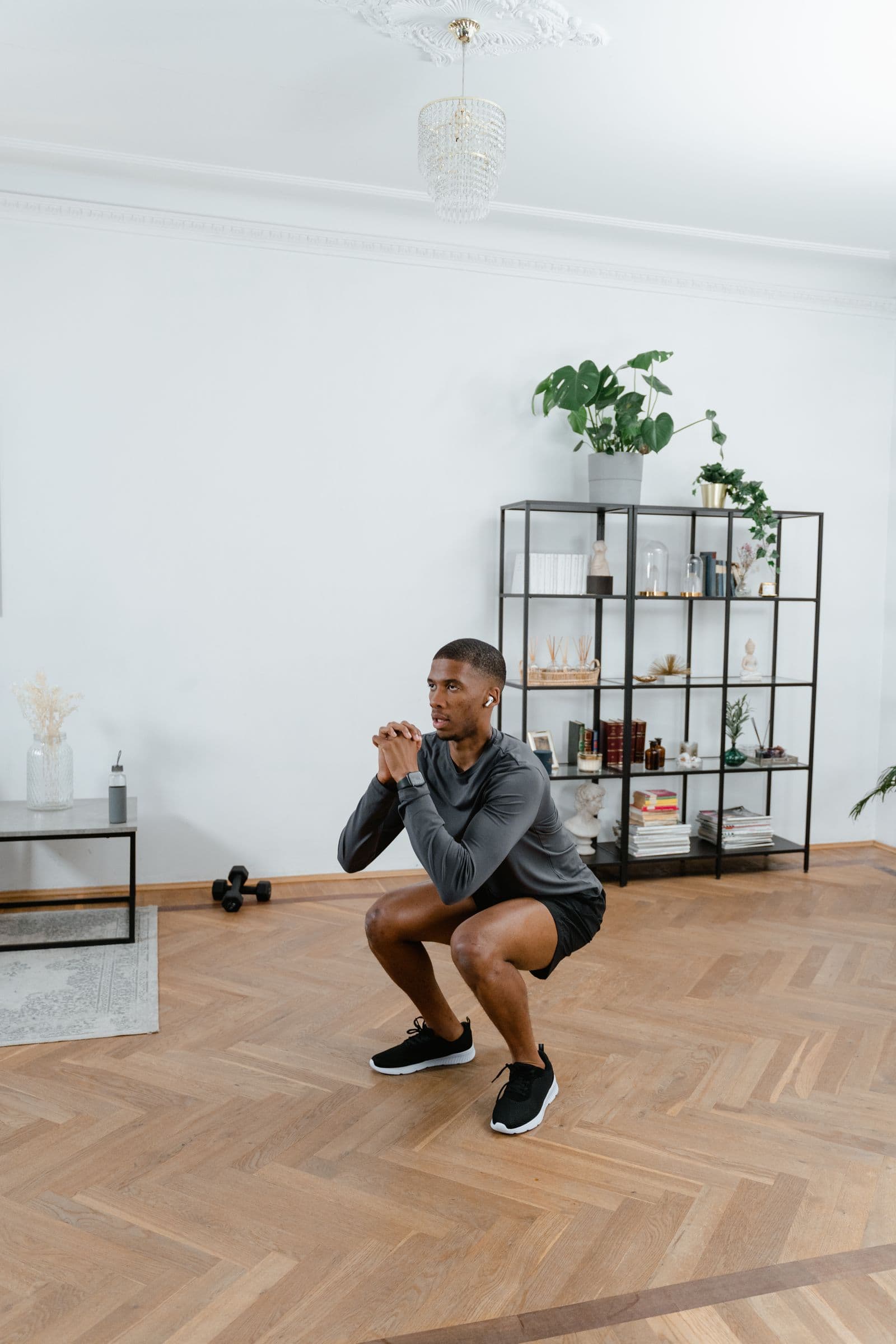
Work the middle, not the ends. Train through a range you can control rather than the full range you own. For most hypermobile lifters that's roughly 80 percent of available range, which in practice means stopping a squat a little above your true bottom and stopping a press a little short of lockout. The last few degrees are where the joint is least supported and where the least useful work happens.
Slow down the lowering. Three to four seconds down on your main lifts. Tempo is the cheapest way to build control in a range, and it exposes the positions where you lose the plot. If a slow descent gets wobbly at a particular depth, you've found your working limit.
Add isometrics. Holds at mid-range, 20 to 30 seconds, for the positions that feel least stable. Split squat holds, plank variations, a half-kneeling hold with a weight overhead. Boring to do and hard to argue with for this group.
Single-leg and single-arm work. This is the proprioception lever. Standing on one leg demands continuous position reporting in a way that two-legged work doesn't.
What to pull back on. Ballistic stretching, loaded stretching at end range, and partner-assisted PNF work all push further into a range that isn't the constraint. If you enjoy your yoga class, keep going. The adjustment that matters is stopping a little short of your maximum in the poses where you'd normally sink all the way in, and adding strength work on the other days.
And the honest caveat: if you're hypermobile in some places and genuinely stiff in others, which is extremely common, the stiff areas still want mobility work. Hypermobility is rarely uniform. I've screened people who scored 7 on the Beighton and still couldn't get their shin past vertical in a lunge. The question of whether to prioritize mobility or strength is answered per body part, not per person.
Give it eight weeks and retest all three. Check 2 moves first, usually inside a month. The Beighton score itself won't change much, and that's fine, because it was never the thing you were training.
When this belongs with a doctor
The Beighton score is a measure of joint range. Some people who score high have a connective tissue condition, and most don't, and that distinction is a clinician's to make rather than mine.
Worth a proper assessment: joints that actually dislocate or partially dislocate, skin that is unusually stretchy or scars poorly, significant fatigue or digestive symptoms alongside the joint laxity, a family history of connective tissue disease, or widespread chronic pain. Those are the features that move the conversation from "you're flexible" toward something with a name, and a GP or rheumatologist is the right person for it.
Also worth a clinician rather than a training plan: any joint that gives way under you, pain that wakes you at night, or a joint that swells after ordinary activity.
None of that stops you training. It changes who should be helping you plan it.
Where to start
Run the Beighton. It takes four minutes and a phone, and it reframes every other movement result you'll ever get, because "tight" and "stiff" mean different things depending on where you sit on this distribution.
If you scored high and want to know which specific areas are loose versus genuinely restricted, that's what the movement screen sorts out. Five minutes, no email, and it checks the hip, ankle, shoulder and trunk patterns individually rather than treating your body as one number.
And if you've been told to stretch more for years while something kept hurting, that's a conversation worth having in person. I've run more than 12,000 sessions in San Jose and the South Bay, and the flexible clients are the ones most often working from the wrong instructions. Book a consultation and bring your score.
Ready to train smarter?
Get a personalized program built around your goals, your body, and your schedule.
Book Your Free ConsultationRelated Articles

Sitting-Rising Test at Home: Score Yourself, Then Fix Your Weak Link
The sitting-rising test scores how well you get down to the floor and back up without support. How to run it at home, what your score actually means, and the four-week plan that adds points. A San Jose trainer's guide.

Exercises for Bone Density After 40: What Actually Loads Bone (and What Doesn't)
Walking and light dumbbells barely register at the hip and spine. What the bone research actually prescribed, why force and speed matter more than minutes, and what changes if your scan came back osteopenia. A San Jose trainer's guide.

When Work Stress Should Change How You Train: A Busy Professional's Guide
A San Jose trainer's framework for knowing when life stress should change your workout — five honest signs, a green/yellow/red week decision system, and how to come back without losing the strength you built.