
Lifting with knee osteoarthritis: what 217 trials say about loading a worn joint

Jeffrey Sun, ACE-CPT
September 9, 2026 · 12 min read
ACE-certified personal trainer specializing in functional movement, mobility, and strength training for busy professionals in San Jose and the Bay Area.
Book a free consultation →
A client in Willow Glen brought me his knee X-ray report on a Tuesday. He was 58, had been lifting three days a week for about four years, and had stopped almost entirely six weeks earlier. Not because of pain. Because a doctor had used the phrase "bone on bone," and he'd decided that every squat from then on was spending something he couldn't get back.
That's the part that gets me about this diagnosis. The thing that ends most people's training isn't the arthritis. It's the sentence about the arthritis.
So I went through the research on loading an osteoarthritic knee. It says two things at once, and almost every article I found on this topic picks one and drops the other. Lifting doesn't appear to wear the joint out. Lifting also isn't the pain cure the strength training internet promises. Once you stop treating those as contradictory, what to actually do gets clearer.
Does loading a worn knee wear it out faster?
This is the fear underneath everything else, so it goes first.
Bricca and colleagues published a systematic review in the British Journal of Sports Medicine in 2019 that went looking specifically for randomized trials measuring what happens to cartilage on MRI. Not pain scores, not questionnaires. Actual imaging of the tissue. They found nine trials covering 14 comparisons, two in people at increased risk of knee osteoarthritis and twelve in people who already had it.
In the group that already had OA, six comparisons found no effect on cartilage thickness, volume, or defects. The composition findings were mixed, with two showing a positive effect on collagen and two showing none. Their conclusion was that knee joint loading exercise seems not to be harmful for articular cartilage in people at risk of, or with, knee OA.
The authors were careful about what they had, and I'll be equally careful. They rated the quality of evidence low. Nine trials is not many, MRI cartilage measures are finicky, and some of the interventions studied sat outside what they'd consider a therapeutic loading range. This is not a proof that you can load an arthritic knee however you like.
What it does mean is that the mental model most people are running, where cartilage is a tread depth and every rep takes some off, isn't supported by the imaging we have. Cartilage is living tissue that responds to load, and the trials that watched it under exercise didn't see it degrade.
It helps to know what "bone on bone" actually describes. It's a radiologist's reading of joint space on an image, and joint space narrowing correlates surprisingly loosely with how much a knee actually hurts. Plenty of people have dramatic-looking films and mild symptoms. Plenty have the reverse. The image is real information, but it isn't a verdict about what you're allowed to do.
What heavy strength training actually did in the biggest trial
Now the part that argues against my own side of this.
If lifting is safe for the joint, the obvious next claim is that you should lift heavy and your knee will feel better. That claim has been tested properly, and it didn't hold up.
The START trial, published in JAMA in 2021 by Messier and colleagues, randomized 377 community-dwelling adults aged 50 and over with knee pain and radiographic knee osteoarthritis into three groups: high-intensity strength training, low-intensity strength training, and an attention control. Mean age was 65, 40 percent were women, and 85 percent finished the 18-month protocol. That's a large, long, well-run trial by the standards of this field.
The high-intensity group did not do better than control on knee pain. Adjusted WOMAC pain scores came in at 5.1 versus 4.9, a difference of 0.2 on a 20-point scale where the minimally important difference is 2. Knee joint compressive force during walking didn't differ either, at 2453 N versus 2512 N. High-intensity didn't beat low-intensity on pain either.
The authors' conclusion was that the findings do not support using high-intensity strength training over low-intensity training or control in adults with knee osteoarthritis.
I've sat with that result for a while because it cuts against how I'd have guessed it would go. Quad strength and knee pain look less tightly linked than the standard trainer explanation assumes. Getting stronger is good for a long list of reasons. Reliably making an arthritic knee hurt less is not one of the things it's been shown to do.
Heavy loading wasn't free of aggravation either. There were 53 nonserious adverse events in the high-intensity group against 4 in control. And the 13 serious adverse events across the whole trial were judged unrelated to the study.
The 217-trial ranking, and what it changes
The most complete picture we have arrived in October 2025, when Yan and colleagues published a network meta-analysis in The BMJ pulling together 217 randomized trials and 15,684 participants, run between 1990 and 2024. They compared aerobic, strengthening, flexibility, mind-body, neuromotor, and mixed programs against controls.
Aerobic exercise came out on top. Moderate certainty evidence for large improvements in pain at short term (standardised mean difference -1.10) and mid-term (-1.19), in function at mid-term (1.78), in gait performance (0.85), and in quality of life (1.53). Across outcomes it consistently had the highest probability of being the best option.
Aerobic here means walking, cycling, swimming. The unglamorous stuff.
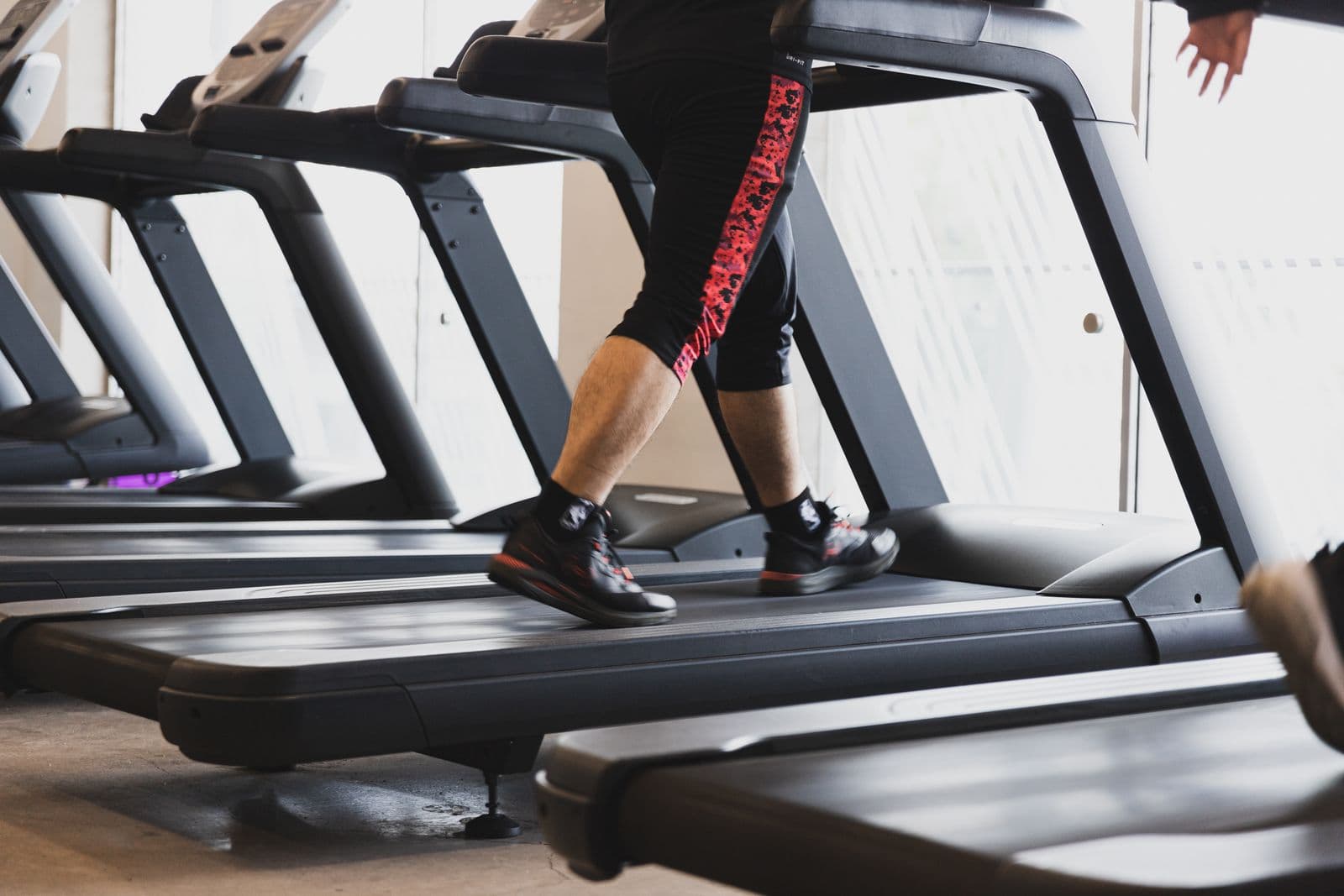
Strengthening didn't disappear from that analysis, and this is the part the headlines flattened. It produced a large improvement in function at mid-term follow-up, standardised mean difference 0.86, also with moderate certainty. It just wasn't the top-ranked option for pain.
The review has real limits and says so. Many comparisons were indirect, long-term data was thin, trial quality varied, and safety was only reported in 40 of the 217 studies.
Reading the three findings together
Loading the knee doesn't appear to damage it. Heavy strength work isn't a dependable way to make it hurt less. Aerobic work has the strongest evidence for the hurting-less part, and strength work has good evidence for the being-capable part.
So these two things are doing different jobs, and the mistake I see most often is expecting one of them to do both.
If your main complaint is that your knee aches on stairs and you want that to change over the next three months, the evidence points at building a walking or cycling habit before it points at adding load to your squat. If your concern is that you're 58 and you want to still be carrying your own luggage at 75, strength work is doing something the walking isn't, and the START trial's null result on pain says nothing against that.
Most people I train want both, and both fit in a week without much trouble. Two lifting sessions and two or three easy aerobic sessions is a completely ordinary schedule, and it's roughly what the combined evidence would suggest for someone in this situation. If you want a read on where your aerobic base currently sits, the at-home cardio fitness tests give you a starting number rather than a guess.
I'll add the obvious caveat that a research average is not a person. Some people's knees respond beautifully to loaded strength work and get quieter as they get stronger. The trials say that isn't the reliable outcome, not that it never happens.
The pain rules that let you keep training
For most people the hard part isn't deciding to train. It's not knowing how much discomfort means damage.
The rule of thumb used widely in osteoarthritis and tendon rehab is straightforward. Discomfort up to about 5 out of 10 during the session is acceptable, provided it settles back to your normal baseline within 24 hours. Above that, or still elevated the next day, means the dose was too high.
I like this rule because it moves the question from "does it hurt" to "how does it behave," and the second question is answerable. A knee that grumbles at a 4 during step-ups and is back to normal by the next morning is telling you the session was fine. A knee that felt like a 3 during the session and is swollen and stiff on Wednesday is telling you it wasn't, regardless of how it felt at the time.
When it goes over the line. Reduce something and repeat the session rather than abandoning it. Cut the load by a third, or cut the range, or drop a set. You're looking for the version of the movement that lands under the threshold, because that version is the one that builds anything.
When there's swelling. A joint with fluid in it isn't a joint to push through. Back off to whatever doesn't provoke it for a few days, keep moving in the ranges that stay quiet, and rebuild from there.
When it's not behaving like arthritis. Locking, giving way, or a knee that swells hard within hours of a specific incident are different problems and want a clinical assessment. I go through those patterns in more detail in the post on desk-worker knee pain.
The 24-hour rule also protects you from the opposite error, which is the person who feels a twinge, decides the joint is degrading, and stops. Six weeks of that costs real strength, and the leg that comes back is weaker than the one that quit.
Changing the position instead of dropping the movement
Most of the adjusting I do with clients who have knee OA is about where in the range the discomfort lives, not about banning exercises.
Knees with arthritis usually have a zone that's fine and a zone that isn't, and for most people the uncomfortable zone is the deep end under load. So the work is finding the depth that's tolerable and training there with real effort, then checking every few weeks whether the tolerable range has grown. It usually does.
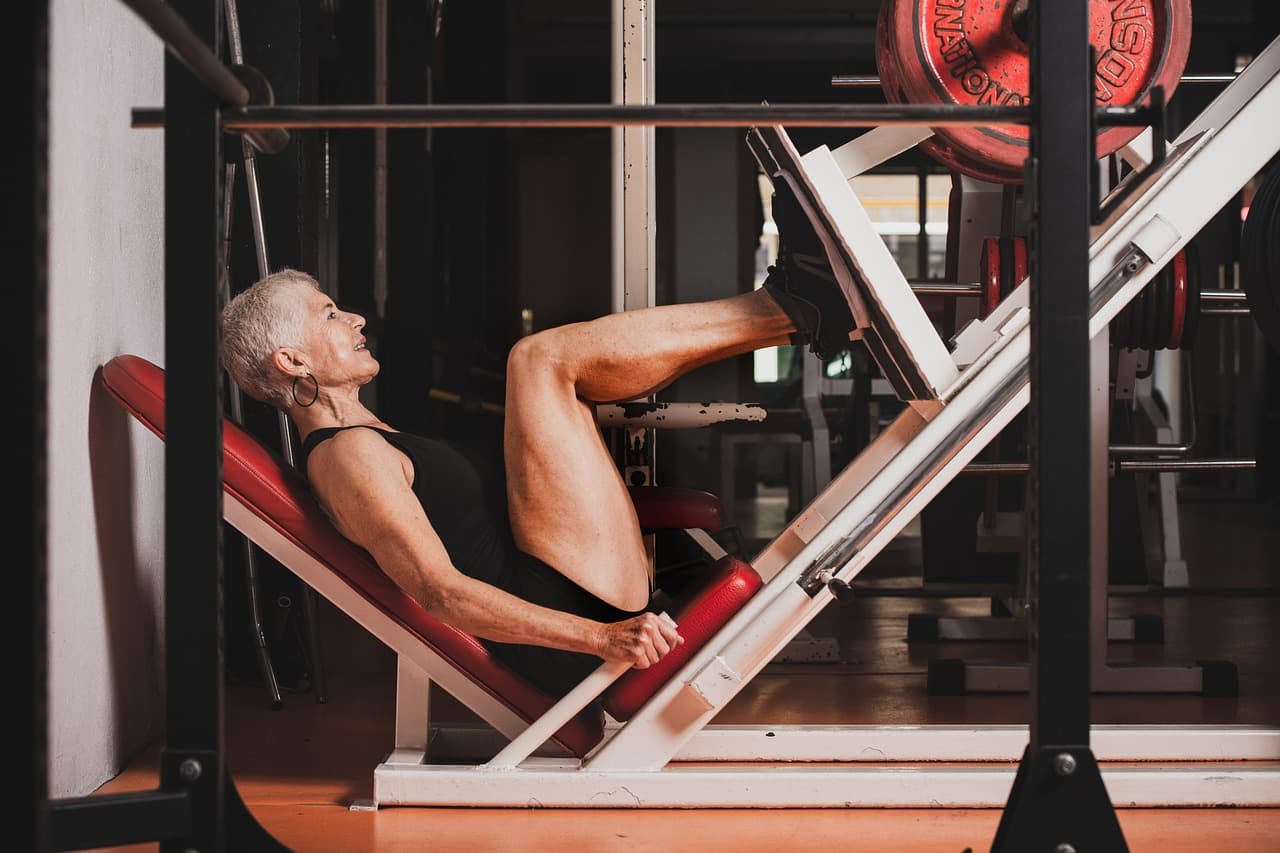
Squats. A box or bench behind you sets a consistent depth so you're not renegotiating it every rep. Holding the weight in front, goblet style, changes the balance and often feels better than a bar on the back. Slowing the lowering phase gives you more information about where the discomfort starts.
Step-ups and split squats. These load one leg at a time, which is useful because arthritis is often much worse on one side. Step height is an easy dial to turn. Start lower than feels necessary.
Leg press. Gets a bad reputation in some circles, but it lets you load the leg hard with a supported back and a range you can set precisely, which is exactly the combination this situation calls for.
Impact. Running and jumping are the genuine judgment calls here rather than automatic exclusions. Some people with mild OA run comfortably for years. Others find it reliably sets the joint off. This is the one area where I'd let your own 24-hour response do more of the deciding than any general recommendation.
What I'd steer away from is the version where someone with an arthritic knee spends a year doing seated leg extensions with pink dumbbells because it's the only thing that feels definitely safe. That's a leg that gets weaker while the person waits for the knee to give permission.
Where to start, and when to get eyes on it
If you're coming back after stopping, start smaller than you think and build for longer than you'd like. Two lower-body sessions a week, loads you could manage for a few more reps than you're doing, and something aerobic on the days between. Then watch the 24-hour response for three or four weeks before you make any judgments about what your knee tolerates. One session tells you almost nothing.
The knee is also rarely working alone. Ankle range and hip strength both change how much the knee has to absorb, and stiffness upstream or downstream tends to show up as knee complaints. If the arthritis is in your hip instead, the research there points somewhere different, and I've written up three at-home tests for hip osteoarthritis along with what the newer trials say. If you're not sure what else is contributing, the free movement screen scores six areas including your ankles and hips in about five minutes without asking for an email. It's the same assessment I start new clients with.
If you're working through a diagnosis and a program at the same time, that's also a reasonable moment to get another set of eyes involved, whether that's a physical therapist or a coach.
And if you want someone building the program around your knee rather than around a template, that's what one-on-one training is for. I've logged more than 12,000 sessions with adults around San Jose and the South Bay, and a good share of them have been with people training around a joint that a scan had already written off.
The Willow Glen client started back with box squats to a height that didn't bother him, split squats off a low step, and three walks a week. Fourteen months later he's squatting deeper than he was when he stopped, and his knee is about where it was. That last part matters as much as the first. Nothing got worse.
Ready to train smarter?
Get a personalized program built around your goals, your body, and your schedule.
Book Your Free ConsultationRelated Articles
Strength training for hip osteoarthritis: three at-home tests and what the newest trials say
Strength training for hip osteoarthritis does less for pain than most exercise lists suggest and more for what you can still do. Three at-home tests show which problem your hip actually has. A San Jose trainer's read on the 2024 to 2026 research.
Exercises for Bone Density After 40: What Actually Loads Bone (and What Doesn't)
Walking and light dumbbells barely register at the hip and spine. What the bone research actually prescribed, why force and speed matter more than minutes, and what changes if your scan came back osteopenia. A San Jose trainer's guide.

SI Joint Pain When Sitting at a Desk: 3 Self-Tests and What They Mean
Why the SI joint takes the brunt of a desk job, three self-tests you can run at home, and the corrective routine that actually helps. A San Jose trainer's guide for desk workers.