
Strength training for hip osteoarthritis: three at-home tests and what the newest trials say

Jeffrey Sun, ACE-CPT
October 6, 2026 · 19 min read
ACE-certified personal trainer specializing in functional movement, mobility, and strength training for busy professionals in San Jose and the Bay Area.
Book a free consultation →
A client in Cupertino stopped hiking Rancho San Antonio the spring he turned 61. Nothing dramatic happened. His right groin ached by the second mile, then on the walk back to the car, and then a doctor looked at an X-ray and told him he had moderate osteoarthritis and would "probably need a new hip eventually."
He heard "eventually" and decided the next decade was a waiting room. He stopped lifting, stopped hiking, and spent most of a year getting weaker while he waited for the hip to get bad enough to fix.
I've watched that happen enough times to have opinions about it. I also went back through the hip osteoarthritis research this month, because a lot has been published in the last two years and almost none of it has reached the exercise lists that rank for this topic.
Here's where I've landed. For an arthritic hip, exercise is a modest pain treatment and a much better treatment for what the leg can still do, and it's safe at higher intensities than most people assume. Once a hip is severe, surgery does far more for pain. Those two findings stop looking contradictory once you know which kind of hip you have, and three at-home tests will tell you most of that.
This isn't medical advice. The last section covers what belongs with a doctor.
Hip arthritis or just a stiff desk hip?
Plenty of desk workers over 40 have hips that feel tight, ache after a long drive, and complain at the bottom of a squat. Most of them don't have osteoarthritis. The two can feel alike on a Tuesday afternoon, but they behave differently enough to sort.
The reference point is the American College of Rheumatology hip criteria, published by Altman and colleagues in Arthritis & Rheumatism in 1991. They studied 201 patients who'd had hip pain most days for a month and compared them with people whose hip pain came from something else. Without an X-ray, a painful hip was classed as osteoarthritic if it still rotated inward 15 degrees or more but hurt when it did, stiffened for an hour or less in the morning, and belonged to someone over 50. A hip that rotated inward less than 15 degrees with a normal inflammation blood test also qualified.
That rule caught 86 percent of real cases and correctly cleared 75 percent of the rest. It's fine for sorting research participants and nowhere near good enough to diagnose yourself in a living room. What it does is tell you which signs to watch.
The pain location matters most. Arthritic hip pain usually lives in the groin or the front crease of the hip, sometimes running down the front of the thigh toward the knee. Pain on the outside of the hip, the bony point you lie on at night, is more often a tendon problem with its own set of tests. Pain deep in the buttock is more often the low back or the SI joint.
Mornings are the next clue. Osteoarthritis stiffness eases within about 30 to 60 minutes of moving around. Stiffness that hangs on for hours points to an inflammatory condition, which is a question for a doctor rather than a trainer.
Then there's age. Over 50 doesn't mean arthritis, but under 40 makes it much less likely, and a younger person with this pattern should be asking a clinician about hip impingement or the labrum.
Test 1: seated hip rotation, side to side
The hip mobility test already checks internal rotation range with a 90/90 floor sit. This version asks something different: what happens at the end of the range, and how do the two sides compare?
Sit on the front edge of a firm chair or bench, thighs parallel, knees bent to 90 degrees. Put a rolled towel between your knees so the thighs can't drift apart, and prop your phone on the floor facing your shins.
Keeping the thigh still and the pelvis flat on the seat, swing one foot out to the side as far as it goes comfortably. That turns the hip inward. Hold a second, come back, then do the other side. Three times each. Screenshot the end position on both sides, judge the shin angle against vertical, and note whether either side brings on pain and where you feel it.
Physical therapy references usually put normal internal rotation somewhere around 30 to 45 degrees, but hips vary a lot and phone angles are rough. Trust the comparison between your two sides more than the absolute number.
Pass: Both shins swing out to roughly the same angle, within about 10 degrees of each other, and nothing hurts.
Borderline: One side rotates visibly less than the other but doesn't hurt. Or there's a dull ache at end range on one side with no loss of range.
Flag: One side barely rotates, around 15 degrees or less, and the end of the movement brings back your familiar groin pain. That's the combination the ACR criteria were built on. It doesn't confirm osteoarthritis, but if you've never had imaging, this is the result that makes an X-ray worth asking for.
A hip that's stiff from sitting usually loses a bit of rotation on both sides and doesn't hurt at the end. An arthritic hip is usually one-sided and painful at end range, and a week of stretching doesn't buy much of it back.
Test 2: the 30-second chair stand
This test measures what the hip lets the leg do, and it's the one the osteoarthritis research world agrees on. When Dobson and colleagues ran an international consensus for Osteoarthritis Research Society International in 2013, polling 138 clinicians and researchers across 16 countries, the 30-second chair stand made the three-test core set for hip and knee osteoarthritis.
The validation work is Jones, Rikli and Beam in Research Quarterly for Exercise and Sport, 1999. In 76 community-dwelling adults with an average age of 70.5, the 30-second count tracked weight-adjusted leg press strength closely (0.78 in men, 0.71 in women) and held up on a retest a few days later.
Use a standard dining chair with a seat about 17 inches high, backed against a wall so it can't slide. Sit in the middle of the seat with your feet flat and shoulder-width apart and your arms crossed over your chest. On "go," stand all the way up and sit all the way back down as many times as you can in 30 seconds. Hips and knees fully straight at the top, weight fully on the seat at the bottom. If you're more than halfway up when time runs out, count it. Then rate your hip pain from 0 to 10, because that number matters as much as the count.
Most people compare against the Senior Fitness Test norms that Rikli and Jones published for adults over 60. Scores below these are below average:
- 60 to 64: fewer than 12 for women, fewer than 14 for men
- 65 to 69: fewer than 11 for women, fewer than 12 for men
- 70 to 74: fewer than 10 for women, fewer than 12 for men
- 75 to 79: fewer than 10 for women, fewer than 11 for men
- 80 to 84: fewer than 9 for women, fewer than 10 for men
The norms stop at 60. For readers in their 50s, I treat fewer than 14 stands for women or 16 for men as worth paying attention to. That's my extrapolation from the trend, not a published cutoff.
Pass: At or above average for your age, with pain at 2 out of 10 or less.
Borderline: At or above average but with pain of 3 to 5, or below average without much pain.
Fail: Below average with pain above 5, or you needed your hands to finish.
One more number. Wright and colleagues, in the Journal of Orthopaedic & Sports Physical Therapy in 2011, followed 65 people with hip osteoarthritis through nine weeks of physiotherapy and asked them to rate how much they'd improved. Depending on the method, a gain of 2.0 to 2.6 stands lined up with what patients called a real improvement. Two or three extra stands doesn't sound like much. It's what people notice when getting out of a car.
Test 3: step-ups with a pain check
The first two tests cover range and capacity. This one is about irritability, which is what decides how hard you can train right now.
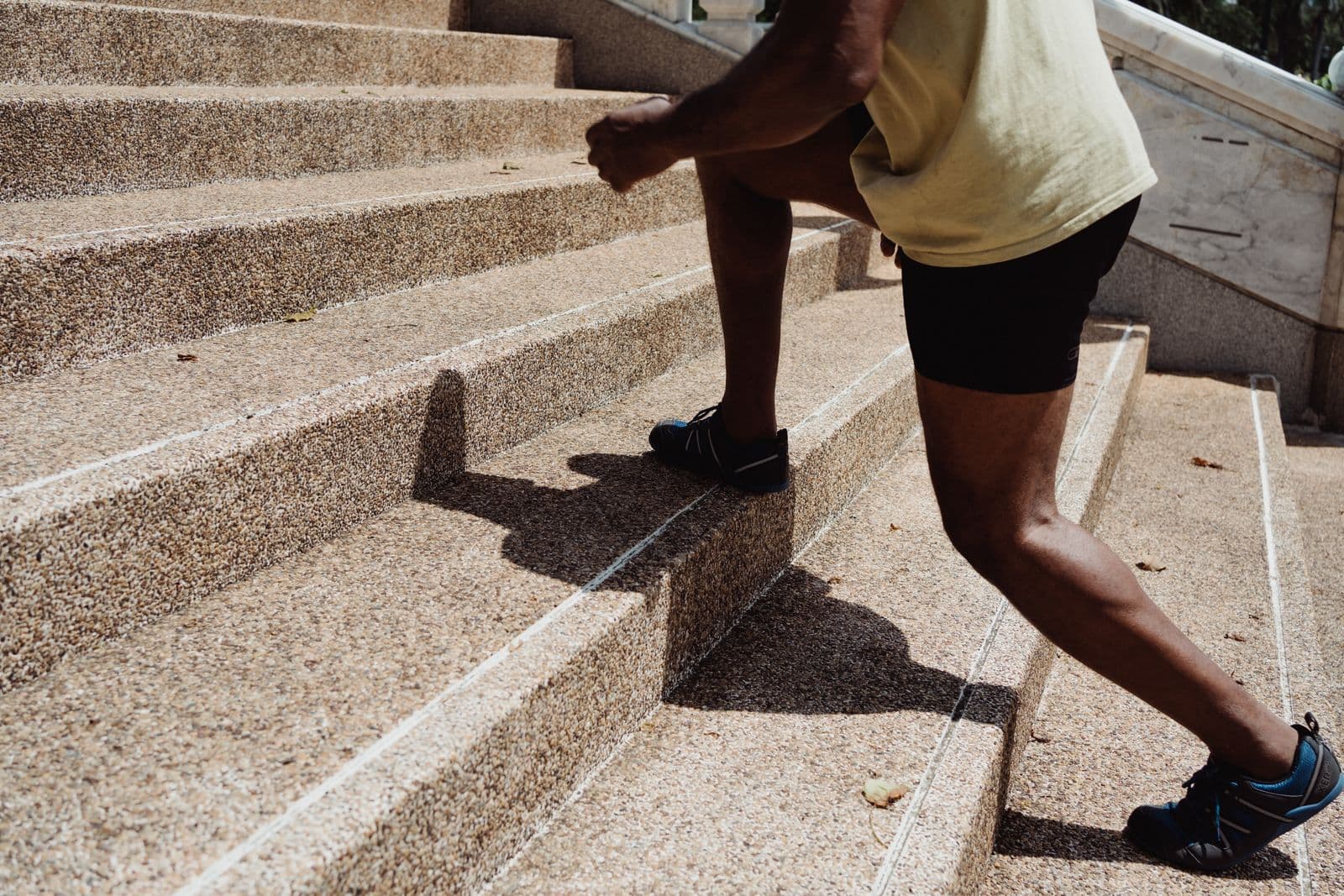
Find one stair or a sturdy step about 8 inches high, with a wall or rail in reach but not in your hand. Do ten slow step-ups leading with the good leg (up, stand tall on it, step back down) and then ten leading with the sore side. Take about two seconds up and two down, and don't push off the back foot.
Write down your pain from 0 to 10 for each side. Note whether the sore side needed help from the trailing foot, or whether your hips tipped and your trunk leaned over the working leg. Then check how the hip feels the next morning compared with a normal morning.
Pass: The two sides feel similar, pain stays at 2 or below, and the next morning is normal.
Borderline: The sore side is noticeably harder or leans, or pain reaches 3 to 5, but you're back to normal by the next morning.
Fail: Pain above 5 during the set, a next morning clearly worse than usual, or you can't finish ten on the sore side without pushing off or grabbing the rail.
The next-morning reading carries the most weight. A hip that grumbles at a 4 during the set and is fine by breakfast handled that dose. A hip that felt like a 2 and is stiff and sore the next day didn't, whatever it felt like at the time.
Reading the combination: four profiles
Any one of these tests is a blunt tool. Together they sort most people into one of four profiles, and each needs a different plan.
Stiff but strong. Test 1 flags or is borderline, and Tests 2 and 3 pass. This is the profile I see most often in people in their 50s with an early diagnosis. The joint has lost range but the leg works fine. Keep loading normally, work the rotation you still have every day, and set squat and hinge depth around the range rather than dropping the movements.
Weak but mobile. Test 1 passes, Test 2 comes in below average, and Test 3 is fine or borderline. The hip isn't the main limiter here, the leg is. This might not be osteoarthritis at all, or it might be mild osteoarthritis on top of a strength problem that would exist anyway. If you're over 50, run the sarcopenia self-test next, since it separates a strength deficit from a muscle-mass one.
Irritable. Test 3 fails, often with chair-stand pain above 5. The hip reacts to load right now. You can still train it, but with a smaller starting dose and shorter ranges, and the next-morning check decides every progression for the first few weeks.
Get it looked at. All three tests flag, or Test 1 flags and you've never had imaging, or your results don't match any of the above. Skip to the last section.
What the newest research says, including the parts nobody quotes
Five findings, most of them published in the last two years, have changed how I talk about this with clients. Every one has limits worth knowing before you build a plan on it.
Start with pain. In July 2026, Hall and colleagues updated the Cochrane review on exercise for hip osteoarthritis, pooling 18 trials and 1,368 people. Compared with no treatment or usual care, exercise probably cuts pain by about 7 points on a 100-point scale and improves function by about 9, with moderate certainty. The authors judged both effects unlikely to be clinically meaningful. Against a placebo or attention-control treatment, in two trials covering 123 people, exercise may have little to no effect on pain at all.
What I find telling is the comparison with the previous version. Fransen and colleagues' 2014 Cochrane review of 10 trials reported almost the same effect, about 8 points, and called it high-quality evidence that exercise reduces pain. Twelve years on, the number had barely moved. The verdict on it had changed.
One trial behind that placebo comparison deserves a look on its own. Bennell and colleagues published it in JAMA in 2014. They gave 102 people with painful hip osteoarthritis either 12 weeks of physiotherapy (education, manual therapy, and home exercise) or a convincing sham with switched-off ultrasound and inert gel. Both groups improved by similar amounts, and the sham group did slightly better on pain. That wasn't a heavy strength program, so it can't tell us what lifting does. It does show how much of the improvement people credit to exercise comes from attention and expectation, plus the simple passing of time.
Then there's surgery. The PROHIP trial, published by Frydendal and colleagues in the New England Journal of Medicine in October 2024, randomized 109 adults over 50 (average age 67.6) who had severe hip osteoarthritis and already qualified for a replacement. At six months the Oxford Hip Score had improved 15.9 points with surgery and 4.5 points with 12 weeks of progressive resistance training, a gap of 11.4 points on a 48-point scale. Twelve of the 56 people in the training group, 21 percent, had the operation anyway before six months were up. For that group the answer is clear: training didn't stand in for a new hip.
Lifting didn't hurt those hips, though. A 2025 follow-up analysis by Bryld and colleagues looked at the 55 PROHIP participants who trained. Over 12 weeks their loads went up and their reps came down, the way any normal strength program progresses. Resting pain before sessions fell from 3.2 to 2.1 out of 10, and pain after sessions fell too rather than climbing with the weights. These hips were bad enough to qualify for surgery, and they took progressively heavier loading without flaring.
Exercise may also buy time. Svege and colleagues followed 109 patients from an earlier trial for six years, reporting in Annals of the Rheumatic Diseases in 2015. People who got exercise therapy plus education kept their own hip longer than those who got education alone. At six years, 41 percent still hadn't had a replacement, against 25 percent, and the median time to surgery was 5.4 years against 3.5. Their hip function was better in the meantime, though pain didn't differ. It's a single trial of modest size and the authors called it explanatory. Even so, it's the best evidence available on the question my clients ask most.
Last, the hip isn't the knee. The big finding in the knee osteoarthritis post was that aerobic exercise ranked highest for knee pain. The hip data points elsewhere. In the PHOENIX trial, published by Hall and colleagues in Lancet Rheumatology in 2025, 196 people with hip osteoarthritis did either resistance exercise alone or resistance exercise plus moderate aerobic activity. Adding the aerobic work didn't improve pain or function any further. Walking and cycling are still good for you for plenty of other reasons. They just added nothing for the hip on top of strength work in that trial.
So strength training won't reliably stop an arthritic hip hurting. What it does reliably is keep the leg capable, and it appears safe even at the severe end, with a chance of pushing surgery further out. For a severe hip that already qualifies, the operation does more for pain than any program I can write. Both are reasonable paths, and which one fits depends on the hip and the life around it.
An 8-week program built around the tests
Do two lower-body sessions a week, which matches the 24 supervised sessions over 12 weeks that PROHIP used. A third is fine if your step-up test passed. Start every session with five minutes of easy movement, then the Test 1 rotation as a drill: ten slow reps a side, staying short of pain.
For pain, I use the same rule as for all osteoarthritis work, explained fully in the knee post. Discomfort up to about 5 out of 10 during a session is acceptable if the joint is back to its normal baseline within 24 hours. If the next morning is worse, cut load or range by about a third and repeat the session rather than skipping it.
Weeks 1 and 2: find the range the hip tolerates.
- Box squat to a high box or bench, 3 sets of 10. Choose a height where the bottom position doesn't provoke the groin. That's your depth for now.
- Step-ups, 3 sets of 8 per side, at a height that passed Test 3 (go lower if it failed).
- Side-lying hip abduction, 3 sets of 12 per side.
- Glute bridge, 3 sets of 12.
Weeks 3 to 5: add load.
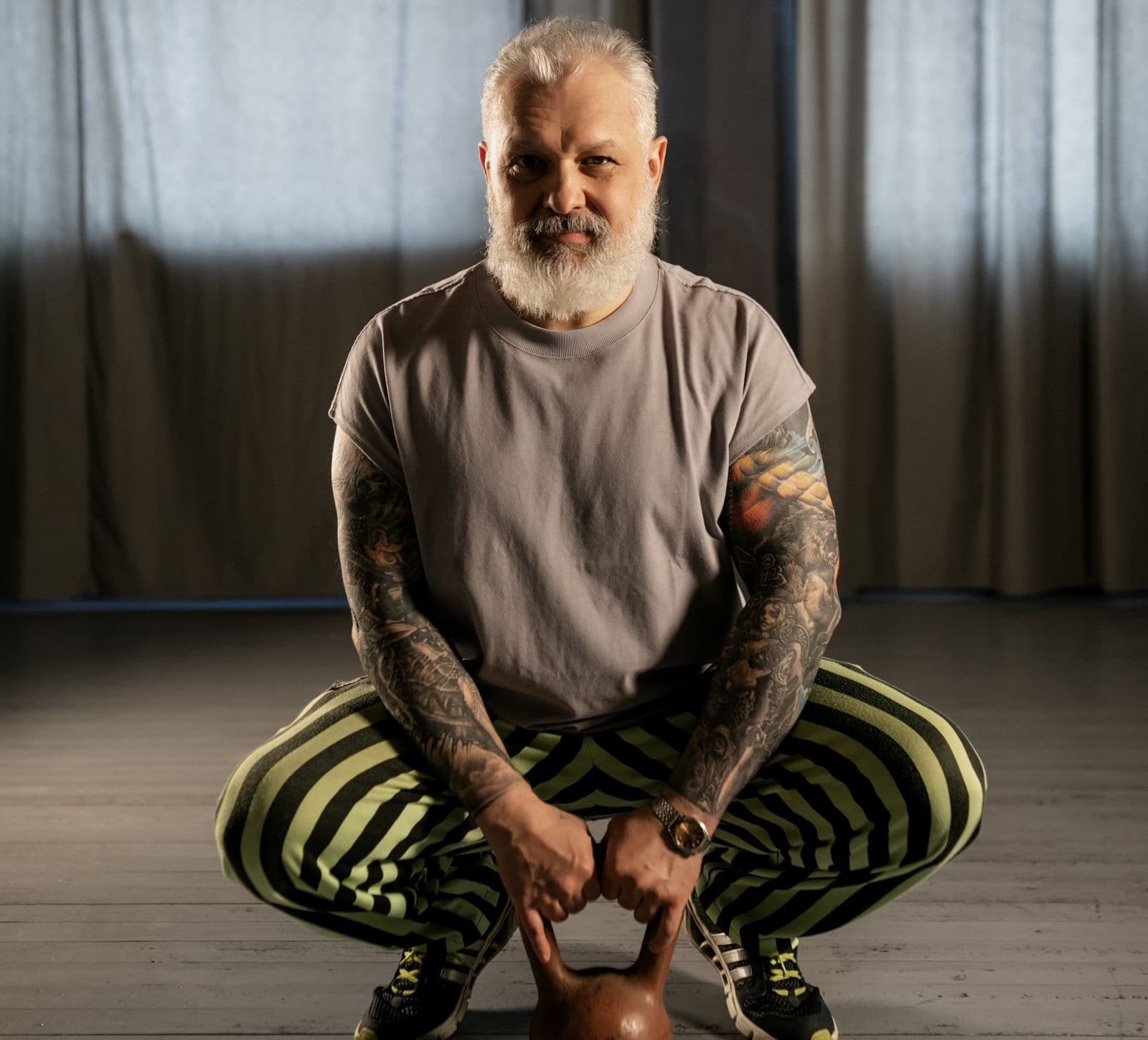
- Goblet box squat, holding a dumbbell or kettlebell at your chest, 3 sets of 8 to 10. Lower the box an inch once the old height has been quiet for a week.
- Dumbbell Romanian deadlift, 3 sets of 8. Hinge only as deep as the hip allows without groin pain, which for a lot of people with osteoarthritis is a bit short of what they're used to.
- Step-ups, 3 sets of 8 per side. Add dumbbells or an inch of height, but not both in the same week.
- Suitcase carry, 3 walks of 30 to 40 seconds per side. Holding the weight on one side makes the stabilizers of the opposite hip work.
Weeks 6 to 8: heavier and fewer.
- Keep the same movements, bringing reps down toward 6 to 8 as the load goes up. That's how the PROHIP participants progressed, and their pain went down while they did it.
- Add a split squat or reverse lunge once step-ups have felt comfortable for two weeks.
- Leave the box at whatever height has stayed comfortable. Depth can keep improving after week 8, and there's no reason to force it before then.
Adjust the starting point by profile. Stiff-but-strong can jump in at week 3. Weak-but-mobile follows the plan as written and can push load harder. Irritable does half the sets in weeks 1 and 2 and moves on only after a full week of clean next-morning checks.
Retest at week 8, and when to get it looked at
Run all three tests again under the same conditions: same chair, same step, same time of day. You're looking for three things:
- Two or three more chair stands than at the start, the change hip osteoarthritis patients themselves notice.
- Step-up pain the same or lower at the same height, with a clean next morning.
- Rotation roughly where it was. Don't expect much movement here. An arthritic hip often keeps its range limits while getting much more capable inside them, and that counts as a good result.
If the chair stand went up and the step-ups calmed down, keep going. The Danish GLA:D program has put close to 10,000 people with hip and knee osteoarthritis through eight weeks of education and supervised exercise, and reported pain improvements of 12 to 14 points out of 100 that held at a year. It's a registry with no control group, so it can't separate the exercise from everything else. What it does show is that gains from this kind of program tend to last once the supervision ends.
Bring in a clinician if any of these apply:
- Pain at rest or at night that has nothing to do with how you're lying.
- Walking distance shrinking month over month despite consistent training.
- Groin pain after a fall, or suddenly being unable to put weight through the leg.
- New hip pain alongside long-term steroid use, heavy drinking, or a history of cancer.
- Fever, unexplained weight loss, or a hot, swollen joint.
- Twelve weeks of consistent training with no change in the chair stand and pain that keeps getting worse.
If imaging shows a severe hip and a surgeon says you qualify, PROHIP suggests the operation will probably do more for your pain than training. Choosing it doesn't mean you've given up on training. You rehab with the leg you take into surgery, so the strength work pays off whichever way you go.
Where to start
Do the three tests this week, write the numbers down, and work out which profile you're in. That answers most of what I'd ask in a first session.
The hip doesn't work alone, either. Ankle range, trunk control, and the other hip all change how much load an arthritic hip has to absorb. For a quick read on those, the free movement screen scores six areas in about five minutes and doesn't ask for an email. It's the same assessment I start new clients with.
If you'd rather have someone build the program around your hip and adjust it as the numbers move, that's what one-on-one training is for. I've logged more than 12,000 sessions with adults around San Jose and the South Bay, and a lot of them were with people training around a joint they'd been told to wait out.
The Cupertino client started back with box squats to a bench that didn't bother him and step-ups off the bottom stair at home. Eight weeks later he had four more chair stands. His rotation was about where it started, and he was walking the lower loop at Rancho San Antonio again. He still might need a new hip eventually. He just isn't spending the years before that sitting down.
Ready to train smarter?
Get a personalized program built around your goals, your body, and your schedule.
Book Your Free ConsultationRelated Articles
Lifting with knee osteoarthritis: what 217 trials say about loading a worn joint
Strength training with knee osteoarthritis won't wear your cartilage down, and it also isn't the pain treatment it gets sold as. A San Jose trainer's read on what the research actually supports for training after 50.
Tennis Elbow or Golfer's Elbow? A 5-Minute Self-Test for Desk Workers Who Lift
Outside elbow or inside elbow, and which of four causes is driving it. Four at-home checks that tell you what your elbow pain is and whether you can keep training. A San Jose trainer's guide for desk workers who lift.

Outer hip pain when you lie on your side? Three at-home tests for gluteal tendinopathy
Hip pain when lying on your side is usually a tendon problem, not bursitis, and some of the usual advice makes it worse. Three at-home tests for gluteal tendinopathy and an 8-week plan from a San Jose trainer.