
Outer hip pain when you lie on your side? Three at-home tests for gluteal tendinopathy

Jeffrey Sun, ACE-CPT
October 9, 2026 · 16 min read
ACE-certified personal trainer specializing in functional movement, mobility, and strength training for busy professionals in San Jose and the Bay Area.
Book a free consultation →
A product manager in Sunnyvale told me she hadn't slept on her left side in eight months. She'd switched to her right, which helped for a few weeks, and then that hip started aching too. A doctor called it bursitis and gave her a cortisone shot. It worked beautifully for about two months.
When it wore off she went looking for exercises. She found clamshells, side-lying leg raises, and an IT band stretch where you pull your knee across your body. She did all three every night before bed, which was more or less the worst routine she could have picked.
None of that was her fault. It's what most of the pages ranking for this problem tell you to do. But the research on outer-hip pain has moved a long way in the last decade, and it says two things most of those pages haven't absorbed: the problem is usually a tendon, and the tendon hates being squeezed.
Three quick tests on your living room floor will tell you whether that's what you've got. After that comes an eight-week plan modeled on what the trials actually used. None of this is medical advice, and the last section covers what belongs with a doctor.
It's usually a tendon, not bursitis
The bony point on the outside of your hip is the greater trochanter. Two of your glute muscles, the gluteus medius and minimus, attach to it by short, flat tendons, and there's a small fluid sac (the bursa) sitting nearby. For decades, pain at that spot was called trochanteric bursitis by default.
Imaging says that label is usually wrong. Long and colleagues reviewed six years of hip ultrasounds in the American Journal of Roentgenology in 2013: 877 people with pain at the greater trochanter, average age 54. Only 20 percent had bursitis. About half had tendon changes in the gluteus medius or minimus, and almost 30 percent had a thickened iliotibial band. Bursitis was the minority finding, and when it showed up it was usually riding along with a tendon problem.
That matters because the two labels push you toward different responses. "Bursitis" sounds like inflammation, so it leads to rest and injections. A tendon problem responds to gradually increasing load, which is the opposite of rest.
It's also common. In the Multicenter Osteoarthritis Study, reported by Segal and colleagues in Archives of Physical Medicine and Rehabilitation in 2007, 3,026 adults aged 50 to 79 were examined for it. In women, 15 percent had it on one side and 8.5 percent on both. In men the figures were 6.6 and 1.9 percent. Women had more than three times the odds, and people with low back pain had nearly three times the odds as well.
How it differs from its neighbors. Hip osteoarthritis usually hurts in the groin and limits how far the hip rotates inward. If that sounds more like you, the hip osteoarthritis tests are the better place to start. The Segal study found that hip rotation didn't differ between people with and without outer-hip pain, which makes rotation a useful way to tell the two apart. Pain deep in the buttock that's worse with sitting is a different problem again, usually the hamstring tendon at the sit bone or the sciatic nerve, and the buttock pain tests sort those out.
Why it hurts at night: compression
The tendons wrap around the outside of the greater trochanter. When your thigh moves inward past the midline, the tendons get pressed against the bone, with the IT band tightening over the top of them. Grimaldi and colleagues laid out this mechanism in a 2015 review in Sports Medicine, and once you understand it, most of the confusing parts of this problem stop being confusing. Tendons tolerate being pulled. They tolerate being pressed against bone much less well, especially once they're irritated.
Once you know that, the night pain makes sense. Lying on the sore side presses the tendon straight into the bone. Lying on the other side, the top knee drops down toward the mattress and drags the tendon tight across the same spot. Either way, you spend seven hours compressing the tissue that hurts.
The same thing happens during the day in positions most people never think about:
- Sitting with your legs crossed, or with your knees pressed together.
- Standing with your weight hanging on one hip, the classic way people hold a toddler or wait in line.
- Low, soft seats where your knees end up higher than your hips.
- Stretches that pull the knee across the body, including the IT band stretch and the figure-four.
That last one is why the Sunnyvale client's routine backfired. She was stretching the exact tissue that was irritated, by compressing it, every night before lying on it.
I'd add side-lying hip raises to the list for now. They're a good exercise for a lot of people, and I prescribe them in the glute activation and hip osteoarthritis posts. For an irritated gluteal tendon, though, they load it hard at the top of the movement while the bottom hip sits directly on the mattress. I bring them back in week 6 or so, once the tendon has calmed down.
Test 1: press the bony point
Lie on your good side with a pillow between your knees. Find the bony point on the outside of the sore hip, roughly a hand's width below the top of your pelvis, and press firmly over it and just above and behind it with two or three fingers. Then do the same on the other hip for comparison.
Pass: No tenderness on the sore side beyond what you feel on the good side.
Flag: Pressing reproduces your familiar outer-hip pain.
This test is better at ruling the problem out than in. Grimaldi and colleagues tested it against MRI in the British Journal of Sports Medicine in 2017 in 65 people with outer-hip pain. Tenderness at the trochanter was present in 80 percent of those whose MRI showed gluteal tendinopathy, so if it doesn't hurt when you press, gluteal tendinopathy becomes unlikely. If it does hurt, that's consistent with the diagnosis but doesn't confirm it, since plenty of things around the outside of the hip are tender to a firm press.
Test 2: knee across the body
Lie on your back. Bend the sore-side hip and knee to about 90 degrees, then use your opposite hand to draw that knee gently across your body toward the other shoulder, as far as it goes without forcing. Hold it there for 10 seconds and rate the pain on the outside of the hip, 0 to 10.
Pass: Outer-hip pain stays at 1 or below.
Flag: Outer-hip pain of 2 or more, and it feels like your usual pain.
This is a home version of the compression tests clinicians use, and it's a direct check of the mechanism in the last section. The thigh crosses the midline, the tendon presses into the bone, and an irritated tendon complains. Groin pain during this test is a different signal, and it points back toward the hip joint itself.
I'll be honest about this one. The Grimaldi study looked at several compression and stretch tests like it, and none came out as conclusive as Test 3 below. Treat it as supporting evidence rather than a deciding vote.
Test 3: thirty seconds on one leg
This is the test with the strongest evidence behind it, and it's scored entirely on pain.
Stand next to a wall or kitchen counter with a fingertip resting on it for balance. Lift the good leg and stand on the sore one, knee soft, pelvis level. Start a timer and hold for 30 seconds. Note whether outer-hip pain appears, and if so, at how many seconds.
Pass: No outer-hip pain in 30 seconds.
Borderline: A mild ache that shows up in the last 10 seconds.
Fail: Your familiar outer-hip pain appears within 30 seconds, especially within the first 20.
In the Grimaldi study, pain within 30 seconds of standing on the affected leg was the most conclusive finding. Every person in the study who had that pain also had tendinopathy on MRI, a specificity of 100 percent, and it moved a 50 percent starting probability to 98 percent. The authors were careful to say their sample was small, so the precision on those numbers is low. But nothing else in the study came close.
The glute activation post uses the same single-leg position and scores whether your pelvis drops. This version ignores the pelvis entirely and only asks whether the outside of the hip hurts. Same stance, different question.
Reading your three results
Likely gluteal tendinopathy. Test 3 fails, and Test 1 is tender. That combination is about as strong as a self-assessment gets for this problem. Test 2 hurting as well adds weight but isn't required.
Possible, milder. Test 1 is tender and Test 2 flags, but Test 3 passes. The tendon may be irritated without being sensitive enough to light up in 30 seconds. The plan below still fits, and the compression rules matter most.
Probably not this. Test 1 isn't tender. Gluteal tendinopathy becomes unlikely, though not impossible: in the same study, 20 of the 65 participants had tendinopathy on MRI but came out negative on the clinical tests. If your pain is in the groin, go to the hip osteoarthritis tests. If it's deep in the buttock or travels down the leg, the low back or SI joint is the more likely source.
Get it looked at. Anything in the last section's list, or results that don't fit any of these.
What the trials say about treatment
The best evidence is the LEAP trial by Mellor and colleagues, published in The BMJ in 2018. They randomized 204 people aged 35 to 70 (167 of them women, average age 54.8), all with outer-hip pain for at least three months and MRI-confirmed tendinopathy. One group got education plus exercise, 14 physio sessions over eight weeks. One got a single cortisone injection. One got told to wait and see.
At eight weeks, 51 of 66 people in the exercise group rated themselves a success, against 38 of 65 after the injection and 20 of 68 waiting. Average pain was 1.5 out of 10 with exercise, 2.7 with the injection, and 3.8 waiting.
At a year, the exercise group still had more people rating themselves improved than the injection group, 51 of 65 against 36 of 63. Pain, though, had evened out between the two, at 2.1 and 2.3. Both still beat waiting.
A Dutch trial by Brinks and colleagues in the Annals of Family Medicine in 2011 tells a similar story about the injection from a different angle. In 120 primary care patients, 55 percent had recovered three months after an injection against 34 percent with usual care. At 12 months it was 61 percent against 60. The shot speeds things up. It doesn't change where you end up a year later.
I don't think that makes injections a bad choice. If you haven't slept properly in four months and you've got a big quarter at work, getting relief in a week is worth something real, and plenty of people use that window to start the exercise program. What I'd steer you away from is the injection on its own, followed by a return to the same sleeping position and the same nightly stretch.
The other piece of evidence explains why strength work matters here. Allison and colleagues measured hip abductor strength in Medicine & Science in Sports & Exercise in 2016, comparing 50 people with one-sided gluteal tendinopathy against 50 matched controls. The sore side was 32 percent weaker than in controls. The pain-free side was 23 percent weaker too. The authors couldn't say whether the weakness came first or followed the pain, but it was in both hips, which tells you this isn't only about the one that hurts.
An 8-week plan
The LEAP program combined load education with progressive exercise, so this plan does both. Everything below assumes your pain is 4 out of 10 or less during the exercises and back to baseline by the next morning. If it isn't, scale back a step.
Weeks 1 and 2: stop squeezing the tendon, start holding.
The habit changes come first, because no exercise program outruns seven hours a night of compression.
- Sleep on your back, or on the good side with a firm pillow (or two) between your knees and ankles so the top leg stays level with the hip.
- If you have to lie on the sore side, a foam mattress topper spreads the pressure.
- Sit with your knees hip-width apart and slightly below your hips. Don't cross your legs.
- Stand with weight even on both feet. If you're carrying a child, switch sides.
- Drop the IT band stretch, figure-four stretch, and any stretch that pulls the knee across your body.
Then add one exercise, daily: a standing isometric abduction hold. Stand with feet slightly wider than hip-width on a non-slip floor and push your feet outward as if trying to spread the floor apart, without letting them move. Build to about 70 percent effort. Hold 30 to 45 seconds, rest a minute, five times. You can also do it lying on your back with a strap or belt looped just above your knees, pushing out against it.
Isometrics load the tendon without moving it into compression, and some people find they take the edge off the pain for a while afterward.
Weeks 3 to 5: load in neutral positions, two to three times a week.
- Continue the isometric holds on non-training days.
- Glute bridge, 3 sets of 10, knees hip-width apart with a band above them pushing slightly outward.
- Sit-to-stand from a chair at a height where your knees stay below your hips, 3 sets of 10. Add a dumbbell held at your chest once it's easy.
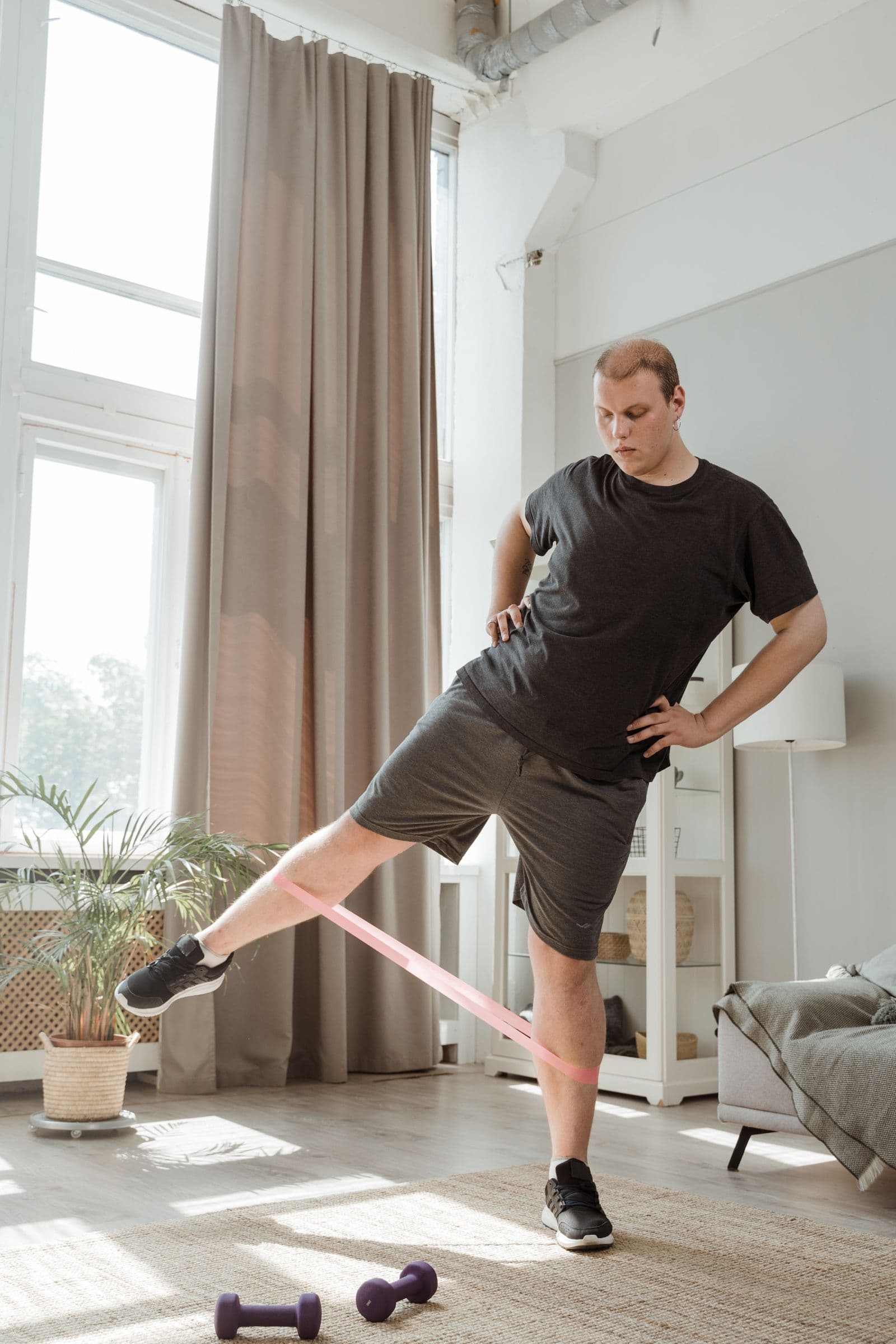
- Standing banded hip abduction with a light band above the knees, 3 sets of 12 per side, moving slowly and keeping the standing hip level.
- Hip hitch off a step: stand on the sore leg on a step with your pelvis level, lift the other side of the pelvis an inch higher, hold two seconds, and lower back to level. 3 sets of 10. The video lets the pelvis drop below level first. Skip that part for now, since dropping the pelvis moves the standing hip into the compressed position.
Weeks 6 to 8: single-leg and heavier.
- Step-ups onto a 6 to 8 inch step, 3 sets of 8 per side, holding dumbbells once they're comfortable.
- Split squat, 3 sets of 8 per side.
- Single-leg balance holds on the sore side, building to 30 seconds without pain, which is also your Test 3 retest.
- Side-lying hip abduction can come back now if you want it, lying on the good side with a pillow under the bottom knee and starting with small ranges.
- Suitcase carry, holding the weight on the sore side so the opposite hip has to work, 3 walks of 30 seconds.
Keep walking throughout, but on flat ground at a comfortable pace, and keep strides moderate rather than long. Steep hills and stairs can come back from week 5 if the next-morning check stays clean.
Retest at week 8, and when to get it looked at
Run all three tests again. What you're looking for:
- Test 3: from pain inside 30 seconds to a pain-free 30 seconds, or at least a clear delay before it appears.
- Test 1: tenderness reduced. It often lags behind the other two, so don't worry if pressing still hurts a bit.
- Sleep: whether you can lie on the good side with a pillow, and eventually on the sore side, without waking up.
In LEAP, most of the improvement showed up inside the eight weeks and held at a year. If you're clearly better, keep the strength work going twice a week and loosen the habit rules gradually. If you're not, that's useful information too.
Get a clinician involved if any of these apply:
- Pain in the groin rather than the outside of the hip.
- Numbness, tingling, or pain travelling below the knee, which points toward the back.
- Night pain that doesn't change with position, or pain at rest that's getting worse.
- Pain that started with a fall or a specific injury.
- Sudden weakness, or a new limp you can't walk off. A tendon can tear, and a weak, painful hip after a specific moment needs imaging.
- Fever, unexplained weight loss, or a history of cancer.
- Eight weeks of consistent work with no change on Test 3.
Where to start
Do the three tests tonight. They take five minutes, and they'll tell you whether this post is about your hip or someone else's.
The hip abductors don't work alone, and the Allison study's finding that both hips were weak is a hint that the problem is wider than the sore spot. How you stand and how well your trunk holds steady both change how much work the outside of the hip has to do. If you want a broader read, the free movement screen checks six areas in about five minutes and doesn't ask for an email. It's the same assessment I start new clients with.
If you'd like someone to build the program around your hip and adjust it week to week, that's what one-on-one training is for. I've logged more than 12,000 sessions with adults around San Jose and the South Bay, and outer-hip pain shows up in a lot more of them than the bursitis label would suggest.
The Sunnyvale client dropped the nightly stretch, bought a knee pillow, and did her isometric holds while the coffee brewed. Seven weeks in, she slept a full night on her left side for the first time since the winter before. She texted me about it at 6 a.m., which I chose to take as a compliment.
Ready to train smarter?
Get a personalized program built around your goals, your body, and your schedule.
Book Your Free ConsultationRelated Articles

Buttock pain when sitting? At-home tests to tell a hamstring tendon from a trapped nerve
Buttock pain when sitting usually comes from one of two places: the hamstring tendon at the sit bone, or the sciatic nerve deep in the buttock. Three at-home tests to tell them apart, and a plan for each, from a San Jose trainer.
Strength training for hip osteoarthritis: three at-home tests and what the newest trials say
Strength training for hip osteoarthritis does less for pain than most exercise lists suggest and more for what you can still do. Three at-home tests show which problem your hip actually has. A San Jose trainer's read on the 2024 to 2026 research.
Do your glutes actually fire? A three-part dead butt syndrome test you can score at home
Dead butt syndrome has a real mechanism and a real test. A San Jose trainer walks through three glute activation checks with pass, borderline, and fail lines, what each result means for your back and knees, and a four-week plan to wake the muscles back up.