
Standing desk back pain? A two-minute self-check and a sit-stand-walk routine that helps

Jeffrey Sun, ACE-CPT
November 2, 2026 · 11 min read
ACE-certified personal trainer specializing in functional movement, mobility, and strength training for busy professionals in San Jose and the Bay Area.
Book a free consultation →
A UX researcher in Mountain View bought a standing desk in January to fix her back. By February her back hurt more than it ever had sitting. The ache started about 40 minutes into standing, low and across both sides, and it took an hour of sitting before it faded. She'd started thinking her back was just bad.
It wasn't. She'd swapped one long, still position for another, and her body was telling her about it.
A standing desk is a good tool, and plenty of my clients love theirs. But "standing desk back pain" is common enough that there's a small body of research on exactly this, mostly from one lab at the University of Waterloo. It shows who gets it, why, and what helps. Below are two quick self-checks, a better way to use the desk, and a four-week plan for the muscles the research points to.
Why your back can hurt more after you switch to standing
The Waterloo researchers had healthy adults with no history of back pain stand at a workstation for two hours, rating their discomfort as they went. Consistently, a large share developed low back pain. In one 2014 study by Gallagher and colleagues in Ergonomics, it was 55 percent of 20 people. Researchers call them "pain developers."
What separated the pain developers from the rest is the useful part. In the Gallagher study, they held their lower back in a narrower range of positions during the stand. They moved less. And in a 2018 study by Viggiani and Callaghan in the Journal of Applied Biomechanics, which tested 40 young adults, the pain developers' hip abductors (the muscles on the outside of the hip that hold the pelvis level) tired sooner. After a fatiguing hip exercise, the non-pain developers recovered their lost strength during two hours of standing. The pain developers didn't.
So the picture is a back held still for a long time, supported by hip muscles that run out of endurance before the workday does.
It also seems to matter beyond the afternoon. In a 2014 follow-up by Nelson-Wong and Callaghan in Spine, people who had developed pain during a lab standing test were tracked for three years. They went on to have more episodes of clinical low back pain: 35 percent against 23 percent, and three times the likelihood in the first two years. Standing pain isn't a disaster, but it's worth taking as an early signal.
What standing desks do and don't do for back pain
The reviews are honest and a little underwhelming. A 2018 meta-analysis by Agarwal and colleagues in Ergonomics pooled eight studies of sit-stand workstations and found a small reduction in low back discomfort, roughly a third to a half of a point on a 10-point scale. A 2019 Cochrane review, covering 10 studies and 955 workers, found no significant difference in low back symptoms with sit-stand desks, and rated the evidence low quality.
At the other end, a 2018 meta-analysis by Coenen and colleagues in the British Journal of Sports Medicine, pooling 49 studies and 88,158 workers, found that standing for more than four hours a workday was associated with somewhat more low back symptoms.
None of that means standing desks are a bad buy. They give you a choice of position, and choice is useful. What they don't do on their own is fix a back that's sore from staying still. The fix is in how you use the desk and in the muscles holding you up.
Self-check 1: your standing tolerance
This one measures what's actually happening to you, which matters more than any recommended ratio.
For three ordinary workdays, every time you start a standing bout at your desk, note the time. Note it again when you first notice any low back discomfort, even a 1 out of 10. Then note how long it takes to fade after you sit or move.
Take the shortest of your three days.
Pass: 45 minutes or more before any discomfort, or none at all.
Borderline: 20 to 45 minutes.
Fail: Under 20 minutes, or discomfort that takes more than 30 minutes to settle after you sit.
These bands are my working lines, not published cutoffs. Your number is your starting point: it tells you how long your standing bouts should be right now, which is a little under your tolerance, not over it.
Self-check 2: the active hip abduction test

This test comes from the clinical research on standing pain. It looks at whether your pelvis and trunk can stay still while your hip muscles do the work.
Lie on your side on the floor with both legs straight and in line with your body, your head resting on your lower arm. Put your top hand on the front of your top hip so you can feel any movement. Slowly lift your top leg about a foot, keeping it in line with your body and your toes pointing forward. Hold for two seconds and lower. Do three reps, then switch sides. If you can, have someone film you from behind.
Score each side:
- 0: The pelvis and trunk stay still. The leg lifts cleanly.
- 1: Slight rocking backward or forward, or a small hitch at the start of the lift.
- 2: Clear rocking, or the leg drifts forward to make the lift easier.
- 3: You can't keep your balance on your side, or the leg can't lift without the whole body rolling.
Pass: 0 or 1 on both sides, with no more than one point between them.
Fail: 2 or 3 on either side, or a two-point difference between sides.
A 2016 study by Sorensen and colleagues in Human Movement Science used a version of this test in people with no back pain, then had them stand for two hours. The people who later developed standing pain moved their pelvis less symmetrically during the test, and the more asymmetric the movement, the worse their standing pain got.
This is a different test from the single-leg pelvic-drop check in the glute activation post. That one asks whether the glutes can hold the pelvis level when you stand on one leg; this one asks whether the trunk stays quiet while the hip moves. A failed result on both points the same way: toward hip endurance.
One caution. If you have pain on the outside of your hip when you lie on that side, skip this test for that side for now. Lying on an irritated gluteal tendon can make it worse.
How to use your standing desk
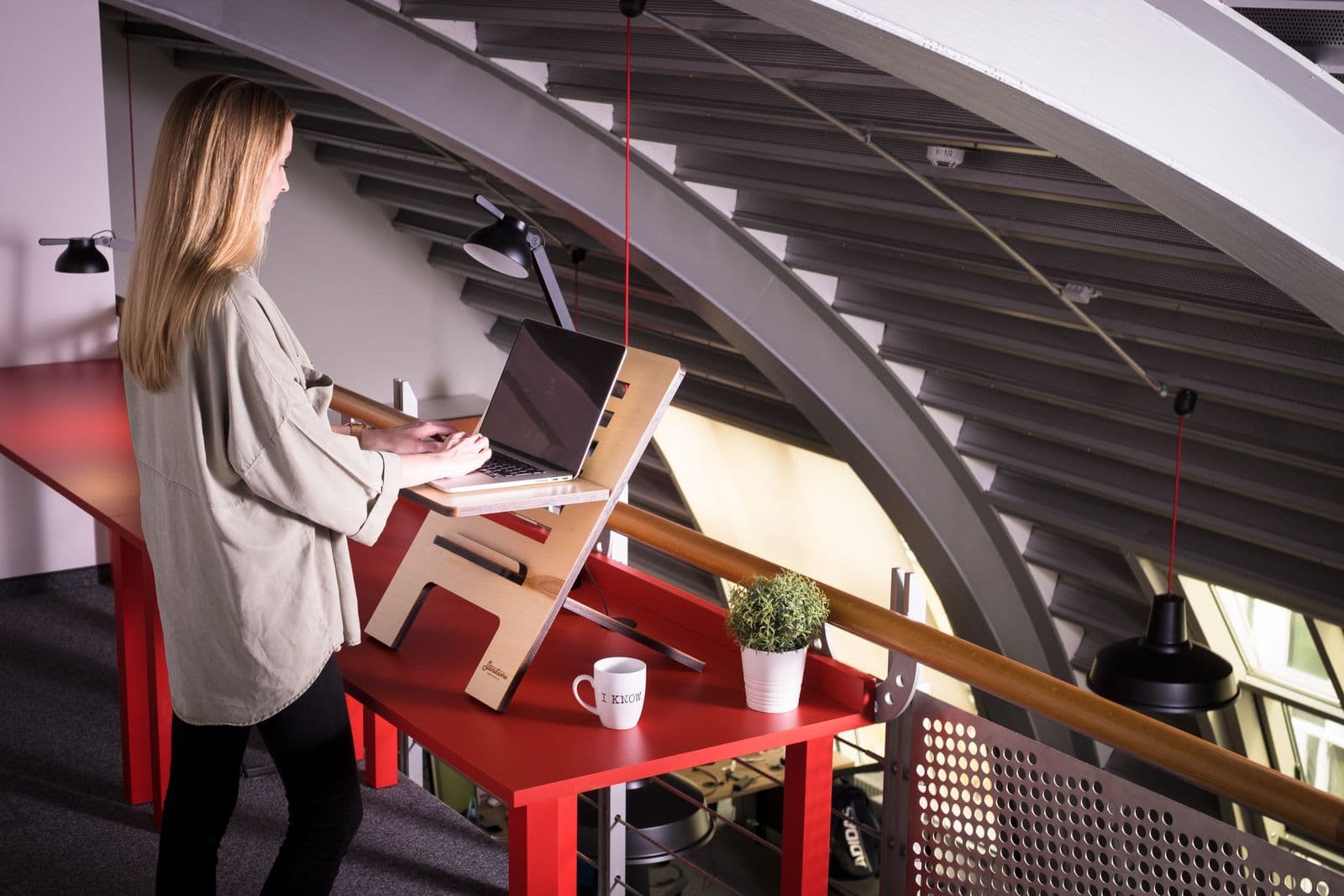
The research points away from a fixed ratio and toward movement.
In the 2014 Gallagher study, standing 45 minutes and sitting 15 didn't stop pain from building; it came back each time people stood again. A 2019 study by Gallagher and colleagues in Human Movement Science tried something different. Nineteen people stood for two hours twice: once straight through, once with a five-minute walk every 25 minutes. Without breaks, 58 percent developed back pain. With walking breaks, 26 percent did.
Footrests helped too, in a small way. In a 2019 Waterloo study by Fewster and colleagues, 12 people stood for 80 minutes, spending one minute in every four with one foot up on a low platform. Of the six who had developed pain in previous standing tests, only one developed it this time. The raised foot shifted the lower back slightly out of the position it had been stuck in.
So here's how I'd set it up:
- Stand in bouts a little shorter than your tolerance from self-check 1. For most people starting out, that's 20 to 30 minutes.
- Walk between bouts. Even two to five minutes. If it fits your day, this is where your exercise snacks go.
- Put something under one foot. A box, a low step or a thick book, about 6 to 8 inches high. Switch feet every few minutes.
- Shift your weight and move. Standing still is the problem, so fidgeting is fine.
- Sit when you need to. Sitting isn't failure. A mix of positions is the goal.
Desk setup matters less than people think, but get the basics right: the desk at a height where your elbows are at about 90 degrees with your shoulders relaxed, the top of the screen around eye level, and supportive shoes or a mat if you're on a hard floor.
A four-week plan for hip and trunk endurance
This targets what the research found: hip abductors that tire early, and a trunk that holds the lower back in one position. The aim is endurance, not maximal strength. In a 2010 study by Nelson-Wong and Callaghan, pain developers who did a four-week exercise program reported lower standing pain afterward than those who didn't.
Do this three times a week. It takes about 15 minutes.
Weeks 1 and 2
- Standing hip abduction, holding the desk or a counter, lifting the leg out to the side slowly with the trunk still. 2 sets of 15 per side.
- Clamshells, lying on your side with knees bent, opening the top knee without rolling the pelvis back. 2 sets of 15 per side.
- Dead bug, 2 sets of 8 per side.
- Bird dog, 2 sets of 8 per side with a two-second hold.
Weeks 3 and 4
- Banded standing hip abduction, a light loop band above the knees. 3 sets of 15 per side.
- Side plank from the knees, building to 30 seconds per side. Move to full side plank when that's easy.
- Suitcase carry, a dumbbell or heavy bag in one hand, walking tall without leaning. 3 walks of 30 to 40 seconds per side.
- Glute bridge march, lifting one foot at a time without the hips dropping. 2 sets of 8 per side.
If you have outer-hip pain, swap the side-lying clamshells and side plank for the standing versions only. They load the same muscles without pressing on the tendon.
At the end of week four, repeat both self-checks. You're looking for a longer standing tolerance, a cleaner score on the hip abduction test, and a smaller difference between sides.
When to get it checked, and where to go from here
Low back pain from standing usually settles with the changes above. Get it looked at if:
- The pain travels below your knee, or comes with numbness, tingling or weakness in your leg.
- It's there all the time, including when lying down, or wakes you at night.
- It started after a fall or injury.
- You have new trouble controlling your bladder or bowels. That's urgent.
- Four weeks of the plan haven't changed your standing tolerance at all.
For the UX researcher, self-check 1 came in at 22 minutes on her worst day, and she scored a 2 on her left side in the hip test. She cut her standing bouts to 20 minutes, put a shoebox under her desk for one foot, and walked to refill her water between bouts. By the end of the four weeks she was standing 40 minutes before noticing anything, and the left side scored a 1. She still uses the desk every day.
Your hips and trunk are only part of how you stand. Ankle and hip mobility, and how your pelvis sits, all change how much your lower back has to do. The free movement screen checks six areas in about five minutes, with no email required, and it's the same assessment I start new clients with.
If you'd like someone to watch how you stand and build the plan around what they see, that's what one-on-one training is for. I've logged more than 13,000 sessions with adults around San Jose and the South Bay, and a standing desk shows up in a lot of their stories.
Ready to train smarter?
Get a personalized program built around your goals, your body, and your schedule.
Book Your Free ConsultationRelated Articles
Morning heel pain? At-home tests for plantar fasciitis, and why the first step after sitting hurts most
Heel pain in the morning that eases as you walk is the classic plantar fasciitis pattern. Three at-home self-tests to confirm it, a way to find what's driving yours, and the strength program the trials support, from a San Jose trainer.

Am I losing muscle? A four-part sarcopenia self-test you can score at home
Sarcopenia has clinical cutoffs you can test with a chair, a tape measure, and a hallway. A San Jose trainer walks through the four screens, what a low score actually means after 50, and what to do about each cause.
Test your muscle power at home after 40: three leg power tests you can score, and why power fades before strength
Muscle power drops years before strength does, and no gym number catches it. A San Jose trainer walks through a sit-to-stand power test, a stair power test, and a vertical jump with pass, borderline, and fail lines, then sorts a low score into the four things that cause it.