
Knee pain hiking downhill: three tests for whether your legs can handle the descent

Jeffrey Sun, ACE-CPT
September 27, 2026 · 13 min read
ACE-certified personal trainer specializing in functional movement, mobility, and strength training for busy professionals in San Jose and the Bay Area.
Book a free consultation →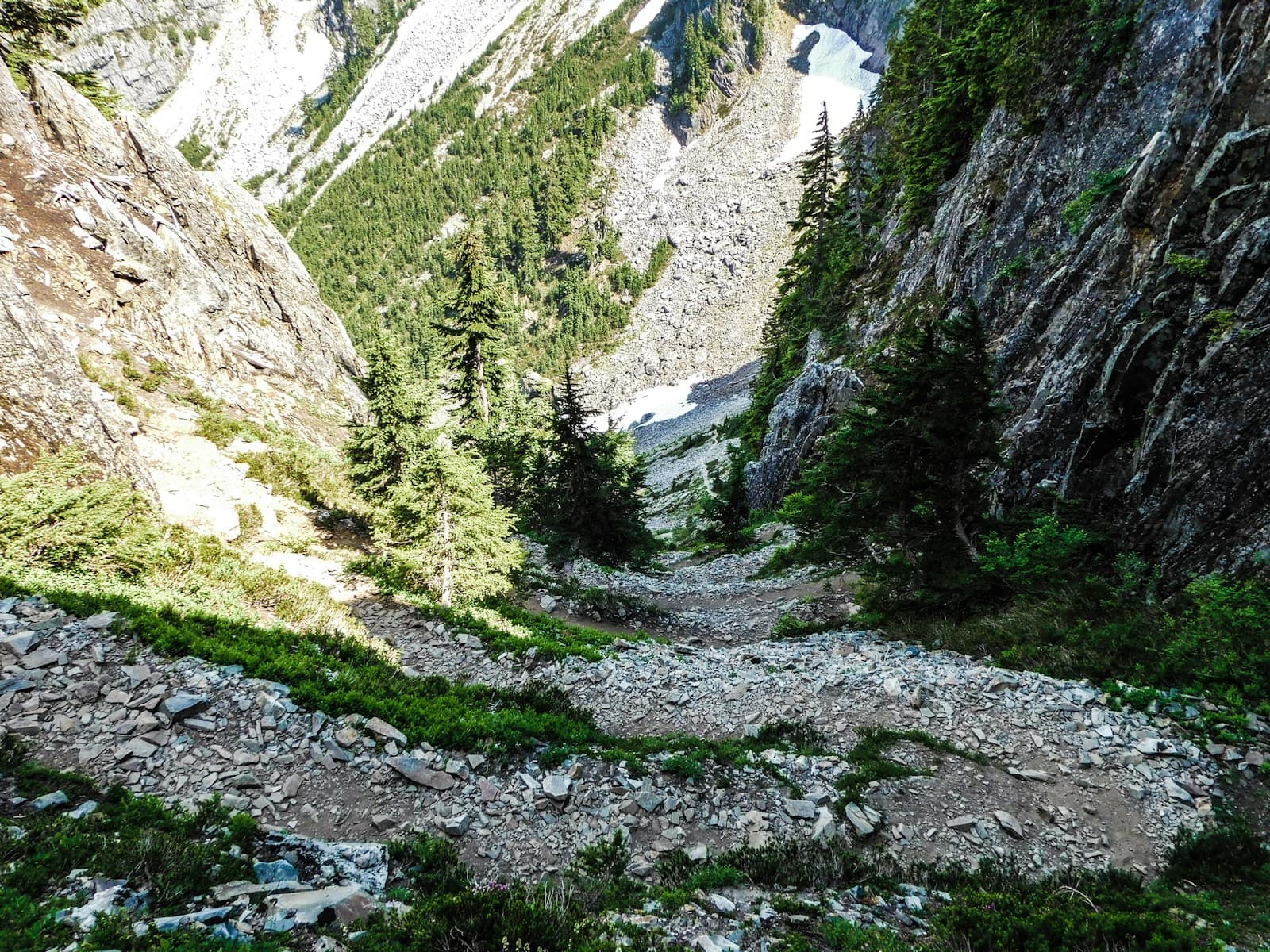
A director at a company off North First Street told me he'd finally done Mission Peak on a Saturday in March. He'd trained for months, and the climb was fine. Hard, but fine. He made the summit in good time and felt pleased with himself.
Then he walked down. By the car park his quads were shaking so badly he had to sit on a rock. For the next three days he went down his office stairs sideways, one step at a time, holding the rail.
Nothing was injured. He'd trained the wrong half of the hike.
Mission Peak drops about 2,000 feet in roughly three miles, and that descent is a fundamentally different physical demand from the climb. Going up, your quads shorten as they push you up, your lungs set the limit, and you feel the effort honestly as it happens. Going down, your quads have to lengthen under load while stopping your bodyweight from accelerating downhill, several thousand times. That's braking, and it's the job almost nobody trains for.
Every page that ranks for downhill knee pain hands you the same six exercises. None of them lets you find out whether you actually need them, or which one. Below are three tests with real scoring, a reading of what the combination means, and six weeks of work sorted by which one you failed.
This isn't medical advice, and the last section covers the results that mean you should see a clinician instead.
Why the descent is the part that hurts
The quadriceps have two ways of working. They can shorten while producing force, which is what pushes you up a hill. And they can lengthen while producing force, which is what stops your knee folding when your foot lands below you. The second one is the braking job, and it is unavoidable on a descent.
Lengthening contractions produce more force for less metabolic cost, which sounds like a bargain and isn't. The muscle is being pulled apart while it resists, and that produces far more soreness than the same amount of uphill work. It's why you can feel completely fine at the summit and destroyed at the trailhead.
The part that surprised me in the research is that strength isn't the first thing to go. Werner, Valero-Cuevas and Federolf published a study in 2023 in which young, healthy adults walked for 30 minutes on a treadmill set to a 20-degree decline. Afterward, their leg dexterity and their front-to-back balance had both dropped significantly. Their maximum leg extension strength had not.
The thing that degraded was the fine control of foot placement, the system deciding exactly how your foot meets the ground. The raw strength was still sitting there unused. So the reason people slip, stumble and turn an ankle late in a descent isn't only that they're tired in the usual sense. The control loop itself gets noisy.
That study was done in young healthy people on a treadmill at a fixed angle, which is not a Bay Area fire road with loose gravel, and it doesn't tell us how the effect scales at 55. But it does explain something I see constantly: the second half of a descent is when people get hurt, and it isn't because their legs got weak.
So a useful set of tests has to look at control and endurance separately, because those are two different failure modes with two different fixes.
Test 1: how big a step can you control?
Most step-down tests count reps. This one finds your ceiling instead, because a trail doesn't ask for twenty identical small steps. It asks whether you can control the one big rock step in front of you.
You'll need steps or sturdy boxes at a few heights. A standard stair is about 7 inches. Two stacked is around 14. A kitchen chair seat is roughly 18.
How to run it. Stand on the step on one leg, hands off everything, the other leg hanging free in front. Lower yourself slowly, about three seconds down, until the heel of the free foot just touches the floor. Then come back up. Film from the front. Start at 7 inches and work up until the quality breaks.
What counts as breaking. The scoring criteria come from clinical step-down assessment, where the things examiners watch for are the arms flying out for balance, the trunk leaning to the side, the pelvis dropping on the free-leg side, the knee caving inward, and losing your footing. Any one of those means that height is above your current ceiling.
Pass: you can control 14 inches on both legs with none of those five faults.
Borderline: 7 inches is clean, 14 inches shows one fault.
Fail: 7 inches already shows a fault, or there's a clear difference between legs.
A caution on self-scoring. Piva and colleagues in 2006 tested how consistently trained physical therapists rated movement quality on a step-down task in 30 patients, and the agreement between examiners was only moderate. If experienced clinicians watching the same person disagree at the margins, you watching your own phone footage should hold your result loosely. Treat a borderline as a fail and retest in six weeks.
The side-to-side comparison is sturdier than the absolute grade. Loudon and colleagues in 2002 measured functional tests including the step-down in 29 people with kneecap pain and 11 without, and found the symptomatic group averaged 85 percent symmetry between limbs while the healthy group averaged 97 percent. Their cohort averaged 27 years old, so don't import the numbers directly. The principle transfers: near-identical sides is the healthy pattern, and a leg that's obviously worse is the leg that will complain at mile two of the descent.
Test 2: the wall sit, scored to failure
Test 1 measures control. This one measures how long the quads can keep producing force before they quit, which is the quality that runs out in the second hour of a descent.
Back flat against a wall, feet about two feet out, slide down until your thighs are parallel to the floor and your knees are directly above your ankles. Hands off your legs, arms folded or hanging. Start a timer and hold until you either lose the position or have to push on your thighs.
Pass: 90 seconds or more.
Borderline: 60 to 90 seconds.
Fail: under 60 seconds.
These are my training lines, not published norms, and I'll say that plainly because the internet is full of wall-sit charts presented with more authority than they've earned. What I'll stand behind is the pattern across the people I've coached: someone who can't hold 60 seconds is someone whose quads will be shaking at the bottom of a long descent, and someone past 90 rarely reports that specific problem.
The useful detail is where you feel it. Burning across the front of the thighs is the test working. Pain at the front of the kneecap, or under it, is a different signal, and it belongs in the last section of this post rather than in a training plan.
Test 3: the descent rehearsal and the 48-hour answer
The first two tests happen in your living room. This one uses an actual descent, because the delayed response is the thing you can't fake and can't feel at the time.
Find a real downhill. A steep street, a stadium's worth of stairs, or a short trail section. Walk down for 15 minutes at a comfortable pace. Not a hike, just the descent. Then do nothing unusual for two days and pay attention.
Pass: mild stiffness the next day, gone by day two, stairs never a problem.
Borderline: noticeable soreness peaking at 24 to 48 hours that makes stairs awkward but manageable, clearing by day three.
Fail: soreness that has you going down stairs sideways, or anything still there on day four.
Soreness peaking a day or two later is what braking work normally does, and on its own it's information rather than a warning. What the severity tells you is the gap between the dose you gave your legs and the dose they were ready for. Fifteen minutes producing a three-day recovery means a two-hour descent is going to be a genuinely bad time.
This test also has the best carryover of the three, because repeating it is itself the training. Tissue adapts to eccentric work quickly once it's exposed to any of it at all.
Reading the three together
All three pass. Your legs can handle a long descent. Pacing and pack weight are the variables left, and the section below covers both.
Test 1 fails, Tests 2 and 3 fine. A control problem. You have the engine and the endurance, and the leg isn't organizing itself well under a single big load. This usually traces upstream to the hip rather than the knee, and the glute activation checks will tell you whether the muscle that's supposed to stop the pelvis dropping is actually doing it.
Test 2 fails, Test 1 fine. An endurance problem, and the most common single result I see. Your mechanics are fine for a few steps and the quads run out of road. This is the most trainable of the three, and six weeks moves it substantially.
Test 3 fails while 1 and 2 pass. An exposure problem. The capacity exists in the gym and the tissue hasn't met a descent recently. The fix is dosing, not strengthening, and it's the fastest of the lot.
Tests 1 and 2 both fail. Start with Test 2. Endurance underpins control once fatigue arrives, and the step-down height usually improves alongside it without separate attention.
A big left-to-right difference on any test. Deal with that before adding distance. One leg taking a disproportionate share for a two-hour descent is the mechanism behind a lot of one-sided knee complaints.
Building descent capacity in six weeks
Two sessions a week, about twenty minutes. Everything here is a lowering movement, because that's the job.
Step-downs. Three sets of six per leg at a height you can control with clean form, three seconds down. When six are easy, add an inch of height rather than more reps. Height is the variable that transfers to trail steps.
Wall sits. Three holds, each to about 80 percent of your test time, resting a minute between. Add ten seconds a week. Dull and effective.
Split squats with a slow lower. Three sets of eight per leg, taking three to five seconds to descend and standing up at normal speed. Hold a weight once bodyweight stops being interesting.
The weekly descent. The one people skip. Once a week, go walk down something. Start at whatever produced only mild soreness in Test 3, and add roughly 10 to 15 minutes of descending each week. This is the piece that actually prepares tissue for a long day, and no amount of indoor work replaces it.
Retest all three at week six. Wall sit time moves first, usually by week three. Step-down height follows. The 48-hour response is the slowest to change and the most meaningful when it does.
What poles, pacing and pack weight actually change
On the day itself you control three things, roughly in this order of usefulness.
Trekking poles. Bohne and Abendroth-Smith tested this in 2007 with 15 experienced male hikers descending with and without poles across three different backpack loads, and found pole use reduced the joint moments and power at the lower limb. Fifteen experienced men is a small, specific sample, so treat the size of the effect as approximate. The direction is solid and it matches what people report. Poles work well for anyone carrying weight or covering long descents. For someone who finds them fiddly on technical ground, the trade-off shifts, and that's a reasonable call to make for yourself.
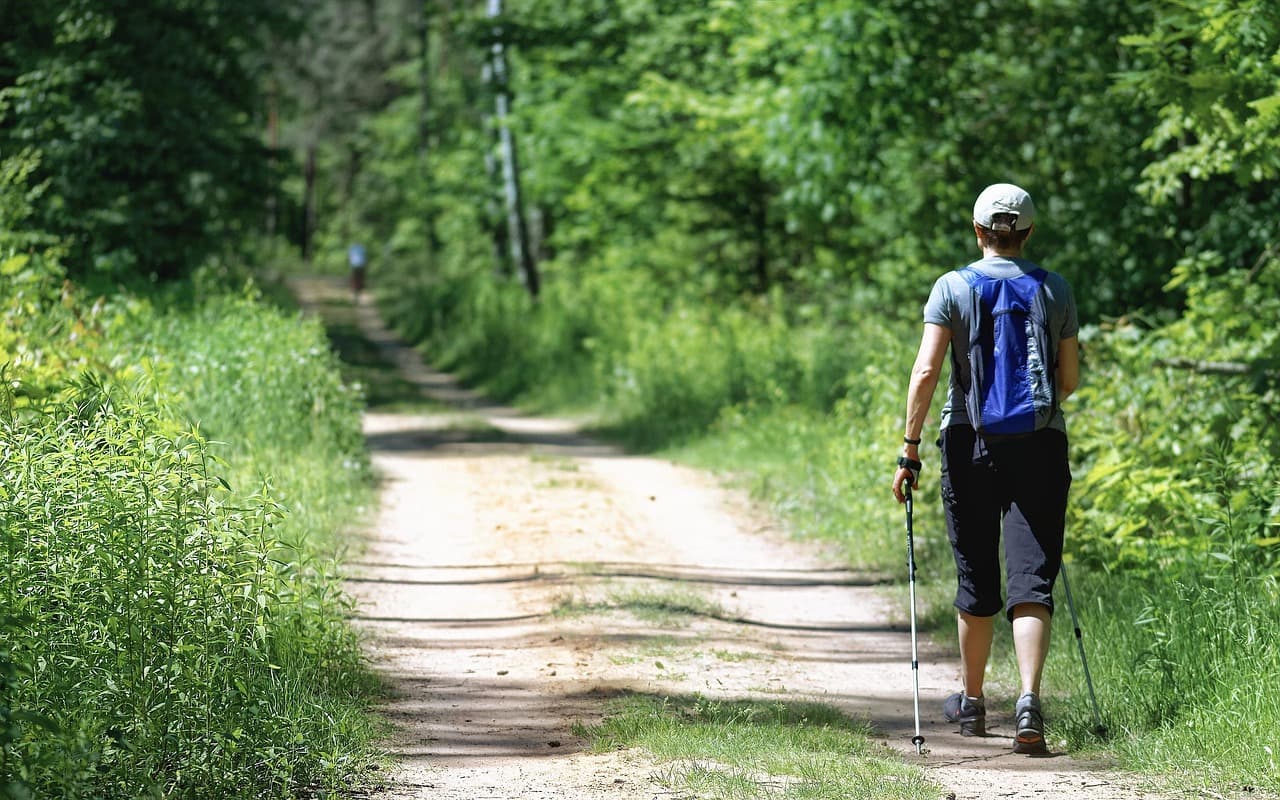
Pack weight. Every pound is a pound your quads brake on every step down. The same study varied load precisely because load and descent compound each other. If your tests came back borderline and you're carrying a heavy pack, the pack is the cheapest variable to change.
Step length and pace. Shorter steps mean less distance for your body to fall between footfalls, so each braking contraction is smaller. Going down faster feels efficient and raises the force of every landing. On a long descent, deliberately shortening your stride is free and most people only discover it when their legs are already gone.
What none of these do is build capacity. They reduce the demand on the legs you brought. That's worth having, and it's a different thing from being ready.
When downhill knee pain isn't a training problem
A few results point to a clinician instead.
Pain at the front of the kneecap or underneath it during the wall sit, rather than muscular burning. Pain that's sharp instead of achy. Swelling after a hike, or a knee that feels warm. Any catching, locking or giving way. Pain that starts early in a descent rather than building through it.
Downhill pain that arrived suddenly on one specific step, rather than accumulating across months of hikes, is an injury rather than a capacity gap, and it gets assessed before it gets trained.
And if you've been told you have knee osteoarthritis, the loading picture is genuinely different and worth reading properly. Strength training with knee osteoarthritis covers what the evidence supports and where it's weaker than people assume.
Where to start
Run Test 2 tonight. It takes 90 seconds, needs a wall, and for most people it's the one that comes back borderline.
If the results were mixed, or you want to know whether the limitation is the knee at all before you pick a plan, the movement screen is the assessment I run in a first session. Five minutes, no email, and it checks the ankle and hip patterns that decide whether a control fault is really coming from the knee.
And if you'd rather have someone watch you do the step-down and tell you what they see, that's what a first session is for. I've run more than 12,000 sessions in San Jose and the South Bay, and a good number of them started with someone who could get up the hill perfectly well. Book a consultation and bring your three scores.
Ready to train smarter?
Get a personalized program built around your goals, your body, and your schedule.
Book Your Free ConsultationRelated Articles

Outer hip pain when you lie on your side? Three at-home tests for gluteal tendinopathy
Hip pain when lying on your side is usually a tendon problem, not bursitis, and some of the usual advice makes it worse. Three at-home tests for gluteal tendinopathy and an 8-week plan from a San Jose trainer.

How Often Should You Strength Train After 30?
The honest answer for busy professionals: two or three days a week usually fits best, while higher frequencies work great when your schedule and recovery can support them. A San Jose trainer breaks down the trade-offs.
Strength training for hip osteoarthritis: three at-home tests and what the newest trials say
Strength training for hip osteoarthritis does less for pain than most exercise lists suggest and more for what you can still do. Three at-home tests show which problem your hip actually has. A San Jose trainer's read on the 2024 to 2026 research.