
A dumbbell-only home strength program after 40, with a starting test that picks your weights

Jeffrey Sun, ACE-CPT
October 30, 2026 · 12 min read
ACE-certified personal trainer specializing in functional movement, mobility, and strength training for busy professionals in San Jose and the Bay Area.
Book a free consultation →
A software engineer in Campbell told me he'd bought a pair of 15-pound dumbbells during the pandemic and used them for exactly one week. He'd found a 20-minute YouTube workout, done it six days straight, felt wrecked, and then never quite got back to it. The dumbbells spent three years holding a door open.
The problem wasn't the dumbbells or his discipline. It was that nobody told him whether 15 pounds was the right weight for him, how many sets to do, or what to change when it got easier. Every program he found was a list of exercises, and none of them answered the questions that actually decide whether a home program works.
That's what this post is for. A 15-minute starting test that tells you how heavy to lift on three key movements, a guide to which dumbbells to buy, a twice-a-week plan that fits around a full workday, and a way to keep progressing when the next dumbbell is a big jump. It's the version of a home program I give clients who travel too much to see me every week.
What a pair of dumbbells can do after 40
A fair question, since most of the strength research you hear about involves barbells and machines.
The short answer is that dumbbells cover every pattern that matters: squat, hinge, push, pull and carry. If you want the case for why those five matter more than any single exercise, the beginner's guide to strength training for longevity lays it out. What dumbbells limit is how heavy you can go, especially for the legs. That matters less than people think.
A 2021 network meta-analysis in Medicine & Science in Sports & Exercise, pooling 28 studies and 747 adults, compared light, moderate and heavy loads. Muscle growth was about the same across all three. Strength was a different story: moderate and heavy loads beat light ones clearly. In other words, lighter dumbbells will still build muscle if you take your sets close to the point where you can't do another rep, but you'll gain more strength as the weight goes up. The program below uses both facts.
Home training on its own has been tested too. A 2021 review by Chaabene and colleagues in Ageing Research Reviews looked at home exercise programs in healthy older adults. Programs focused only on strength improved it moderately, more than mixed programs that spread their time across balance and flexibility. And sessions of 30 minutes or less still worked. A separate 2021 review by Mañas and colleagues, covering 21 trials and 4,053 older adults training unsupervised at home, found no major adverse events and modest gains in leg strength and power. The main problem was adherence: on average, people completed about two-thirds of their sessions.
That's the honest picture. Home dumbbell training works, it's safe, and its biggest weakness is that people stop doing it. A clear plan with a way to see progress helps with that.
The starting test: find your working weights
This test does two jobs. It tells you whether the dumbbells you have are the right weight, and it gives you a working weight for each of the three movements the program is built around.
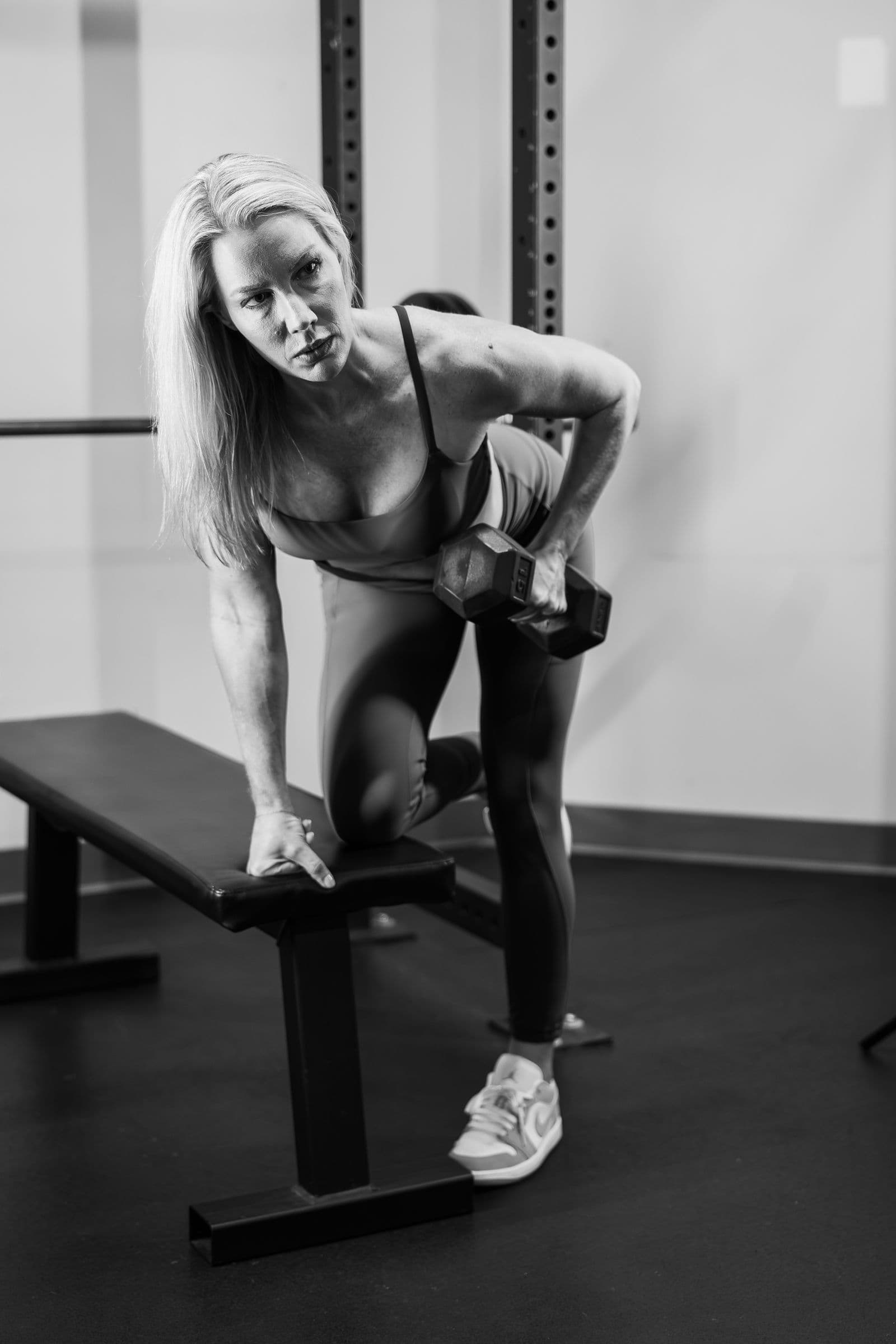
How to run it. Use whatever dumbbells you have. Warm up with one easy set of each movement first. Then for each movement, do as many clean reps as you can, and stop when you think you have one or two good reps left. Not at failure: one or two reps short of it. Write down the weight and the number of reps.
1. Goblet squat. Hold one dumbbell vertically against your chest. Squat down until your thighs are at least parallel, or as deep as you can with your heels down and your back flat, then stand up.
2. One-arm row. Put one hand and the same-side knee on a sturdy bench or chair. Pull the dumbbell from a hanging position up to your hip, elbow close to your side. Test your weaker side and use that number for both.
3. Floor press. Lie on your back with knees bent, a dumbbell in each hand above your chest. Lower until your upper arms touch the floor, then press back up.
Reading your number, for each movement:
- More than 20 reps: too light to build much strength. You'll still use this weight, but with the harder variations described in the progression section, and it tells you what to buy next.
- 12 to 20 reps: a good place to start. This is your working weight for sets of 10 to 15.
- 6 to 11 reps: this is a strength range. Your working weight for sets of 6 to 10.
- Fewer than 6 reps: too heavy for now. Drop to a lighter weight or an easier version (a box squat to a chair, a floor press with one dumbbell at a time, or a row with a lighter weight).
Stopping one or two reps short is harder to judge than it sounds. A 2022 meta-analysis by Halperin and colleagues in Sports Medicine, pooling 12 studies, found people underestimated how many reps they had left by about one rep on average, and were more accurate when the set was 12 reps or fewer. So if you think you had two left, you probably had three. That's fine for the first test. You'll get better at judging it within a few weeks, and the RPE self-test goes deeper into reading effort if you want it.
How heavy should you lift?
Here's the short version I give clients: heavy enough that you finish every working set with one to three good reps left in the tank.
That sounds vague, so here are the numbers. For each exercise, pick a rep range from the test, then pick the weight that gets you to the top of that range with one to three reps to spare.
- Tested 12 to 20 reps: train in sets of 10 to 15, stopping with two or three reps left.
- Tested 6 to 11 reps: train in sets of 6 to 10, stopping with one or two reps left.
- Tested over 20 reps: switch to a harder variation and train in sets of 8 to 12, stopping with one or two reps left.
Two things matter more than the exact weight. First, every rep should look like the first one. When the form starts to change, the set is over. Second, the weight should go up over time. A program where you're still using the same dumbbells for the same reps after two months has stopped working, whatever the starting weight was.
Which dumbbells to buy
You don't need a rack. You need the right two or three weights for your test results, and a plan for what comes next.
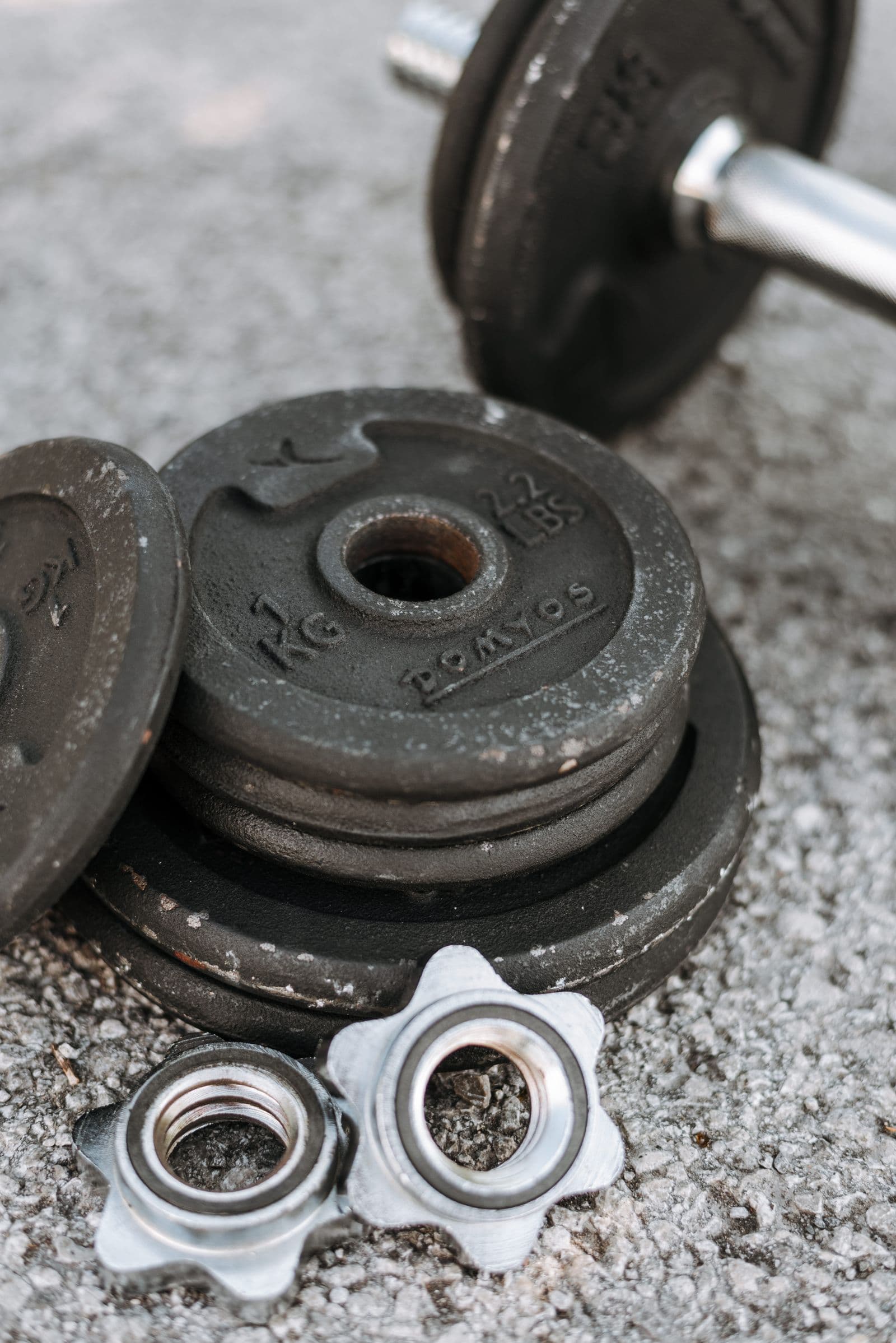
A lighter pair for floor presses, overhead presses and rows. Most people's test numbers put this somewhere around 10 to 25 pounds each.
A heavier single dumbbell for goblet squats, Romanian deadlifts and split squats. Legs are much stronger than arms, so this is usually 25 to 50 pounds. One is enough at first, since most leg movements hold a single weight at the chest or in both hands.
Adjustable dumbbells, either the dial-and-cradle kind or a handle with plates and spin-lock collars, are worth considering if you're planning to train for more than a few months. One set replaces six or more fixed pairs, and it's often cheaper once you've bought your third pair. The trade-off is that changing weight takes a moment, and the dial versions can feel bulky for rows and floor presses.
If you only want to spend money once, adjustables usually win. If you'd rather start with something simple and see whether the habit sticks, one lighter pair and one heavier single dumbbell is a good, cheap way in.
The program: two or three days a week, about 30 minutes
Two workouts, A and B, alternated. If you train twice a week, do A then B. If you train three times, rotate A, B, A one week and B, A, B the next.
Rest 60 to 90 seconds between sets. Every session takes about 30 minutes including a five-minute warm-up of easy reps on the first exercise.
Workout A
- Goblet squat, 3 sets
- Floor press, 3 sets
- One-arm row, 3 sets per side
- Romanian deadlift (dumbbells in front of the thighs, hinge at the hips with a soft knee), 3 sets
- Dead bug, 2 sets of 8 per side
- Suitcase carry (one dumbbell in one hand, walk tall), 3 walks of 30 to 40 seconds per side
Workout B
- Split squat, holding the heavier dumbbell at your chest or the lighter pair at your sides, 3 sets per side
- Half-kneeling one-arm overhead press, 3 sets per side
- Chest-supported row (lie face down on an incline bench or lean your chest on a high table), 3 sets
- Dumbbell glute bridge, the dumbbell resting on your hips, 3 sets
- Side plank, 2 holds of 20 to 30 seconds per side
- Farmer carry (a dumbbell in each hand), 3 walks of 30 to 40 seconds
Use your rep ranges from the test for the first four exercises in each workout. For the exercises you didn't test, start with the same weight as the closest tested movement and adjust after the first session: the split squat follows the goblet squat, the overhead press starts at about two-thirds of your floor press weight, and so on.
On how many days to pick: twice a week is enough to make steady progress. A third day suits people whose schedule can hold it, and the Chaabene review found more than three weekly sessions gave a somewhat bigger strength effect. The plan that works is the one that survives your busiest month.
How to progress when the next dumbbell is too big a jump
The biggest practical problem with home dumbbells is that the jumps are big. Going from 20 to 25 pounds on a floor press is a 25 percent increase, and most people can't make that in one step. So progress the exercise before you progress the weight, in this order:
- Reps. Add a rep or two each week until you hit the top of your range on every set. Then move on.
- Tempo. Take three seconds to lower the weight on every rep. The same dumbbell becomes noticeably harder.
- Pauses. Pause for two seconds at the bottom of each rep, where the movement is hardest.
- Single-limb versions. Goblet squat becomes a split squat, then a rear-foot-elevated split squat with your back foot on a couch. Romanian deadlift becomes a single-leg version. Floor press becomes a one-arm floor press. Each is a big jump in difficulty with no new equipment.
- Then buy the next weight up, and start back at the bottom of your rep range.
Most people can stay on the same set of dumbbells for two to four months by working through these steps. The software engineer from the top of this post went from his 15s to a pair of 25s and a 40 for squats, and he got about three months out of each step before needing the next.
Retest at week six
Run the starting test again at week six with the same dumbbells. You're looking for more reps at the same weight on all three movements, which tells you the program is working and usually means it's time to move up a weight or a variation.
If one movement hasn't moved, that's useful too. Usually it's a technique issue or a mobility limit: a goblet squat that won't get deeper often comes down to the ankles or hips rather than strength.
How much strength training you need for health is less than most people expect. A 2022 meta-analysis in the British Journal of Sports Medicine, pooling 16 cohort studies, found muscle-strengthening activity was associated with 10 to 17 percent lower risk of death from any cause, heart disease, cancer and diabetes. The largest reduction appeared at around 30 to 60 minutes a week. That's observational, so it shows an association rather than proof, but it lines up with the program above: two 30-minute sessions a week is right in that range.
Where to go from here
The starting test tells you how strong you are on three movements. It doesn't tell you whether your ankles, hips or shoulders will let you do them well. If you want that part checked, the free movement screen looks at six areas in about five minutes, with no email required, and it's the same assessment I start new clients with.
If you'd like someone to watch your goblet squat and row, set the weights for you, and adjust the plan every few weeks, that's what one-on-one training is for. I've logged more than 13,000 sessions with adults around San Jose and the South Bay, and plenty of them have been in living rooms with nothing more than a pair of dumbbells.
The engineer's 15s are back in use, by the way. His kids use them now. He moved on to adjustables last spring and keeps them under his desk, which he says is the only reason he trains on Wednesdays.
Ready to train smarter?
Get a personalized program built around your goals, your body, and your schedule.
Book Your Free ConsultationRelated Articles
Strength Training for Longevity After 30
Losing muscle after 30? A San Jose trainer breaks down the minimum effective strength training for a longer, stronger life — even on a packed schedule.
Score your joint hypermobility at home, then change how you lift
The Beighton score takes four minutes and nine points. If you come back hypermobile, the usual mobility advice is aimed at someone else's problem. A San Jose trainer on what the score changes about your training.
Tennis Elbow or Golfer's Elbow? A 5-Minute Self-Test for Desk Workers Who Lift
Outside elbow or inside elbow, and which of four causes is driving it. Four at-home checks that tell you what your elbow pain is and whether you can keep training. A San Jose trainer's guide for desk workers who lift.