
Back pain from lifting your toddler: three capacity tests that beat another lecture on technique

Jeffrey Sun, ACE-CPT
September 24, 2026 · 13 min read
ACE-certified personal trainer specializing in functional movement, mobility, and strength training for busy professionals in San Jose and the Bay Area.
Book a free consultation →
A staff engineer in Willow Glen came to me last spring with a low back that hurt every evening and never in the morning. He'd had the ergonomic assessment at work. He'd bought the chair. He'd read the guide that said bend your knees and hold the child close, and he was doing it.
He also had a two-year-old and a newborn.
I asked him how many times a day he picked up the toddler. He said maybe eight. He counted the next day, mostly to prove me wrong, and got to thirty-one before dinner. Car seat, high chair, bath, stairs, the tantrum in the driveway, the thousand small hoists nobody logs. Call it 30 pounds, thirty times, mostly from floor height, usually one-armed because the other hand had a bottle or a door in it.
Nobody had ever asked him whether he had the capacity for that. They'd only told him how to hold it.
That's what's missing from nearly everything written on this. The advice is all technique, and technique turns out to be the part with the weakest evidence behind it. So below are three tests you can score, and eight weeks of work sorted by whichever one you fail.
This isn't medical advice, and there's a list of things at the end that mean you should see a clinician first.
Your toddler is a 30-pound kettlebell with opinions
Here's the load, written the way I'd write it in a program.
Thirty pounds. Twenty-five to thirty-five reps a day. Floor to chest height. Frequently single-arm. Frequently asymmetric, because you're turning toward the car door as you lift. Occasionally dynamic, because the load decided halfway up that it would rather be on the ground. No warm-up. No rest intervals. Seven days a week, no deload, for about four years.
If a client asked me to program that, I'd tell them we need to build toward it. Nobody gets to build toward it. The load arrives at seven pounds and increases by roughly a pound a month, which is gentle enough that you never notice the day it passed what you can comfortably handle.
And the demand is real. A 30-pound child lifted thirty times is 900 pounds of floor-to-chest work before you've done anything else with your day. Most of the desk workers I see in San Jose don't lift 900 pounds in a training session.
So when the back starts complaining at 7pm and not at 7am, that timing is the clue. Tissue that ran out partway through the day's volume behaves exactly like that. And the useful thing about running out is that you can train for it.
Why "lift with your legs" keeps not working
I want to be careful here, because this advice isn't nonsense and I still coach technique every day. A cleaner lift genuinely costs you less per rep. But on its own, as a strategy for stopping back pain, it has been tested a lot and it hasn't held up.
The clearest look at it is a 2008 systematic review in the BMJ by Martimo and colleagues. They pulled together six randomized trials covering 17,720 participants, plus five cohort studies, all testing advice and training in lifting technique, with and without lifting equipment, in jobs built around heavy lifting. None of the comparisons in the randomized trials produced a significant difference in back pain, disability, or sick leave. The cohort studies agreed. The authors wrote that their findings "challenge current widespread practice of advising workers on correct lifting technique," which is unusually blunt for a review.
Then there's Steffens and colleagues in JAMA Internal Medicine in 2016, a meta-analysis of 21 randomized trials and 30,850 people looking at what actually prevents an episode of low back pain. Education on its own: no effect, relative risk 1.03. Back belts: no effect. Shoe insoles: no effect. Exercise combined with education: risk of an episode cut to 0.55. Exercise alone: 0.65.
The quality grading matters and I'll state it plainly. The exercise-plus-education finding was rated moderate quality; exercise alone was low to very low. These aren't settled numbers. But the direction is consistent across two large independent bodies of evidence, and it points the same way both times: the thing that moves back pain risk is being stronger and more durable, not being better informed about hip angles.
So the technique advice on every page ranking for this topic is worth following. It's just the smaller of the two levers, and it's the only one any of them hands you. Hold your kid close and hinge at the hips, by all means. Then go find out whether you can actually do the job thirty times.
Test 1: the loaded hinge
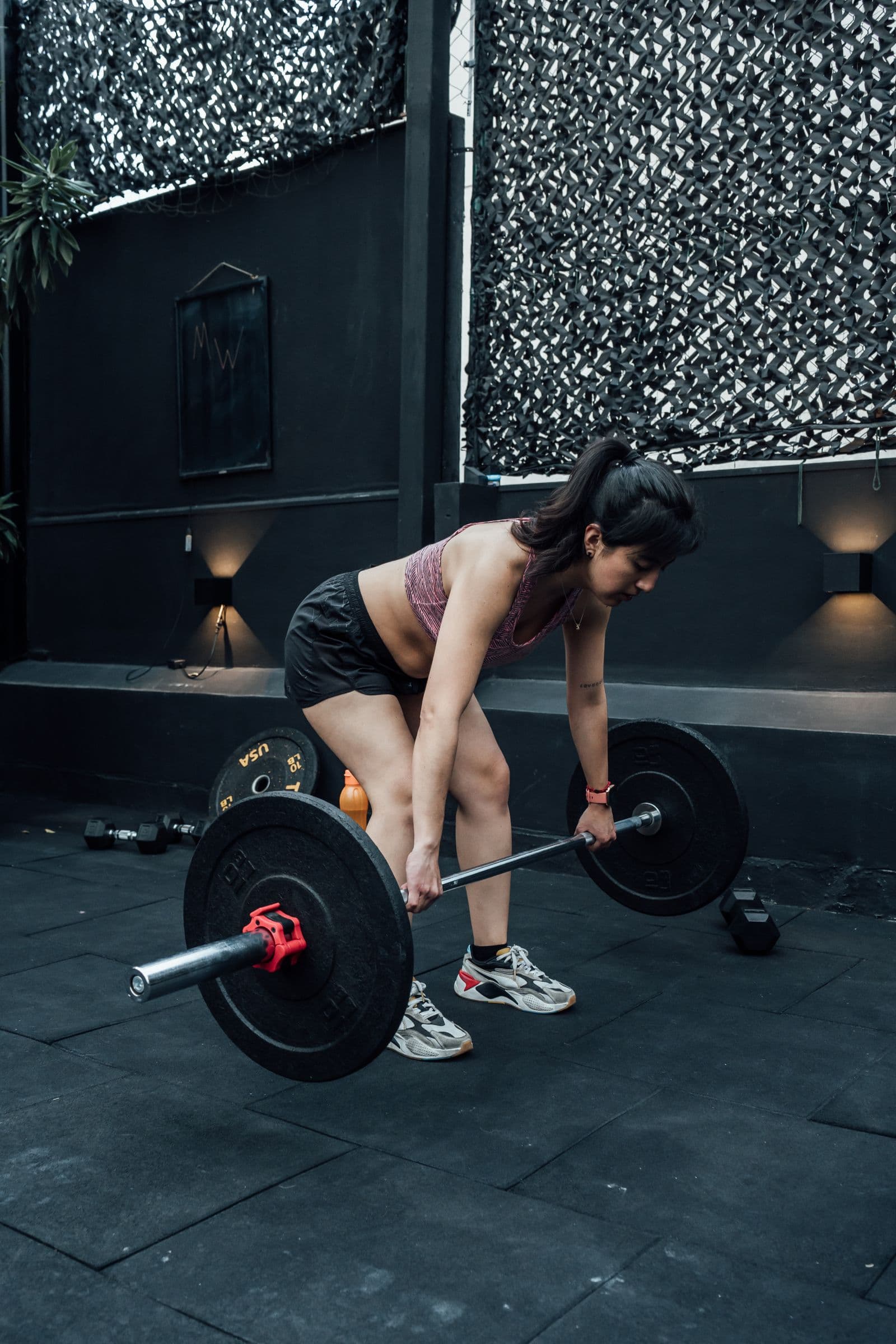
You need an object around 25 to 30 pounds that you can grip: a kettlebell, a loaded backpack, two gallon jugs in a tote, a case of water. Not the child, for this one. Children move, and the test needs a constant.
How to run it. Put the object on the floor in front of you. Film yourself from the side with your phone propped on a shelf. Pick it up and set it down five times at an easy pace, then watch the video.
Pass: the hips travel backward before the chest drops, the lower back keeps its shape from start to finish, the object stays close to your shins on the way up, and you finish standing tall without a shrug or a lean.
Borderline: the lower back rounds slightly in the last few inches before the floor, or the object drifts four or five inches away from your legs on the way up.
Fail: you can't reach the floor without your lower back doing most of the bending, you need to widen your stance dramatically or turn a foot out to get down there, or you're noticeably more comfortable on one side.
The follow-up that tells you why. If you failed, put the object on a step or a stack of books about six inches up and run it again. If the pattern cleans up immediately at the higher start, your problem is range, not strength. Hips and hamstrings are capping how far you can hinge before the spine takes over. If it still looks the same six inches up, the pattern itself needs coaching before load.
Test 2: twenty reps, the actual daily dose
This is the test I care most about, and it's the one no page ranking for this topic runs. One clean lift proves very little when the job is thirty of them.
Same object, same setup, phone still filming. Lift it from the floor to chest height and back down, twenty times, about one rep every three seconds. Don't rush it and don't rest.
Pass: all twenty reps look like the first one. You feel it in the glutes and hamstrings. You're breathing hard at the end and that's it.
Borderline: the pattern holds to somewhere between rep ten and rep fifteen, then the hips start rising faster than the chest, or the object starts drifting away from your body.
Fail: form degrades before rep ten, or the lower back is the first thing to fatigue and the legs never really get involved.
That last distinction is the useful one. Which tissue tapped out first tells you what to train. When the low back fatigues before the legs do, the back extensors are doing a job the hips should be leading, and they're the smaller, less durable option for it.
There's a reason to take back endurance seriously as its own quality. Biering-Sørensen's 1984 study in Spine examined 449 men and 479 women in a Copenhagen suburb, measuring trunk strength, endurance and flexibility, then followed them for twelve months. Good isometric endurance of the back muscles was associated with not developing first-time low back trouble in the men. The effect didn't replicate in the women in that cohort, and it's a forty-year-old single study, so I'd hold it loosely. But endurance being the protective quality rather than peak strength matches what the job actually asks for.
Test 3: the one-sided carry
Now the part that's specific to parenting. Most lifting in a gym is symmetrical. Almost no lifting with a small child is.
Hold the same object in one hand, arm straight down at your side like a suitcase. Stand tall, ribs stacked over your pelvis, shoulders level. Walk at a normal pace for sixty seconds, then switch hands and repeat. Film it from the front if you can.
Pass: sixty seconds a side with your shoulders staying level, no lean away from the weight, and no difference worth noticing between sides.
Borderline: thirty to sixty seconds before the loaded shoulder drops or the trunk starts side-bending, or one side is clearly harder than the other.
Fail: under thirty seconds, an obvious lean from the first steps, or a gap between sides big enough that the weaker side feels like a different exercise.
A side-to-side difference here is worth more attention than the absolute time. Most parents have a default hip, and the pattern is so habitual that people are surprised when I point it out. The body adapts to the side it gets used on, and the other side quietly falls behind.
What your three results mean together
Read them as a pattern rather than three separate grades.
All three pass. Your capacity isn't the limiter, and the evening backache is coming from somewhere else. Total daily load is the usual suspect: the lifting sits on top of eight hours of sitting, broken sleep, and a nervous system that's been running warm for two years. That's a real mechanism, not a consolation prize, and how work stress changes what your training should look like is the more useful read for you than anything below.
Test 1 fails, the rest are fine. A range problem. You have the strength and the durability, and you can't get into the position cheaply. Hips and hamstrings are the usual constraint, and it responds quickly.
Test 1 passes, Test 2 fails. The most common result I see, by a distance. You know how to lift and you run out of the ability to keep doing it. This is an endurance problem in the hips and trunk, and it's the one that maps most directly onto the evening timing of the pain.
Test 3 fails on its own, or one side is much worse. A lateral tolerance problem. The muscles that stop you folding sideways under a one-armed load aren't up to the volume you're giving them, or one side has been carrying a disproportionate share for years.
Tests 2 and 3 both fail. Start with Test 2's plan. Trunk endurance underpins both, and the carry usually improves alongside it without separate work.
The eight-week plan, by which test you failed
Two sessions a week. Twenty minutes. This fits in the gap between bedtime and being too tired to stand, which is the only training window most parents of young children actually have.
If Test 1 failed (range). Spend the first three weeks on getting to the floor. Elevated hinges from a step, dropping the height as it cleans up. Ninety-ninety hip switches and a half-kneeling hip flexor stretch on both sides, daily, two minutes each. Run the hip mobility check to find out which part of the hip is actually short, because chasing the wrong one is how people stretch for a year without changing anything. From week four, add the Test 2 work below.
If Test 2 failed (endurance). Three exercises, two sessions a week.
Hinge lifts: four sets of twelve with your test object, a rep every three seconds, stopping any set the moment the pattern changes. Add two reps per set each week.
Goblet squats: three sets of ten. This is your floor-to-stand pattern for the times you're lifting a child who's sitting rather than lying.
Dead bugs or bird dogs: three sets of eight a side, slowly. If you want to know which of those you actually need, the core stability tests will tell you, and they use the same two movements as scored assessments.
If Test 3 failed (one-sided tolerance). Suitcase carries, three sets of forty seconds per side, twice a week, starting lighter than your test weight and building. Add side-lying hip abduction, two sets of fifteen a side. Then the deliberate part, which costs nothing: alternate the hip you carry your child on, and start on the side you don't like. You'll hate it for about two weeks.
Everyone, regardless. Two things that aren't exercises. Get the child to climb rather than be lifted wherever it's practical, which is most places by age three and turns thirty lifts into twelve. And spread the load: a hip carry is cheaper than a front carry, a backpack carrier is cheaper than either for anything over a few minutes.
Retest all three at week eight. The twenty-rep test is the one that tends to move most visibly.
When it isn't a capacity problem
Some results mean a clinician rather than a program.
Pain that travels below the knee, or numbness, tingling or weakness anywhere in the leg. That's a nerve question and it needs assessing rather than loading.
Pain that wakes you at night, or that's there in full force first thing in the morning before you've lifted anything. The pattern in this post is fatigue-driven, so it builds through the day. A back that hurts most at 6am is telling a different story.
A specific incident. If it started with one sharp moment on one particular lift rather than creeping up over months, that's an injury rather than an accumulated load problem, and it gets assessed before it gets trained.
Six weeks of sensible loading with no change at all.
And if you've given birth in the last year, or you have any leaking, heaviness or pressure through the pelvis, see a pelvic health physical therapist before you start adding load. That's a genuine specialty and it isn't mine.
Where to start
If you only do one thing from this post, run Test 2. It takes ninety seconds, it models the actual demand better than anything else here, and for most parents it's the one that comes back borderline.
If the results came back mixed, or you'd rather know which of the hip, ankle and trunk patterns is the real constraint before you pick a plan, the movement screen is the same assessment I run in a first session. Five minutes, no email required, and it flags where to put the effort.
And if you'd rather have someone watch you lift and tell you what they see, that's what a first session is for. I've run more than 12,000 sessions in San Jose and the South Bay, and a fair number of them have started with a parent who assumed their back was the problem when it was really the arithmetic of thirty lifts a day. Book a consultation and bring your three scores.
Ready to train smarter?
Get a personalized program built around your goals, your body, and your schedule.
Book Your Free ConsultationRelated Articles
Tennis Elbow or Golfer's Elbow? A 5-Minute Self-Test for Desk Workers Who Lift
Outside elbow or inside elbow, and which of four causes is driving it. Four at-home checks that tell you what your elbow pain is and whether you can keep training. A San Jose trainer's guide for desk workers who lift.
Strength training for hip osteoarthritis: three at-home tests and what the newest trials say
Strength training for hip osteoarthritis does less for pain than most exercise lists suggest and more for what you can still do. Three at-home tests show which problem your hip actually has. A San Jose trainer's read on the 2024 to 2026 research.

Outer hip pain when you lie on your side? Three at-home tests for gluteal tendinopathy
Hip pain when lying on your side is usually a tendon problem, not bursitis, and some of the usual advice makes it worse. Three at-home tests for gluteal tendinopathy and an 8-week plan from a San Jose trainer.