
Achilles pain in the morning? At-home tests to find out why, and a 12-week loading plan

Jeffrey Sun, ACE-CPT
October 18, 2026 · 14 min read
ACE-certified personal trainer specializing in functional movement, mobility, and strength training for busy professionals in San Jose and the Bay Area.
Book a free consultation →
An engineering manager in Mountain View, 46, told me the hardest part of his day was the staircase at home. The first trip down every morning, his left Achilles felt like a rusty hinge. By the bottom step it was loosening, and by lunch he'd forgotten about it. Then Saturday pickleball would bring it back for most of Sunday.
He'd been stretching his calf off the edge of a stair every night, letting the heel drop as far as it would go. It was the stretch every page he'd read recommended. For his particular Achilles, it was close to the worst choice.
Morning Achilles pain that loosens as you warm up is one of the most recognizable patterns in sports medicine. What's less obvious is that it comes in two kinds that need slightly different plans, and that most people can keep playing while they fix it. The four tests below sort out which kind you have and how irritated it is. After that comes a 12-week plan built on the trials. None of it is a diagnosis, and there's a section on what needs a doctor.
Why the first ten steps are the worst
The Achilles is the thick cord at the back of your ankle connecting the calf muscles to the heel bone. Every step pulls on it, and running or jumping pulls hard. When it's loaded more than it's ready for, week after week, the tendon gets irritated and sensitive. That's tendinopathy. "Tendonitis" is the older name, but there's usually little inflammation in it.
Overnight, your foot rests pointed slightly down and the tendon stiffens. Your first steps ask it to stretch and take your full weight before it's warmed up, and it complains. A few minutes later it's moving better. Same story after a long meeting, a car ride, or a flight.
It's not just a runner's problem. In a Dutch study by de Jonge and colleagues in the British Journal of Sports Medicine in 2011, researchers counted Achilles tendinopathy diagnoses across 57,725 people registered with family doctors. Among adults aged 21 to 60, the rate was 2.35 per 1,000 people per year. Only 35 percent of cases were recorded as related to sport. A lot of these are people like the engineering manager: sitting all week, then asking a lot of the tendon on the weekend.
Test 1: find where it hurts
Sit with the sore leg crossed over the other knee so you can reach the back of the ankle. Run your thumb and finger gently along the tendon, from where it joins the heel bone up toward the calf, squeezing lightly as you go. Note where it's most tender, and whether the tendon feels thicker there than on the other side.
Midportion: The sore spot is in the cord itself, roughly two to six centimeters above the heel bone, about two to three finger-widths up. There may be a thickened or lumpy section.
Insertional: The sore spot is right where the tendon attaches to the back of the heel bone, sometimes with a bony bump there.
Neither: Tenderness is only underneath the heel, or the tendon isn't tender anywhere.
These two findings are better evidence than they sound. In a 2013 study in Foot and Ankle Surgery, Hutchison and colleagues ran ten different clinical tests on 21 people and compared them against ultrasound. Only two held up. Pain when the tendon was pressed caught 84 percent of the confirmed cases, and pain reported in that two-to-six-centimeter zone caught 78 percent. Both were reliable between examiners. The study was small and looked at midportion tendons only, but it's the clearest guide there is to which simple checks are worth trusting.
If the tender spot is underneath your heel rather than behind it, the plantar fasciitis tests are the better starting point.
Test 2: the morning stiffness clock
This one measures how irritated the tendon is, which matters more than the label because it decides how hard the program starts. For seven mornings in a row, note:
- How many minutes, or how many steps, before your Achilles loosens up.
- How stiff it feels on your first steps, from 0 to 10.
- Anything unusual the day before, like a long walk, a match, or a hilly run.
Low irritability: It loosens within a few minutes or about 20 steps, and first-step stiffness is 3 or below.
Moderate: It takes 5 to 15 minutes to loosen, or first-step stiffness is 4 to 6.
High: It takes more than 15 minutes, first-step stiffness is 7 or more, or it hurts at rest.
These bands are my working lines, not published cutoffs. The trend is what matters most. A tendon that's stiffer on Monday morning after a weekend of pickleball than it was on Friday is telling you the weekend load was too much. The clock gives you a way to see that instead of guessing.
Test 3: the one-rep pain probe
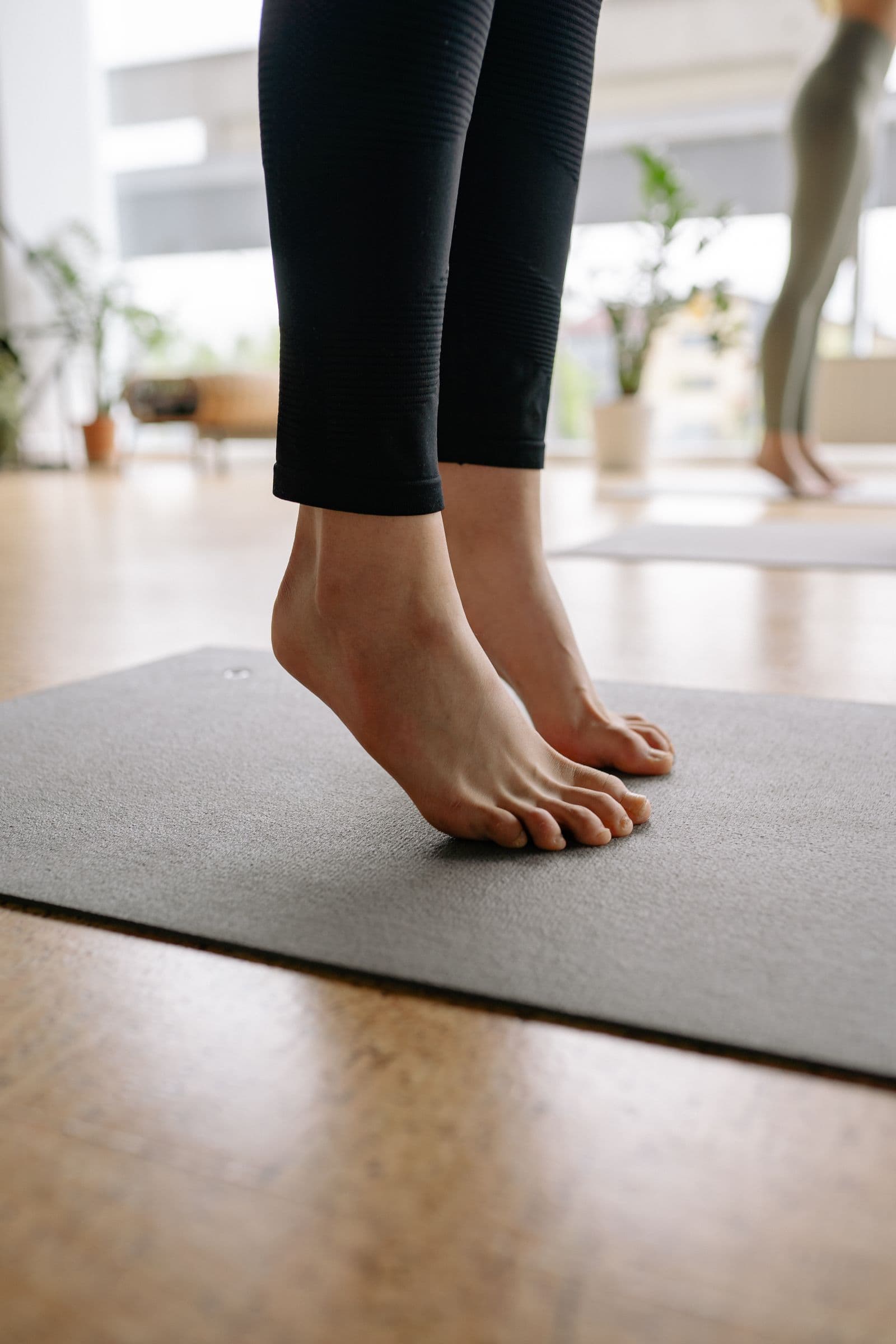
This test looks at how the tendon responds to one rep of load. It doesn't count reps.
Stand on a flat floor with a fingertip on a counter for balance. Do one slow heel raise on both feet: three seconds up, three seconds down. Rate the Achilles pain from 0 to 10. Then do one slow heel raise on the sore leg alone and rate it again. Finish with one on the good leg for comparison.
Pass: Pain 2 or below on the single-leg rep.
Borderline: Pain 3 to 5 on the single-leg rep, with the two-leg rep comfortable.
Fail: Pain above 5 on the single-leg rep, or pain on the two-leg rep.
Then check tomorrow's stiffness clock. If one rep each side made the next morning noticeably worse, the tendon is in the high-irritability group whatever this test scored.
This is about pain, not capacity. If you want to know how much your calf can actually do, the single-leg calf raise test in the return-to-running post counts reps against published norms. I'd do that one only once your pain probe passes.
Test 4: the VISA-A questionnaire
The VISA-A is the standard way clinicians score Achilles tendinopathy, and it works fine at home. It's eight questions about stiffness, pain on stairs, heel raises and hopping, and how much your activity is limited, scored out of 100. You can find the full questionnaire in the original 2001 paper by Robinson and colleagues in the British Journal of Sports Medicine and in most physio clinic resource pages.
That paper gives you useful reference points. People without Achilles problems averaged above 96. People managing tendinopathy without surgery averaged 64. People waiting for surgery averaged 44.
Pass: 90 or above. Close to normal.
Borderline: 60 to 89. The range most people land in when they start a program.
Fail: Below 60, and especially below 50, which is closer to the presurgical group. That's a good reason to have someone look at it alongside the plan below.
The authors were explicit that the VISA-A isn't a diagnostic test. Its job is to track severity, which is exactly how to use it: score it now, and again at weeks 6 and 12.
What's driving yours
Once you know where it hurts and how irritated it is, the question is why the tendon stopped tolerating its load. Usually more than one of these is involved.
Where it hurts changes the plan. Insertional tendons get squeezed against the heel bone when the ankle bends up past neutral. Dropping the heel off a step, steep uphill walking, and deep calf stretches all do that. Midportion tendons tolerate those positions much better. That's why the engineering manager's nightly stair stretch was a poor fit: his tender spot was at the bone.
The load jumped. A new sport, a return to running, a hiking trip, a switch to flatter shoes, a season starting. Weekend athletes are especially exposed, because the tendon goes from almost nothing on weekdays to a lot on Saturday, with no build-up.
Capacity is low. The calf and Achilles have to handle several times your body weight with every running stride. If the calf has lost strength over years at a desk, the same match or run is a bigger ask. Strength is the factor you have the most control over, which is why the plan below is mostly calf raises.
Something systemic is adding to it. A few health factors make tendons less tolerant. A 2015 systematic review by Tilley and colleagues, covering 17 studies and 2,612 people, found that people with tendon pain or altered tendon structure tended to have higher cholesterol. The authors couldn't say whether one causes the other. The more urgent one is a class of antibiotics called fluoroquinolones, which includes ciprofloxacin and levofloxacin. In a UK study of 1,367 Achilles ruptures by van der Linden and colleagues, current use roughly quadrupled the odds of rupture, with the highest risk in people over 60 and those also taking oral steroids. If your Achilles started hurting during or shortly after one of those antibiotics, talk to your doctor before you start loading it.
The 12-week plan
The best-supported treatment is progressive calf loading. The 2018 clinical practice guideline from the orthopedic section of the American Physical Therapy Association puts it at the center of treatment, and two trials shape how I set it up.
The first is about which loading. In a 2015 trial in the American Journal of Sports Medicine, Beyer and colleagues randomized 58 people with midportion tendinopathy to either daily eccentric heel drops (the classic Alfredson protocol, twice a day, every day) or heavy slow calf raises three times a week. Both groups improved by the same amount at 12 weeks and held it at a year. The heavy slow group completed 92 percent of their sessions against 78 percent for eccentrics. Satisfaction at 12 weeks was 100 percent against 80, though that difference fell just short of statistical significance.
Both work. Daily heel drops suit people who like a short routine every day and don't have weights. Three heavier sessions a week suit people who already lift and would rather fold it into a workout. I use heavy slow loading with most clients because they already train with me two or three times a week.
The second trial is about whether to stop playing. In Silbernagel and colleagues' 2007 trial, 38 people with Achilles tendinopathy did the same rehab program. Half kept running and jumping, guided by pain. The other half stopped those activities for six weeks. Both groups improved by the same amount. You don't have to give up your sport to fix this, as long as you follow the pain rules.
The pain rules, adapted from that trial:
- Pain during exercise or sport up to 5 out of 10 is acceptable.
- Pain after activity should settle by the next morning.
- Morning stiffness shouldn't get worse from one week to the next.
If any of those breaks, cut back the last thing you added, whether that's a set, some weight, or a match, and hold for a week.
Weeks 1 and 2: settle and start loading.
- If your stiffness clock or pain probe scored high, start with holds. Stand on both feet, rise halfway onto your toes, and hold for 45 seconds. Five rounds, every day.
- Seated calf raises, three times a week: sit with a heavy backpack or dumbbells on your knees and raise your heels slowly. 3 sets of 15, at a weight where 15 is hard.
- Two-leg standing calf raises on the flat floor, 3 sets of 15, three seconds up and three down.
Weeks 3 to 8: get heavier, move to one leg.
- Seated calf raises with more weight: 3 sets of 12 in weeks 3 to 5, then 4 sets of 8 in weeks 6 to 8.
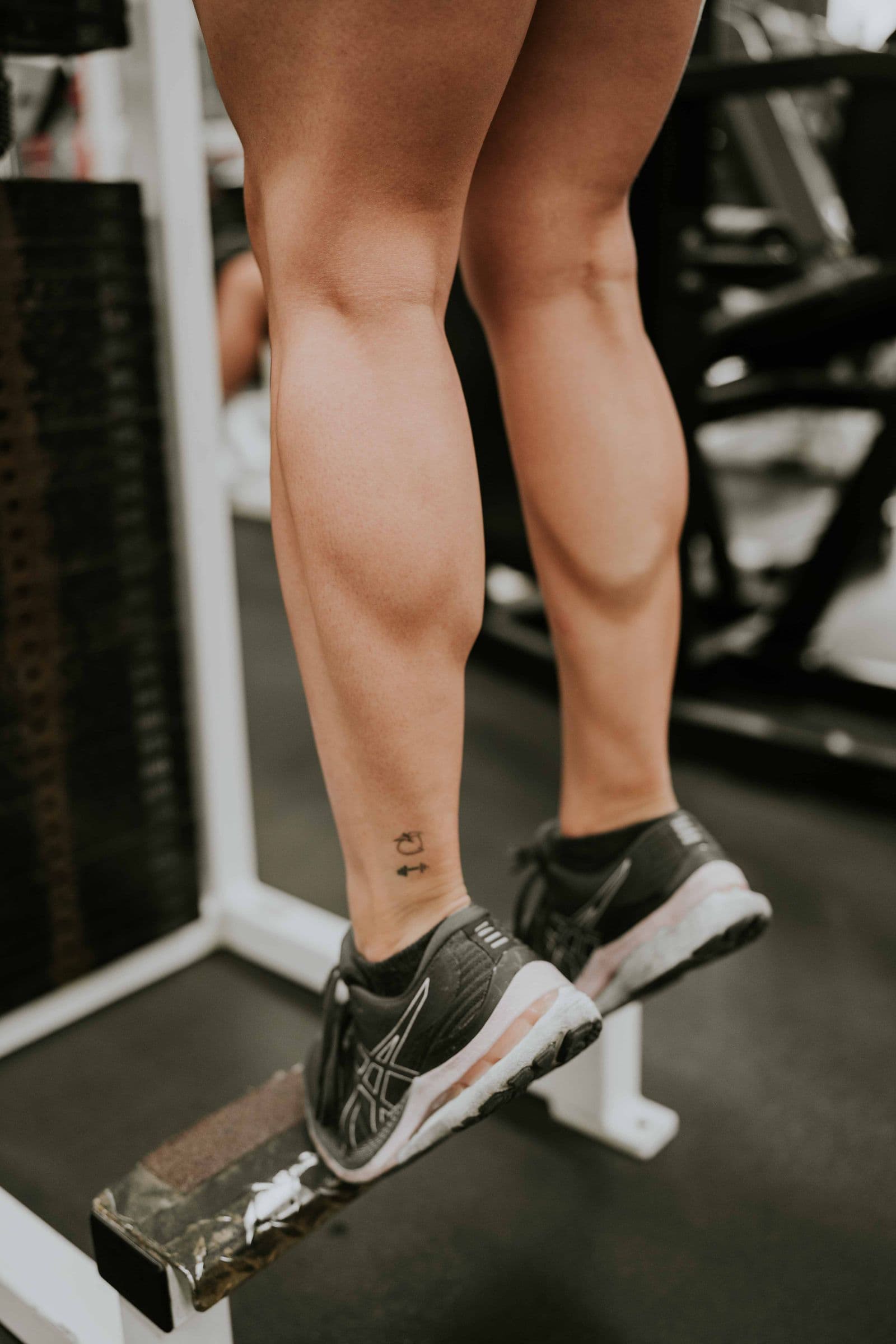
- Single-leg standing calf raises, three seconds up and three down, adding a backpack as it gets easier, on the same rep scheme.
- Midportion: do the standing raises on a step so the heel lowers below level at the bottom.
- Insertional: keep them on the flat floor so the heel never drops below level. That's the change Jonsson and colleagues tested in 2008 in 27 people with long-standing insertional pain, average age 53. Two-thirds were satisfied and back to their activity after about four months, with pain during activity falling from around 70 to 21 out of 100. It was a small pilot study without a control group, but it's the basis of most insertional programs today.
For insertional pain, this video shows how to set the exercises up so the heel stays above level:
Weeks 9 to 12: heavy, then quick.
- Calf raises at 4 sets of 6, as heavy as you can manage with good control.
- Once your pain probe passes and the stiffness clock is low, add quick work: skipping in place, then low hops, then short runs or easy pickleball drills, building up a little each week.
Throughout: For insertional pain, pause the calf stretches off a step and steep hill walking for now. A small heel lift in your everyday shoes can take some pressure off while the program does its work. For midportion pain, a gentle calf stretch is usually fine if you like it.
When to see a doctor
Get it checked promptly if:
- You felt a sudden pop, or a feeling like someone kicked you in the back of the ankle. That can be a rupture, and it needs to be seen the same day.
- You can't rise onto your toes on that side at all.
- The tendon is red, hot, or noticeably swollen.
- It started during or soon after a course of fluoroquinolone antibiotics.
- Both Achilles hurt along with other joints, or you have long morning stiffness elsewhere. That pattern can be inflammatory and belongs with a rheumatologist.
- Your VISA-A is below 50, or 12 weeks of consistent work hasn't moved it.
Retest and where to go from here
Score the VISA-A and run the pain probe again at weeks 6 and 12, and keep the stiffness clock going. You're looking for the VISA-A climbing, the single-leg probe dropping to a pass, and mornings that loosen faster. Tendons change slowly, so give it the full twelve weeks before judging.
The long-term odds are good. In a five-year follow-up by Silbernagel and colleagues, 34 people with an average age of 51 who'd been treated with exercise alone were checked again. Eighty percent had fully recovered from the original problem. People with more fear of movement recovered less calf function, which is one more reason the pain rules matter. They let you keep moving with confidence instead of guarding the ankle for months.
The Achilles takes load that starts higher up. How your ankle bends, how your hips control a landing, and how you've been loading the rest of the leg all change how much it has to absorb. If you want a broader picture, the free movement screen checks six areas in about five minutes, ankle mobility included, with no email required. It's the same assessment I start new clients with.
If you'd rather have someone run the progression with you, adjust the load as your scores change, and get you back on the court, that's what one-on-one training is for. I've logged more than 12,000 sessions with adults around San Jose and the South Bay, and weekend athletes with a cranky Achilles are a regular part of that.
The engineering manager's tender spot was at the bone, so he dropped the stair stretch, put a small heel lift in his work shoes, and did his calf raises on the kitchen floor with a backpack full of cookbooks. He kept playing pickleball, one match instead of three. By week ten the morning walk down the stairs was just a walk down the stairs, and he was back to three matches by the end of the season.
Ready to train smarter?
Get a personalized program built around your goals, your body, and your schedule.
Book Your Free ConsultationRelated Articles
Morning heel pain? At-home tests for plantar fasciitis, and why the first step after sitting hurts most
Heel pain in the morning that eases as you walk is the classic plantar fasciitis pattern. Three at-home self-tests to confirm it, a way to find what's driving yours, and the strength program the trials support, from a San Jose trainer.
Outer hip pain when you lie on your side? Three at-home tests for gluteal tendinopathy
Hip pain when lying on your side is usually a tendon problem, not bursitis, and some of the usual advice makes it worse. Three at-home tests for gluteal tendinopathy and an 8-week plan from a San Jose trainer.
Lifting with knee osteoarthritis: what 217 trials say about loading a worn joint
Strength training with knee osteoarthritis won't wear your cartilage down, and it also isn't the pain treatment it gets sold as. A San Jose trainer's read on what the research actually supports for training after 50.